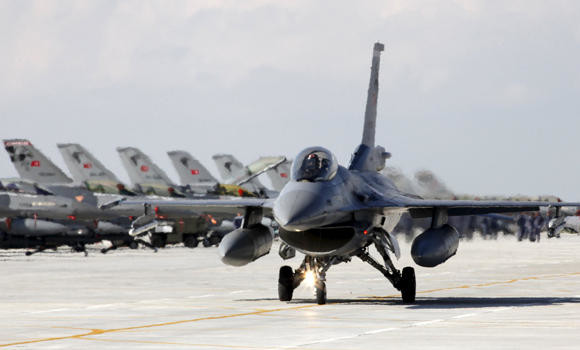
ANKARA, Turkey: NATO member Turkey on Tuesday shot down a Russian fighter jet on the Syrian border, threatening a major spike in tensions between two key protagonists in the four-year Syria civil war.
The Turkish presidency said in a statement that the plane was a Russian Su-24 fighter jet, while Turkish media said one pilot had been captured by rebel forces in Syria.
Moscow confirmed that one of its planes had been shot down, but said the pilots’ fate remained unclear.
The Turkish army said that the plane had violated Turkish airspace 10 times within a five minute period and was shot down by two Turkish F-16s. Russia insisted that the plane was inside Syrian airspace.
“A Russian Su-24 plane was downed under the rules of engagement because it violated the Turkish airspace despite the warnings,” the Turkish presidency said.
Reports said two pilots had ejected from the plane and Turkish television pictures showed two white parachutes descending to the ground.
The CNN-Turk channel said Syrian Turkmen forces fighting the Russian-backed regime of President Bashar Assad captured one pilot.
Russia, meanwhile, confirmed that one of its planes had been shot down.
“Presumably as a result of firing, an Su-24 plane of the Russian forces crashed in the Syrian Arab Republic,” Russian news agencies quoted the defense ministry as saying.
The Russian ministry said the fate of the pilots was not yet clear.
Turkey’s Dogan news agency broadcast footage of what it said was Russian helicopters flying over Syrian territory in an apparent search for the lost pilots.
Ball of fire
The fighter jet exploded in the air and the fireball fell on a mountain on the Syrian side of the border, television pictures showed.
Footage posted by the state-run Anatolia news agency showed plumes of smoke rising behind a mountain a few kilometers from the Turkish border.
Turkish reports said the incident happened in the border area between Turkey’s southern Hatay province and an area in northwest Syria populated by the Turkic-speaking Turkmen minority.
The incident came as Russian and Syrian jets are carrying out a heavy bombing campaign against targets in northern Syria.
The Turkish government has expressed anger at the bombing campaign, saying it is aimed at buttressing the Syria regime and has displaced thousands of Turkmen Syrians.
Russia insists that the air campaign is aimed against Daesh jihadists.
Amid fears of a diplomatic crisis, Turkey said it would take the issue to the United Nations and the North Atlantic Treaty Organization.
“Necessary initiatives will be taken at NATO, UN and at the level of countries concerned by the foreign ministry upon instructions from Mr. Prime Minister,” a statement from Prime Minister Ahmet Davutoglu’s office said.
Russian fighter jets entered Turkish airspace in two separate incidents in October, prompting Ankara to summon the Russian ambassador twice to protest both violations.
Turkey and Russia have long been at loggerheads over the Syrian conflict, with Ankara seeking Assad’s overthrow while Moscow does everything to keep him in power.
The Turkish military in October also shot down a Russian-made drone that had entered its airspace. Moscow denied the drone belonged to its forces.
Russian Foreign Minister Sergei Lavrov is due to visit Turkey on Wednesday in a bid to smooth ties and find a joint approach to finding peace in Syria.
Along with Saudi Arabia and the United States, Turkey and Russia are taking part in talks in Vienna that aim to narrow differences on the Syria conflict and have taken on an extra importance after the Paris attacks.
A Turkish foreign ministry official told AFP Lavrov’s visit would go ahead as planned. “There is no change in the program,” said the official.

Turkey shoots down Russian war plane on Syria border
MPs, parties welcome Lebanon’s decision to ban Hezbollah’s military wing
- Lebanese judiciary issues arrest warrants to pursue those who fired rockets at Haifa
- Bilal Al-Houshaymi: It (Lebanon) is either a fully sovereign state with a single decision-making authority, or it will continue its downward slide into greater danger and collapse
BEIRUT: Lebanon’s Cabinet decisions were described by political parties and parliamentarians as the boldest measures taken against Hezbollah to date, with ministers from the Amal Movement, the group’s key ally, joining in a show of government solidarity.
In an unprecedented move, Lebanon’s Cabinet on Monday declared Hezbollah’s military activities illegal and demanded the immediate handover of its weapons, following Israeli strikes that killed more than 40 people and wounded dozens across Beirut’s southern suburbs, southern Lebanon and the Bekaa Valley.
The Israeli strikes came after rockets and drones were fired from Lebanese territory toward northern Israel — an assault Hezbollah said was carried out in retaliation for the killing of Iran’s Supreme Leader Ayatollah Ali Khamenei. Among those killed were several Hezbollah officials.
Independent MP Ibrahim Mneimneh affirmed his support for the government’s decisions “at this sensitive stage” as he said they consolidate the sovereignty of the state and the confinement of security and military decision-making to its legitimate institutions.
“The protection of Lebanon requires the firm application of the law, without making any exceptions, and providing support for the army and security forces in carrying out their duties in order to safeguard stability and civil peace,” he added.
Beqaa MP Bilal Al-Houshaymi said Lebanon cannot withstand new experiments or further adventures. “It is either a fully sovereign state with a single decision-making authority, or it will continue its downward slide into greater danger and collapse.”
Lebanese Forces party leader Samir Geagea said in a statement that the cabinet had taken an additional step toward the establishment of a functioning state.
“The ball is now in the court of the Lebanese Armed Forces, the Internal Security Forces, General Security, State Security and the competent judicial authorities. It is their chance to begin implementing the government’s decision seriously and decisively as of this moment,” he added.
The party’s two ministers remained alone in their defense of what they called the “resistance.” This stance was articulated by Health Minister Rakan Nassereddine, whom Hezbollah named to represent it in the government, as he said after the session that “no one holds their resistance accountable as we have held ours accountable.” He questioned whether “the Israelis can be trusted.”
Lebanese President Joseph Aoun held those who launched the rockets responsible for their actions, noting that the Lebanese people should not bear responsibility “for a reckless operation.”
Aoun said Hezbollah’s morning strike was “not a defense of Lebanon nor a protection of the Lebanese; it is not acceptable in any way whatsoever, and it gives Israel a pretext to destroy what is left.”
The cabinet asked the Lebanese Army Command to immediately and firmly begin implementing the plan to restrict weapons north of the Litani River, announcing that Lebanon is ready to resume negotiations with Israel.
The cabinet decisions, read out by Prime Minister Nawaf Salam in an address, announced that the government had formally rejected any military or security operations carried out from Lebanese territory outside the authority of the state, reaffirming that the decision of war and peace rests solely with the government.
The measures include an immediate ban on all Hezbollah military and security activities deemed unlawful, a requirement that the group hand over its weapons to the state, and a restriction of its role to political activity within constitutional and legal frameworks — a step aimed at ensuring the monopoly of arms remains exclusively with the state and reinforcing full sovereignty over Lebanese territory.
Salam said that the government does not seek confrontation with Hezbollah. “But we cannot in any way accept the launching of rockets from Lebanon nor the threat of civil war.”
In parallel with the political move, the Lebanese judiciary moved to pursue those who fired rockets at Haifa from Lebanese territory. The military judiciary issued warrants to arrest all those responsible for launching rockets at the Israeli city.
Government Commissioner to the Military Court Claude Ghanem requested that the security agencies identify those who took part in directing the rockets, arrest them immediately and refer them to the military public prosecution.
A judicial source confirmed that the security agencies verified that the rocket-launching operation took place from an area of valleys and forests located north of the Litani River.
A statement bearing the signature of Hezbollah’s Military Media had been issued at dawn claiming responsibility for the operation of bombarding the Mishmar site south of the city of Haifa with a salvo of rockets and drones, as “revenge for the blood of the Iranian Supreme Leader Ali Khamenei.”
While Hezbollah has not issued any official statement tallying its human losses as a result of direct Israeli strikes, Lebanese and Israeli field reports cited the assassination of Mohammad Raad, head of Hezbollah’s parliamentary bloc, who in recent months had coordinated between the state and the party on the issue of restricting weapons; Sheikh Ali Daamoush, the head of Hezbollah’s Executive Council; and Hussein Moukalled, the head of Hezbollah’s intelligence services in the southern suburb.
The reports also mentioned the killing of Mohammad Rida Fadlallah, brother of the late scholar Sayyed Mohammad Hussein Fadlallah, along with his wife; and Sheikh Abdullah Shaito, a Ja‘fari Sharia judge, with his son and daughter.
Amid the strikes, citizens evacuated Beirut’s southern suburb, more than 53 southern villages and dozens of villages in the Beqaa region.
Many fled at night, remaining in their cars or along the roadsides in Beirut, amid successive warnings issued by the Israeli army urging civilians to leave their villages and homes ahead of strikes on Hezbollah targets, according to its claims.
As hotels reached full capacity, many turned to furnished apartments. Although the state opened a number of public schools to shelter the displaced, the hastily opened and prepared facilities were insufficient to accommodate tens of thousands of people.
Meanwhile, a military source suggested that the evacuation of the villages could be a prelude to a ground invasion.
Israel announced the mobilization of about 100,000 reservists along the border with Lebanon in preparation for expanding the war. Israeli army spokesperson Avichay Adraee posted on social media that “all options are on the table,” adding that “Hezbollah chose to launch this campaign, and will pay a heavy price for it.”
Israeli Chief of Staff Eyal Zamir warned of “many days of fighting ahead,” while Israeli Defense Minister Israel Katz said that “Hezbollah chief Naim Qassem is now a ‘target for elimination,’ and Hezbollah will pay a heavy price for launching missiles toward Israel.”