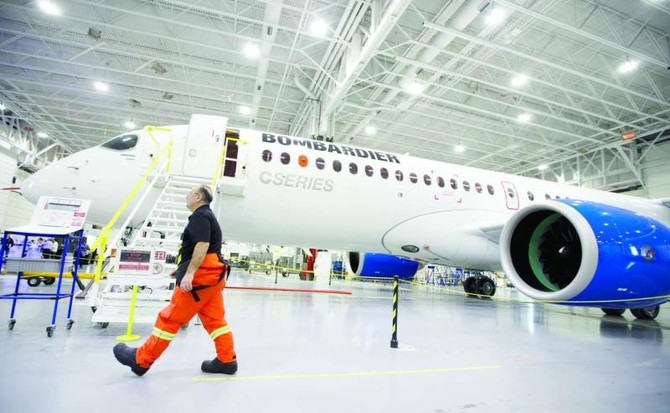
Bombardier cuts 7,000 jobs

Updated 17 February 2016
Follow

Bombardier cuts 7,000 jobs

NEW YORK: Canadian aircraft and train maker Bombardier Inc. said it would slash its workforce by about 7,000 over the next two years, while ramping up hiring to support production of its struggling CSeries commercial jet program.

The company said on Wednesday it had signed a letter of intent with Air Canada for up to 75 CS300 aircraft for as much as $3.8 billion, based on the list price.
Montreal-based Bombardier now has 678 total orders and commitments for the CSeries, including 243 firm orders.
The company has been struggling to find buyers for the 100-150 seat CSeries jet, in to which it has sunk billions of dollars, due to fierce competition from Boeing Co. and Airbus Group SE.
Bombardier’s quarterly results missed analysts’ expectations, and it also forecast lower-than-expected revenue for 2016.
The company expects to record $250 million-$300 million in restructuring charges in 2016 in connection with the layoffs. The company said it has about 64,000 employees.
The job cuts, mainly affecting the company’s aerostructures and engineering services and transportation divisions, will be mostly in Canada and Europe, and are set to start in the coming weeks.
Bombardier said the number of employees directly assigned to the CSeries program is about 3,450 worldwide and is expected to keep growing over the next few years, including new jobs at its plant in Mirabel, Quebec.
The company, which was helped by recent cash infusions from pension fund Caisse de dépôt et placement du Québec and the Quebec government, said it expected free cash flow usage in the range of $1.0 billion-$1.3 billion this year.
Still, Bombardier’s stock has declined more than 65 percent over the last 12 months.
The aircraft maker also proposed a reverse stock split on Wednesday, confirming a report by Reuters that said it would consolidate its shares to prop up the sagging stock, which has traded below C$1 since late January, its lowest in 25 years.
The ratio for the reverse stock split will be decided later, but is targeted to result in an initial post-consolidation share price of C$10-C$20 per class A share or class B subordinate voting share, the company said.
Bombardier’s net loss narrowed to 31 cents per share in the fourth quarter ended Dec. 31 from 92 cents per share a year earlier.
The company broke even on an adjusted basis, below analysts’ average estimate of a profit of 2 cents per share.


‘Without liquidity and credit, it is very hard to invest in infrastructure,’ IBM CEO tells WGS

Updated 9 sec ago
Follow

‘Without liquidity and credit, it is very hard to invest in infrastructure,’ IBM CEO tells WGS

  • ‘Sovereignty is not exclusive ... it’s an add,’ says Arvind Krishna
  • ‘I think sovereignty leads the mind the wrong way because it actually says that we can be a bit independent,’ Ericsson CEO says

DUBAI: Global geopolitical events show that technological sovereignty is important as it preserves nations, boundaries and citizens’ security, Arvind Krishna, IBM’s president and CEO, told the World Government Summit on Tuesday.

“Finance is important because without liquidity and credit, it is very hard to invest in the infrastructure, in companies, and in all of the things that our citizens want,” Krishna told a packed hall during a session on WGS’s first day in Dubai.

Introducing the session titled “Is Technology the New Sovereign Asset?,” moderator Mike Allen, co-founder and executive editor of media company Axios, said the answer to the question is “yes” and that the session was meant to “unpack why technology now goes way beyond being an economic asset, but is a sovereign asset.

“Technology is a force multiplier. Every nation has woken up to the fact that technology can help amplify the impact of both of those and many other industries, so if you get a common amplifier, that means technology becomes as, or perhaps more important, even than finance going forward. It doesn’t replace it,” said Krishna.

Finance has its own role, but the factor that will lead to the most economic growth, according to the IBM CEO, is that what he thinks most countries desire can be driven by technology more than anything else, given sufficient protection.

“Sovereignty is not exclusive. It’s an add. You can use many things from other places, but you do need to run some that you have your control over fully,” he said.

Addressing the session’s other guest, Borje Ekholm, Ericsson Group’s president and CEO, Allen said: “Mr. Ekholm, you have a provocative perspective on this (sovereignty) … you say that it is a misguided term.”

Ekholm agreed and said: “I think sovereignty leads the mind the wrong way because it says that we can be a bit independent … I actually think in technology we cannot.”

Most countries are interdependent, according to the CEO, who added: “Yes, I agree you need to make sure it operates all the time, that its resilient, that it actually has the performance that you can trust it, but you have interdependence on everyone else.”

Ekholm said he would rather use “interdependence as the normal and think about what I need to control in order to make it work.”

Citing a practical example, Ekholm said the US uses Ericsson technology in telecommunications, but the digital stack lacks a domestic vendor.

“So, when you think about that, you actually have a dependence on countries … Europe depends on American technology to run almost all data centers, all operating systems, basically the full digital stack. Same thing here, we all depend on each other, so what you need to think about is, who do I trust to be my vendor, who do I trust to be my partner, how do I build it up and ensure operational integrity? So, sovereignty in a sense we can be independent … I don’t think so,” he said.

Technology, according to Ekholm, will be the key driver of national prosperity in the future.