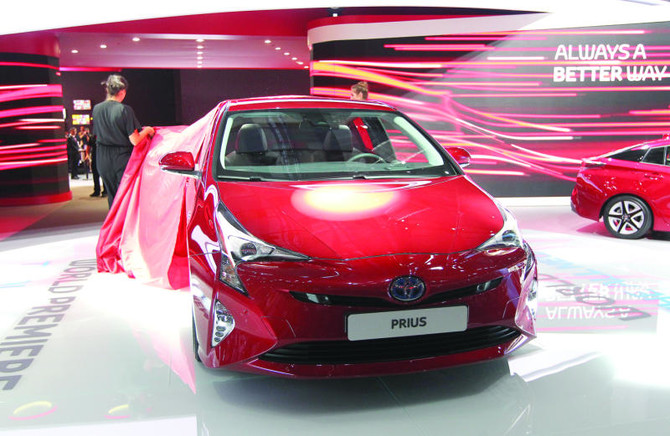
Toyota launches Mirai hydrogen-fueled sedan

Updated 15 September 2015
Follow

Toyota launches Mirai hydrogen-fueled sedan

FRANKFURT: Toyota is taking the next step in its quest for carbon-free travel with the launch of the Mirai hydrogen-fueled sedan.
The Japanese brand that pioneered the hybrid gas-electric powertrain sees hydrogen cars as the end-game, following plug-in hybrids and full-electric vehicles.
The region’s new CEO, Johan van Zyl, said on the sidelines of the Frankfurt auto show on Monday that “It’s not a question of if, it’s a question of when,” hydrogen technology will go mainstream.
Toyota Europe expects sales of between 50 and 100 Mirai’s this year and next, with 47 ordered to date. It is being sold only in Britain, Germany, Denmark and Belgium, where Toyota is working on getting in hydrogen pumping stations with local partners.
Toyota Europe sales chief Karl Schlicht said that current customers include governments and companies looking to reduce their carbon emissions. He expects the technology to be affordable for average consumers by 2025.
Toyota Europe last year sold 880,000 cars, up 3 percent from a year earlier. Twenty percent of those were hybrids. Schlicht forecasts sales will be down 1-2 percent this year due to the economic slowdown in Russia.
Van Zyl expects hybrid sales to grow with the launch at Frankfurt show of the new RAV4 small SUV, which for the first time will be offered also with a hybrid powertrain, joining the Yaris, Auris and restyled Prius.


Economies must turn AI tokens into growth, says Microsoft CEO

Updated 5 sec ago
Follow

Economies must turn AI tokens into growth, says Microsoft CEO

  • AI tokens are basic units of text read and generated by artificial intelligence models when processing language

DUBAI: Global economies will need to transform AI tokens into economic growth, Microsoft CEO Satya Nadella told the World Economic Forum on Tuesday.

GDP growth anywhere will be directly correlated with the accessibility of power and resources such as AI tokens, said Satya, adding: “We have a new commodity which is tokens, and the job of every economy is to translate tokens into economic growth. If we have cheaper commodities, it’s better.”

AI tokens are basic units of text read and generated by artificial intelligence models when processing language.

Satya also discussed the importance of diffusing AI technology and implementing it globally.

“Our job is to pioneer the relationship between AI and people so that productivity can increase. The scale of operations can really be increased by utilizing this technology,” he said.

“On the supply side, the ratio of tokens per dollar per watt has to get better. We have to ensure that the supply is there from the chips to the token factory. It's like electricity. We need a ubiquitous grid of energy and tokens that will power the economy.”

On the consumer side, Satya urged all firms to start using it and said both small- and large-scale operations would face different challenges.

“If you start fresh it’s easier to implement these tools, for large organizations there is a fundamental challenge to achieve scale in implementing the change. The change management challenge for large organizations is bigger,” he said.

He added this technology has the ability and demand to be implemented globally.

“We have the ability to deliver tokens all around the world, this will ensure even distribution of resources. The technology is in our hands to create opportunity in the Global South and beyond. As long as there is a demand and an environment to create capital investment, then it's worth it,” he said.