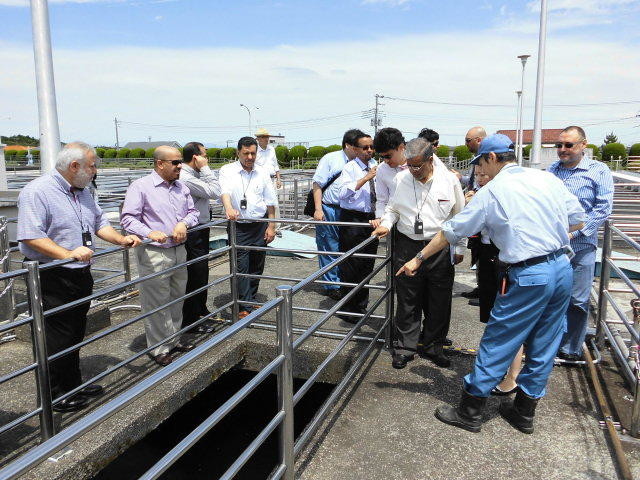
Saudi water mission tours Japan

Updated 12 June 2015
Follow

Saudi water mission tours Japan

JEDDAH: A Saudi water-related business mission, headed by Abdulrahman Jazzar of Abdulrahman A.B. Jazzar for Telecom & IT, Jeddah, recently toured Osaka and Tokyo.
In Osaka, the delegation visited Kubota Corporation’s Hirakata Plant (306,084 sqm), which manufactures valves, pumps (vertical and horizontal), steel casting, construction machine. They were briefed about the advanced technology on the effective use of energy. Kubota’s RO pump systems feature high efficiency, easy maintenance and high reliability, based on their technologies.
At Toray Industries’ Shiga Plant, the visitors were given a presentation on its products, RO/UF membrane and MBR (membrane bio-reactor) and its worldwide supply record.
The mission members discussed their products’ technical features and Saudi water quality.
The members next visited Toray Innovation Plaza, where they learned Toray’s various product lines and new products, including carbon textiles, plastics/chemical, films and materials for IT, and pharmaceutical equipment.
At the Toray Research Center (TRC), the visitors witnessed its engineers and experts doing surface, structural, material characterization, organic/inorganic and environmental analysis.
In Tokyo, the mission visited Yokohama’s Nishiya Water Purification Plant and Hokubu Sludge Treatment Center. In Nishiya, the mission members viewed examination of water leakage detection, utilizing conventional and mechanical equipment (demonstrated by Yokohama’s engineers), which were actually implemented out by Yokohama City’s Environmental Planning Bureau.
In Hokubu, the mission members learned the advanced technology of sludge treatment systems, which focused on the effective use of digestion gas for electricity and fuel, incinerated ash (for cement material and improved soil, and fuelization from sludge by a major Japanese municipality.
Saudi companies gave their presentations before participating in B2B meetings. They included Saudi Arabian Mining Company (Maaden), SAWEA, Skado GOCSA, Abdulrahman A.B. Jazzar for Telecom & IT, Global Solution for Leak Free, Saudi Bio-Acids Company, BMS Factories, WETICO, AAHD ALTAWEER Trading & Construction, and Kindasa Water Services.


Artificial intelligence is transitioning into a ‘digital employee’

Updated 27 February 2026
Follow

Artificial intelligence is transitioning into a ‘digital employee’

  • AI can be an effective tool, business leaders tell Arab News
  • Not about jobs, but ‘convergence of human capital and AI’

RIYADH:  Artificial intelligence is fundamentally reshaping the world of work, transitioning from a supporting tool to an active partner that is radically changing the nature of professions and productivity standards.

Amidst the current global transformations, an active regional digital environment is emerging.

This is being led by Saudi Arabia through Vision 2030 and massive investments in smart infrastructure, providing a living model for studying the implications of this partnership between humans and machines on the future of work in the region.

Arab News spoke to various business leaders about the emerging shape of the sector.

Salem Bagami, co-founder of Metatalent, said the ideal relationship between humans and machines at work should be complementary and collaborative.

Humans would bring creativity, emotional intelligence, and complex decision-making, while machines excel at processing big data and performing repetitive, precise tasks.

He believes that this type of balanced partnership would lead to unprecedented productivity and innovation.

While machines excel at processing big data and performing repetitive, precise tasks, humans would bring creativity, emotional intelligence, and complex decision-making. (Supplied)

Mohammad Al-Jallad, chief technologist and director at HPE, said AI has gone beyond being merely an executive tool to becoming a “digital employee” entrusted with automating routine tasks and providing insights based on data analysis.

He believes that the real opportunity lies not in the debate over job replacement, but in “the convergence of human capital and artificial intelligence.”

AI should augment human teams by taking on menial and routine tasks, enabling employees to focus on critical thinking, creativity, and ethical reasoning, significantly improving operational results.

Bagami also emphasized the complementary nature of this partnership. “The ideal relationship between humans and machines at work is one of collaboration, where each complements the others.”

He explained that humans bring creativity, emotional intelligence, and nuanced decision-making, while machines excel at processing big data and performing repetitive tasks efficiently, leading to increased productivity and innovation.

Opinion

This section contains relevant reference points, placed in (Opinion field)

Salem Alanazi, chairman of Jathwa Technology Co., notes a significant trend among Saudi Arabia companies toward using AI applications to provide faster services to customers at lower costs.

The emergence of the “virtual employee” available around the clock has eliminated the need for some traditional jobs in specific sectors.

Alanazi warns that some companies’ reluctance to adopt AI may expose them to real risks. “All those who hesitated to benefit from AI applications have a lack of understanding of these technologies.”

He said those who adopt these technologies will be able to offer lower-cost, higher-quality services, which will affect the market position of companies that lag behind.

Ali Aljumhour, CEO of VALUE Consultancy, said that the transition of AI into a partner has reshaped the list of most in-demand skills in the job market.

Skills such as “prompt engineering,” “human-machine integration,” and “digital ethics” are becoming increasingly important.

He added that AI has become an instantly available “technical knowledge base,” shifting the criteria for professional distinction toward those capable of smart interaction with these technologies.

In terms of ethics, transparency, and trust, Alanazi points to the complexities of global AI governance, where legislation overlaps and evolves rapidly to keep pace with potential risks, particularly in the areas of cybersecurity and privacy.

Ali Aljumhour, CEO of VALUE Consultancy. (Supplied)

Al-Jallad emphasizes this crucial dimension, noting that providing responsible and reliable AI solutions that meet the highest standards of transparency is a key priority, especially in regulated sectors.

Bagami believes there should be basic standards for the ethical use of Al, emphasizing the need for transparency, accountability, and fairness, along with using diverse data sets to prevent bias and protect privacy.

He believes that building trust between humans and machines requires clear explanations of how systems work, giving users the opportunity to provide feedback and conducting periodic performance reviews.

On performance evaluation, Aljumhour said: “I expect radical changes in standards, shifting from measuring individual effort to evaluating the quality of the partnership between humans and machines.”

There should be a focus on the quality of inputs provided to intelligent systems, the accuracy of review and modification, and complex decision-making based on outputs.

He warns, however, of new risks that may arise, such as over-reliance on AI or difficulty in determining responsibility for mistakes.

In the employment sector, Aljumhour expects fundamental changes in standards.

There will be questions and tests focusing on measuring skills in dealing with AI, such as asking candidates about their experiences of collaborating with these systems, or testing their ability to formulate effective requests for complex tasks.

Aljumhour identifies significant human challenges in this transition, with “fear, loss of power, and exclusivity of knowledge” being the biggest concerns for experienced employees.