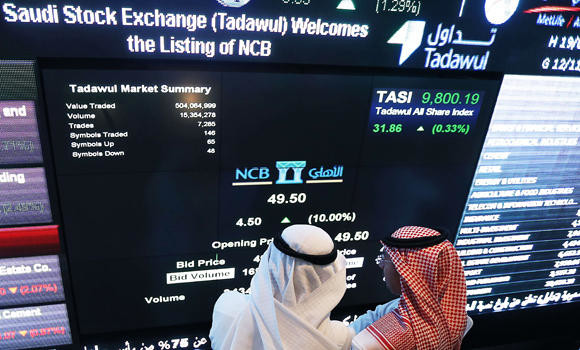
The 10 percent surge on Wednesday of the National Commercial Bank’s (NCB) share prices in their first day of trading underscores a generally bullish mood on Saudi stock market, investors and analysts said.
The shares jumped their daily 10 percent limit upon listing on Wednesday after a SR22.5 billion IPO.
The Tadawul All Share Index “will be positively impacted over the long term as this bank is the oldest bank in the country and the largest one in the region,” said Basil Al-Ghalayini, CEO of BMG Financial Group.
“I believe the NCB stock price will witness a gradual increase in the weeks ahead,” he told Arab News.
John Sfakianakis of Ashmore Group commented: “Today we saw the debut of NCB and the stock didn’t disappoint, as expected. NCB hit the limit up at the open.”
He added: “There is massive interest from foreign international institutions and regional players, and this appetite is expected to continue.”
The shares were priced at a discount for the initial public offering and could double at the start of trading, an analyst forecast earlier, before Tadawul announced the stock would trade with a “fluctuation limit” of 10 percent up to SR49.5.
Bahrain-based Securities & Investment Co. rated NCB a “high conviction buy” with a target price of SR72.


NCB stock surge reflects Tadawul’s ‘bullish mood’
NCB stock surge reflects Tadawul’s ‘bullish mood’

Islamic banks’ market share in Turkiye rises to 9.2%: Fitch Ratings
RIYADH: Islamic banks in Turkiye lifted their asset market share to 9.2 percent in 2025 from 8.1 percent a year earlier, as financing and deposits outpaced the broader banking sector, a new analysis showed.
In its latest report, Fitch Ratings said financing and deposit market shares rose to 7.9 percent and 10.4 percent, respectively, by the end of 2025, compared with 7.3 percent and 9.4 percent in 2024.
The agency noted that new digital Islamic banks are emerging in the country, with investment from Gulf Cooperation Council countries expected to continue.
Turkiye’s strong ties with Islamic countries across the Balkans, Africa and the Middle East support the development of its Islamic banking sector, attracting investors and contributing to the industry’s growth.
In its latest report, Fitch stated: “Three recently established private Islamic banks (two digital) grew rapidly in the first nine months of 2025. Investment in digital participation banking from the Gulf Cooperation Council countries underscores the potential for further investment from the region.”
It added: “Planned establishment of new participation banks, and rapid growth of recently established banks – albeit from small bases – means that the segment landscape may be reshaped in 2026.”
Dubai Islamic Bank PJSC’s investment in digital bank TOM underscores the potential for further GCC investment.
Turkish regulators have approved the establishment of Halk Katilim Bankasi A.S. and Adil Katilim Bankasi A.S. (digital), while BIM Birlesik Magazalar A.S.’s application is pending.
Fitch added that state-owned participation banks may merge or pursue initial public offerings, potentially reshaping the banking landscape.
The report predicts Islamic banks’ market share will rise further in 2026, supported by strong internal capital generation and growth appetite. However, the non-performing financing ratio may increase moderately due to high inflows.
“The segment’s non-performing financings ratio deteriorated to 2 percent at end-2025 compared to 1.2 percent in 2024 but remained below the sector average of 2.5 percent,” said Fitch.
It added: “We expect pressure to persist given still-high financing rates, high but declining inflation, and the sensitivity of unsecured retail (lower share than conventional banks) and SME segments to economic cycles. We forecast a moderate increase in the segment NPF ratio in 2026.”


