NEW YORK: Oil prices spiked abruptly at midday on Thursday, extending an early bounce from new four-year lows as a combination of technical buying and options expiry for US crude triggered a sudden frenzy of buying.
Markets had gained earlier in the day, led by a pick-up in gasoline futures after data showed US stockpiles fell to their lowest level in two years, and as some traders bet that a more than 25 percent slump since June had been overdone.
At around 1700 GMT, the market suddenly surged by as much as $3 a barrel, a move traders said was fueled by investors covering positions tied to US WTI options trades, which expire later in the day, as well as automatic buy-stops.
By 1:18 p.m. EDT, oil prices had given up about half of the midday gains, but December Brent crude was up $2.18, or 2.6 percent, to $86.30 a barrel, putting it on track for the biggest one-day gain since the market began a lengthy slide in mid-June. Expiring November Brent rose 47 cents to $84.25 a barrel.
US November crude rose $1.37 to $83.15 a barrel, off the intra-day high of $84.83 a barrel.
The rally appeared partly to be a reaction to the steepening sell-off over the past week or two, fueled by a growing realization that Saudi Arabia and other OPEC members are in no hurry to cut production and shore up prices.
“The oil market is trying to find a bottom around $80, but there’s a lot of support and short covering,” said Andrew Lipow, president of Lipow Oil Associates.
US oil data earlier on Thursday set off a rally in New York gasoline futures, which rose more than 3 percent.
US gasoline stocks fell by 3.99 million barrels from the prior week to reach 205.6 million barrels, their lowest level since November 2012, according to weekly data from the US Energy Information Administration released on Thursday.
The data also showed US crude inventories rose 8.9 million barrels, far higher than analysts’ expectations for a build of 2.8 million barrels.
The global price of oil was relatively stable for nearly four years, averaging $110 per barrel.
Increased production in the US, Canada, Iraq and elsewhere made up for declining supplies in nations such as Iran and Libya and helped meet rising global demand.
The global sell-off in stock markets deepened on Thursday, with European indexes in particular suffering heavy losses amid growing concerns about Greece’s financial stability.
After being stable on the open, the German DAX stock index was down 1.8 percent by midday in Europe. France’s CAC 40 shed 2.3 percent and Britain’s FTSE 100 lost 1.8 percent.
Markets in economically weaker European countries fared worse — Spain’s was down 2.9 percent and Italy’s 2.8 percent.
Wall Street was expected to drop on the open, with Dow and S&P 500 futures down 1.1 percent and 1.4 percent, respectively.
Asian markets closed lower earlier, with Tokyo’s Nikkei 225 diving 2.2 percent.
Investors are worried about a downturn in global growth and inflation. Slowdowns in Europe and China are seen threatening the US recovery.
In Europe, the biggest concern was Greece, where investors are worried the country might need more financial support as its government borrowing rates have risen sharply in recent days.
The country’s benchmark 10-year bond yield was up a stunning 1.13 percentage points on the day on Thursday, to 8.86 percent. The rate was around 6.5 percent just earlier this week.
The rise suggests Greece is unlikely to be able to wean itself off its bailout loans as hoped, because borrowing on bond markets independently would be too expensive.
According to the Wall Street Journal, the European Central Bank agreed overnight to provide liquidity support to Greek banks to keep them stable.
A slump in energy prices has also shaken many global investors
Though lower oil prices can help consumer spending, they can weigh on inflation. Low inflation is a problem for many developed economies, particularly in Europe.


![]()
![]()
![]()
![]()
![]()
![]()
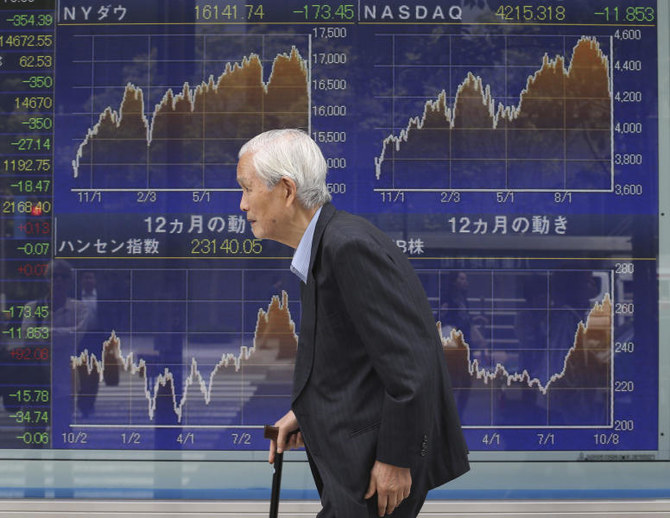
World stock market sell-off deepens


World stock market sell-off deepens
Latest updates


© 2026 SAUDI RESEARCH & PUBLISHING COMPANY, All Rights Reserved And subject to Terms of Use Agreement.