LONDON: Global steel production slowed in August, according to the latest figures from the World Steel Association.
It always does in August, a dead month in the Northern Hemisphere steel calendar. But, crucially, on a year-on-year comparison global steel runs were 1.1 percent lower than in August 2011.
The headline global figure masks the scale of the production cuts being taken in economic weak spots such as the euro zone.
At 144 million tons annualized euro-zone production last month was the lowest since 2009, a telling comparison given what seems an inexorable slide back into recession in the region.
Other regions feeling the macro pain are Eastern Europe, where annualized production of 107 million tons in August was the lowest in two years, and South America, where production last month dropped almost 7 percent relative to last year.
Such is the "normal" lagging reaction of steel output to slowing manufacturing momentum.
However, there will be no sustainable recovery either in steel prices or in raw material markets such as iron ore and coking coal until China, the world's largest producer, follows suit.
Superficially, a 1.7-percent year-on-year drop in August output would seem to suggest that China's legion steel mills are getting the message.
There are two problems, though.
This pull-back is coming from an extremely elevated base. Chinese production had been running at near-record levels right through to July.
At 691 million tons annualized August's production was still high by any yardstick other than the preceding few months.
Secondly, the higher-frequency figures from the China Iron and Steel Association (CISA) showed output re-accelerating in the first part of this month.
This was probably a reaction to the combination of lower iron ore inputs after last month's brutal sell-off and a sharp rally in Shanghai steel rebar futures at the start of this month.
That rally was fueled by China's gift-wrapped announcement it was speeding up infrastructure spend to help stimulate its flagging economy.
However, the so-called stimulus proved to be all pretty packaging and little substance.
Shanghai investors' disappointed reaction was clear to see on Thursday, when rebar futures recorded their heaviest ever daily slump.
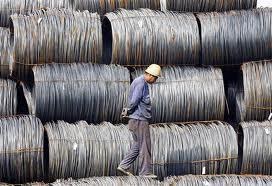
So, we're pretty much back where we started: China's steel industry producing too much metal relative to actual demand.
Margins are still painfully compressed, inventories are still too high and Chinese net exports are booming, flooding other markets with excess material.
August's trade figures showed net export growth running at close to 20 percent year-on-year in the first eight months of 2012. At the heart of the Chinese steel puzzle is the challenge facing a fractured sector of how to respond to slower demand growth.
Right now, too many Chinese mills are still pumping out too much steel, unprepared to sacrifice market share to margin pain.
That pain is the single-most important reason why iron ore prices have bombed.
It's not as if the country is importing less. August imports were up almost 6 percent year-on-year. But buyers are destocking higher-priced material and bargain-hunting for fresh replacement units.
There seems to be a growing realization that iron ore prices won't recover until Chinese steel prices recover and steel prices won't recover until production is cut back more aggressively to reflect real end-user demand.
It's about learning to live with excess production capacity, a lesson that other parts of the steel world have had to learn in the past, witness European mills' (relatively) fast response to slowing demand signals.
And it's a lesson that China's steel sector will need to learn going forwards as well.
Analysts the world over are chipping away at their GDP forecasts for China this year, as each new set of data extends the current "soft patch".
And some, such as Macquarie Bank, are now questioning whether old assumptions that Beijing will "do what it takes" to maintain headline growth figures still hold true.
Social stability rather than growth for growth's sake is Beijing's overriding concern, according to Macquarie, which argues that still-strong income growth and a still-tight labor market mitigate against any more "shock and awe" stimulus packages such as that unleashed in 2008-2009. If true, the implications for China's huge steel sector are massive.
Indeed, Macquarie has just cut its Chinese steel demand assessment for the 2012-2015 period from 5.0 percent per year to 3.6 percent.
That still translates into a continuing need for ever more quantities of steel and ever more quantities of the iron ore and coal that are required to make that steel.
But the question is whether an industry geared toward the sort of super-fast growth engineered in 2010 and 2011 can adapt to a more sedate growth environment?
Right now the signs aren't looking too promising.
August's slowdown in Chinese production was too shallow and may already have been largely reversed in the first part of September on the false-dawn Shanghai rebar rally.
The next couple of months should provide some insight as to whether an industry shaped by the battle for share of a fast-expanding market can shift to one shaped by operating margin and collective discipline.
— Andy Home is a Reuters columnist.
The opinions expressed are his own.
The outcome will have ramifications not just for China's steel sector but, via rising imports, the global steel industry and, via falling raw material prices, the global resources sector.
Expectations are already shifting.
Alberto Calderon, chief executive of BHP Billiton's aluminum, nickel and corporate development, told a conference earlier this week that the sort of "spectacular imbalance" between iron ore supply and demand seen last year won't happen again.
Quite right.
It's a different sort of "spectacular imbalance", that between China's steel production and its steel demand, that will now be the key influence on the company's vast iron ore operations in Western Australia.
— Andy Home is a Reuters columnist. The opinions expressed are his own.


Can China adjust to slower steel demand growth?
Can China adjust to slower steel demand growth?

MENA funding surges on flurry of startup rounds
- 42 MENA-based startups raise a combined $563m in January
RIYADH: Investment activity across the Middle East and North Africa startup ecosystem strengthened at the start of the year, with 42 MENA-based startups raising a combined $563 million in January.
That figure marked a 228 percent month-on-month increase, although it was an annual drop of 35 percent.
Debt financing was limited, representing nine percent of total capital raised during the month.
Funding was heavily concentrated by geography. The UAE led MENA in January, attracting $426.3 million across 12 deals, driven largely by two large transactions: Mal’s $230 million agreement and Property Finder’s $170 million round.
Saudi Arabia ranked second, with 18 startups raising $56 million in total, while Egypt placed third as four startups secured a combined $22.1 million.
By sector, fintech drew the largest share of funding in January, with seven startups raising $319.7 million. Property tech followed, with three startups raising $189 million. Software-as-a-service ranked third, as seven startups raised a combined $17 million.
Deal activity continued to tilt toward early-stage companies, with 31 startups in this category raising $66 million during the month. Only two later-stage deals were recorded, totaling $11 million, while the remaining capital went to startups that did not disclose their funding stage.
Consumer-focused startups captured the majority of capital deployed.
Business-to-consumer companies raised $470.8 million across 17 deals, while business-to-business startups completed 19 transactions worth $43 million,
Hybrid B2B2C models raised $9 million across six deals.
Funding distribution by founder gender remained uneven. Male-founded startups accounted for 36 deals and raised $560 million. Startups founded solely by women raised $300,000 across three deals, while mixed-gender founding teams secured $2.2 million across three transactions.
Hydrovest raises $275k
Doha-based agriculture tech company Hydrovest Technology Trading and Contracting W.L.L has closed an investment round worth $275,000 from unnamed investors.
Founded in 2020 by Jeacim Francis Adaya, the company develops climate-smart agricultural solutions, crops, and value-added products.
The funding will be used to move Hydrovest into commercial-scale production, expand research and development collaborations, and prepare for market entry into the UAE in the fourth quarter of 2026.

Shorooq launches $200m late-stage growth fund
UAE-based investment firm Shorooq has launched a $200 million late-stage growth fund under its Qatalyst Series, backed by Qatar Investment Authority and other sovereign and institutional investors. The announcement was made during Web Summit Qatar.
Founded in 2017, Shorooq is a multi-strategy investment firm spanning venture capital, credit, private equity, and real assets.
The new fund will target late-stage and pre-IPO companies with proven scale, strong fundamentals, and clear exit pathways, aiming to address a gap in consistent institutional late-stage funding in the region.
HAQQ Legal AI raises $3m
Lebanon-based regulatory tech HAQQ Legal AI has raised $3 million to date to accelerate the development and global rollout of its legal AI and practice management platform.
The round was led by Sowlutions Ventures, with participation from strategic and financial investors.
Founded in 2020 by Antoine Kanaan and Maitre Abbas Kabalan, the company is building a vertically integrated legal AI operating system.
The capital will be used to deepen its AI and agent architecture and expand enterprise and institutional deployments across MENA, including Egypt and Jordan.
Kitopi secures $50m growth round
UAE-headquartered cloud kitchens platform Kitopi has raised $50 million in a growth capital round led by EvolutionX, a private credit provider backed by Temasek and DBS Bank.
Founded in 2018, Kitopi operates more than 200 outlets across the UAE, Saudi Arabia, Qatar, Bahrain, and Kuwait.
The funding will support the scaling of its homegrown brands and accelerate regional and international franchising. In 2022, the company raised an additional $300 million in its series C round, extending that round to $715 million.
Viero raises $1.2m seed round to unify logistics operations
Saudi-based fleet and logistics platform Viero has raised $1.2 million in seed funding led by Watheeq Capital and Share Investment Co., with participation from angel networks and individual investors.
Founded in 2024, Viero is building a unified operating layer for logistics companies facing fragmented systems for deliveries, collections, and cost management.
The funding will support product development and regional expansion across the MENA region.

Qureos closes $5m seed round
UAE-based human resources tech company Qureos has raised $5 million in a seed round led by Prosus Ventures and Salica Oryx Fund, with participation from regional and international investors.
Founded in 2020, Qureos provides an AI-driven hiring platform designed to help enterprises scale recruitment more efficiently.
The funding will be used to further develop its AI capabilities, expand go-to-market teams, and accelerate geographic expansion.
Shorooq signs MoU with PayLater
Shorooq has signed a memorandum of understanding with PayLater during Web Summit Qatar to explore the structuring of a scalable, institutional-grade credit facility.
PayLater is Qatar’s first Qatar Central Bank-licensed, Shariah-compliant buy now, pay later provider.
The potential transaction would support PayLater’s next phase of growth through non-dilutive credit capital, while reinforcing Shorooq’s position in structured credit solutions for regulated fintech companies.
SkipCash raises $4m in series A round
Qatar-based fintech platform SkipCash has raised $4 million in a series A round with participation from Qatar Development Bank and other institutional and angel investors.
Founded in 2019, SkipCash provides digital and mobile-first payment solutions across in-store and online commerce. The funding will be used to enhance its technology stack, expand its Tap-to-Phone point-of-sale solution, and enter new GCC markets.
Mersal Media Capital raises $1.3m in first funding round
Saudi-based media investment platform Mersal Media Capital has raised $1.3 million in its first funding round, led by an unnamed private investment fund.
Founded by Abdulwahid Al-Humaid and Anas Al-Humaid, the company focuses on acquiring and scaling digital media assets.
The funding will support growth initiatives, operational readiness, and strategic partnerships.
MUHIDE closes series A with Asyad Group
Saudi-based fintech MUHIDE has closed a series A funding round with Asyad Group for an undisclosed amount.
Founded in 2023, MUHIDE focuses on authenticating and governing B2B trade transactions and is working toward building Saudi Arabia’s first unified trade ecosystem.
Daleel raises $3m pre-seed
Daleel has raised $3 million in a pre-seed round from an unnamed angel investor.
Founded in 2025, the company is developing an AI-native intelligence layer for GCC real estate, combining verified government transaction data with live property listings.
The funding will be used for product development, mobile app launches, UAE expansion, and preparation for entry into Saudi Arabia.
Alefredo acquires Tutor House
Jordanian education tech company Alefredo has acquired UK-based tutoring platform Tutor House in a transaction valued at $600,000.
The deal is primarily structured as equity in Alefredo Holding Co., with additional strategic and performance-based components.
Founded in 2020, Alefredo provides digital learning tools and assessments for international curricula, and the acquisition completes its AI-driven learning stack by integrating tutoring, analytics, and adaptive learning paths.


