- Syria and Jordan signed 11 agreements aimed at strengthening economic ties across various sectors, including agriculture, transport, and energy.
- The agreements include eight memoranda of understanding, two executive programs, and one cooperation protocol, focusing on areas such as food security and higher education.
JEDDAH: Syria and Jordan have signed 11 agreements covering investment, agriculture, transport and other sectors, as the two countries seek to deepen economic cooperation and advance joint development projects.
The deals comprise eight memorandums of understanding, two executive programs and one cooperation protocol.
They cover food security, agriculture and the environment, and investment, as well as water, railway transport, and youth, in addition to public administration, civil aviation, higher education and scientific research, and education.
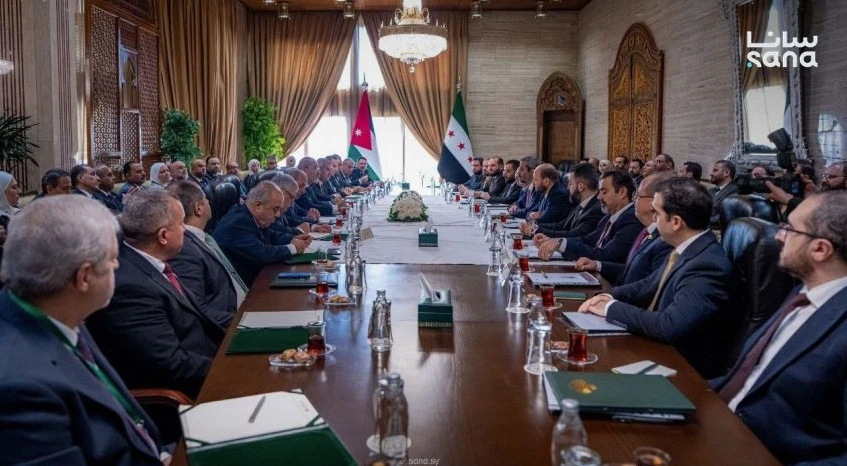
The agreements were signed at the conclusion of the third session of the Syrian-Jordanian Higher Coordination Council, held in Damascus from Nov. 8 to 9 and co-chaired by Syrian Foreign Minister Asaad Hassan Al-Shaibani and Jordanian Deputy Prime Minister and Foreign Minister Ayman Safadi, according to Syria News Agency, or SANA.
The signing of the deals comes as trade between the two countries reached 334 million Jordanian dinars ($471 million) in 2025, nearly three times the 116 million dinars recorded in 2024, according to Amman Chamber of Commerce figures reported by Jordan news Agency, or Petra.
Jordanian exports to Syria totaled 252 million dinars, led by construction and industrial products including cement, iron, marble and specialized chemical products.
Imports from Syria reached 82 million dinars, mainly comprising agricultural commodities and raw materials.
Investment and industrial cooperation
The council also “emphasized addressing technical, logistical and legislative challenges affecting trade flows and the development of joint supply chains, especially in the pharmaceutical and food industries and industries associated with reconstruction,” SANA reported.
The two sides discussed expanding industrial, logistical and investment activities within the Syrian-Jordanian Joint Free Zone, as well as exploring the establishment of a joint economic city along their border to accommodate industrial, production and service activities and attract investment.
The council emphasized the need to activate the Joint Jordanian-Syrian Business Council and strengthen partnerships between private-sector institutions in both countries.
The discussions also covered mechanisms to develop and finance priority projects, including initiatives identified by Syria for potential financing through a dedicated Syrian Investment Fund for reconstruction, in coordination with donors and financing institutions.
Energy and gas cooperation
Energy was another focus, with the two countries discussing ways to help meet Syria’s natural gas requirements, including the possibility of supplying industrial facilities in southern Syria with compressed natural gas from Jordan’s Risha gas field.
They also examined the potential use of storage capacity in Jordan’s Madouna area to supply southern Syrian regions with petroleum products, alongside the transfer of Jordanian expertise in liquefied natural gas storage and regasification.
The discussions extended to coordinating Syria’s gas requirements for 2027 and arrangements for transporting natural gas to Lebanon through Syrian territory, and “the possibility of using gas supplied from Jordan to generate electricity at Syrian power plants and export the resulting electricity to Lebanon,” as per SANA.
The council said trilateral coordination would continue to finalize the necessary technical, commercial, and contractual arrangements.
Transport and rail links
In transport, the two countries discussed advancing a regional railway corridor linking Syria, Jordan, Saudi Arabia, and Turkiye.
They welcomed ongoing technical coordination with Riyadh and Ankara and the exchange of studies on railway connections.
“The council agreed to complete technical studies and cost estimates, explore investment and financing opportunities, and examine the reactivation of the Hejaz Railway,” SANA stated.
The two sides also discussed rehabilitating the international highway linking Syria and Jordan and developing the Damascus-Homs-Aleppo corridor to facilitate truck movements. They also agreed to expand transport exemptions to reduce delays and cargo transshipment.
Plans to upgrade the Nassib-Jaber border crossing include separating truck and passenger lanes, improving traffic management and information exchange, and working toward round-the-clock operations.
Agriculture, water, and technology
In agriculture, the council discussed establishing a joint agro-industrial zone within the Syrian-Jordanian Free Zone, including a food-processing and manufacturing complex.
The discussions also covered expanding grain storage capacity, managing strategic reserves of essential commodities, and exploring opportunities to use surplus Syrian wheat and barley.
The two countries considered strengthening agricultural marketing cooperation, including the possibility of Syria joining the Jordanian-Palestinian Agricultural Products Marketing Co.
On water, they agreed to continue cooperation through the Joint Technical Water Committee and pursue studies on the Yarmouk River Basin to reach understandings on the equitable distribution of water resources.
They also signed a memorandum of understanding on a joint cloud-seeding project and discussed the potential development of a project to convey desalinated water from coastal areas.
In the digital sector, the council welcomed progress on the Syrian-Jordanian Darb Al-Safa connectivity project and discussed establishing a regional internet exchange point, expanding cooperation in data centers and cloud computing, and developing a digital corridor linking Saudi Arabia, Jordan, and Syria to Europe.
The second Syrian-Jordanian Information and Communications Technology Forum is scheduled to take place in Aqaba in April 2027.
In March, Syrian and Jordanian officials discussed ways to boost trade between the two countries, stressing their commitment to facilitating the movement of goods and products across their borders and ensuring smooth transit through flexible procedures that support commercial activity.