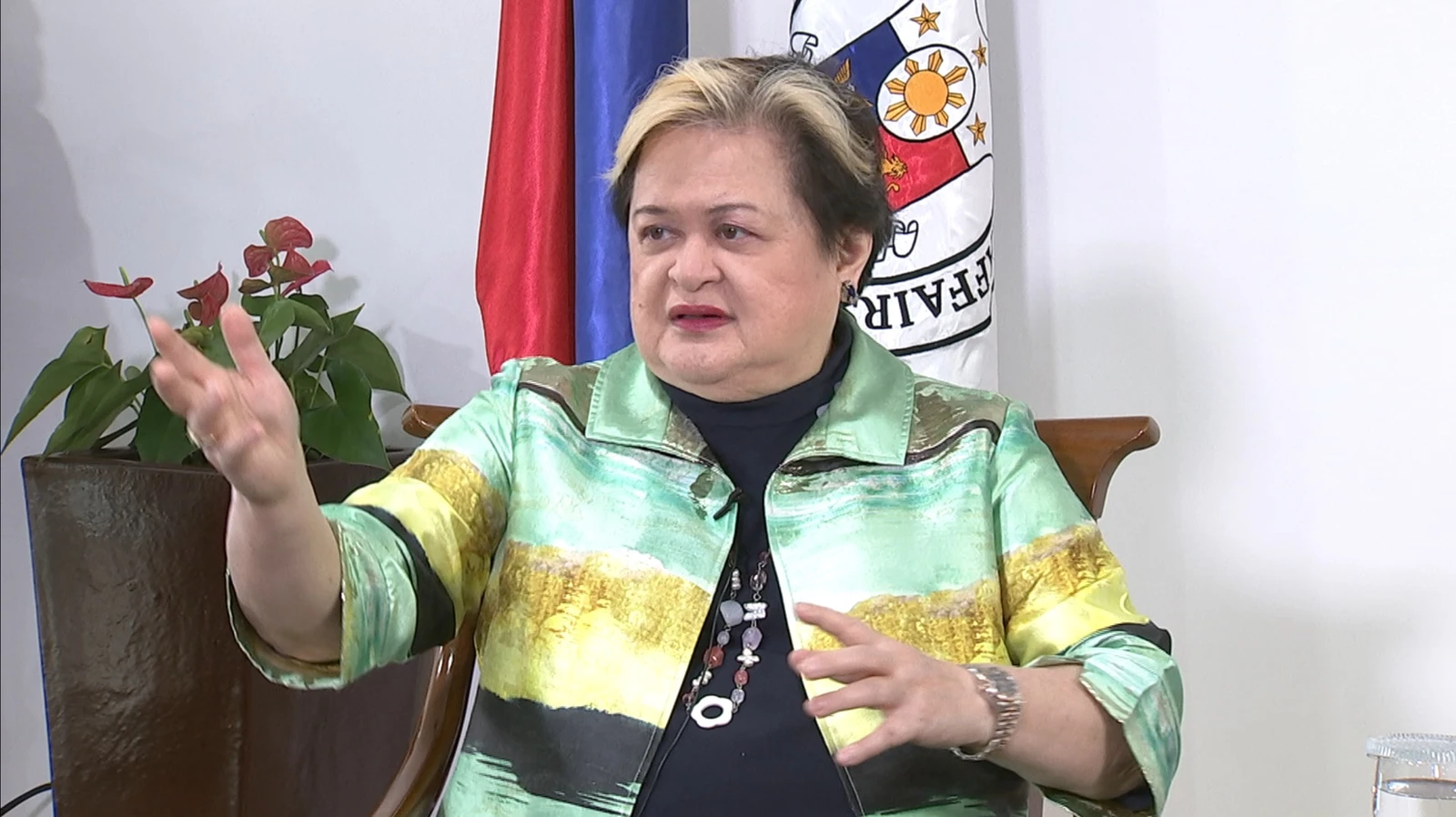
MANILA: The Philippines wants to broaden its relationship with Saudi Arabia beyond oil and overseas workers, Foreign Affairs Secretary Theresa Lazaro has told Arab News, as instability in the Middle East is increasingly affecting the Southeast Asian nation’s security.
Disruptions from the US-Iran war over the past six months have directly affected Philippine energy and food security, as well as the safety of more than 2 million Filipinos living and working in Gulf Cooperation Council countries.
What followed the war’s outbreak, including the blockade of the Strait of Hormuz, has taken “quite a toll on the Philippines,” Lazaro told Arab News at her office in Manila on Thursday.
“What is happening in the Middle East always affects us.”
On whether the war had become a Philippine national security issue, Lazaro said: “I would think so.”
The situation has not only brought surging fuel, electricity and commodity prices, but has as well dealt a blow to agriculture, which relies on fertilizers imported from the Middle East.
It has also increased concerns over the welfare of overseas Filipino workers, who are a major contributor to the Philippine economy, and whose protection is one of the main pillars of Philippine foreign policy, alongside national security and economic security.
“It’s really the third pillar of our foreign policy,” Lazaro said, adding that the war is affecting these efforts and “taking its toll on many aspects of the country.”
Expanding Saudi, GCC ties
Dependent on imported fuel, the Philippine government declared a national energy emergency already in early March, in the first days of the war, and is now considering legislation to establish its first state-owned petroleum reserve to shield itself from potential supply shocks. The Department of Energy announced last week that it is in preliminary talks with Saudi Arabia on a strategic oil storage facility.
“The principle and concept is good,” Lazaro said. “The support of Saudi Arabia is indeed very welcome to have this stockpiling.”
While energy and labor have long been the foundation of Philippine relations with Saudi Arabia and GCC, Manila now wants to use that base to build a wider economic partnership, expanding into investment, healthcare, digitalization and technology.
“We would like to shift this relationship to other substantive matters,” Lazaro said. “We know for a fact that Saudi Arabia is a leader, also in many other spheres of endeavor such as healthcare, digitalization, of course — many other aspects of technology.”
Manila also wants Middle Eastern countries to play a larger economic role in the Bangsamoro Autonomous Region in Muslim Mindanao, which is due to hold its first regular parliamentary vote on Sept. 14 — a milestone in a peace process that follows decades of armed conflict.
“We’re looking at countries, particularly the Middle East, to provide more investments in the area, because of, also, the many natural resources situated in that area,” Lazaro said, identifying infrastructure, education and health care as priority sectors.
“Now that we have the elections ... we’re very hopeful that this will stabilize Mindanao.”
Trump’s Board of Peace
Earlier this year, US President Donald Trump invited the Philippines to join his Board of Peace — a controversial “transitional governance administration” proposed by the US for post-war Gaza. The Philippines said it would review the request.
But there has been no decision from Manila, which is currently focused on its regional role as this year’s chair of the Association of Southeast Asian Nations.
“Not yet ... The Board of Peace is something that we have not discussed recently because of our preoccupation with the ASEAN chairship,” the foreign secretary said.
“In principle, I think it’s a very good concept. But in terms of logistics and resources, I think that might be the issue.”
She also reiterated Manila’s support for a two-state solution to Israel’s occupation of Palestinian territories.
“The Philippines has always maintained a two-state policy. In the United Nations, we always support Palestine,” she said. “I think Israel knows our position and we maintain such position.”
Balancing act with Washington and Beijing
As Manila is trying to broaden and diversify its relations with GCC countries, on the other hand its efforts are focused on balancing ties with Washington — on which it relies for security — and Beijing.
“The United States is our only treaty ally. We have a mutual defense treaty since 1952,” Lazaro said. “The United States has provided us with the needed training as well as that of the hard infrastructure and also the economic part of it.”
But the Philippines also wants a workable relationship with America’s key rival, China — its largest trade partner — even though it has an ongoing territorial dispute with Beijing over parts of the South China Sea.
“We just segregate the issue of the disputed area in the South China Sea, and this is a matter that doesn’t affect the other aspects of the bilateral relations,” Lazaro said.
Whether either of the superpowers could be prioritized over the other would remain a question of the Philippines’ national interest, as “the answer is not a matter of choosing,” she added.
“The answer is, what is our national interest? Be that as it may, it’s really our national interest that dictates the foreign policy.”
Philippines seeks broader Saudi ties as US-Iran war becomes national security matter