Kampala: Uganda’s President Yoweri Museveni extended his three-decade rule on Saturday after winning a fifth term in polls rejected as fraudulent by his closest rival who was under house arrest.
The veteran 71-year-old won 60 percent of the vote in the sometimes chaotic elections, far ahead of the 35 percent garmered by detained opposition leader Kizza Besigye, whose house was surrounded by dozens of armed police in riot gear.
“The commission declares Yoweri Kaguta Museveni the elected President of the Republic of Uganda,” Election Commission chief Badru Kiggundu said as he read out results.
Large numbers of police and troops have been deployed on the streets of the capital Kampala. US Secretary of State John Kerry on Friday urged Museveni to “rein in” his security forces.
“The outcome of an elections can either tear or build a country... as Ugandans let us be prepared to exhibit more tolerance,” commission chief Kiggundu said. “We love this country and you Ugandans love your country.”
Besigye’s party has decried results as “fraudulent,” but Museveni’s National Resistance Movement (NRM) party swiftly issued a statement celebrating the win.
“The result confirmed that our opponents failed to offer any alternative,” NRM spokesman Mike Sebalu said. “Behind their vague claims of change, there were no policies and no chance of progress — and people saw through these empty claims.”
Ugandan police chief Kale Kayihura also warned that celebrations after results required police permission.
“We anticipate that candidates who have won in the elections intended to hold celebratory activities... To protect public order, all candidates planning celebrations must first discuss and get clearance,” he said.
The election on Thursday was disrupted in Kampala by the late arrival of ballot boxes and papers and angry demonstrations by voters that the police quelled using tear gas.
At nearly 28,000 other polling centers voting passed off smoothly, but the ballot was extended for a second day in 36 places after delays that Commonwealth election observers called “inexcusable” and that “seriously detracted from the fairness and credibility of the result.”
European Union election observers on Saturday said that “voting was conducted in a calm and peaceful environment in the vast majority of the country.” But the observers also voiced criticism over the “lack of transparency and independence” of the electoral commission.
Ex-prime minister Amama Mbabazi, a former ruling party stalwart, was trailing in a distant third with just over one percent of the vote.


Uganda’s Museveni wins fifth term: election commission
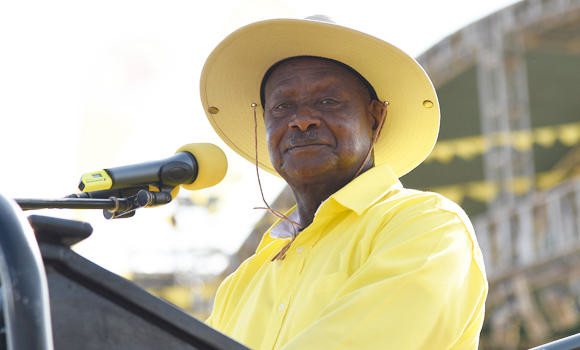
Uganda’s Museveni wins fifth term: election commission

Ukraine contacted Musk’s SpaceX over Russian drones using Starlink
- The Russian army used Starlink satellites to guide its drone attacks deep into Ukraine
- ISW said “Russian forces are increasingly using Starlink satellite systems”
KYIV: Ukraine’s Defense Minister Mykhailo Fedorov said on Thursday Kyiv was in contact with Elon Musk’s SpaceX over allegations that Russian drones were using Internet from Starlink satellites during attacks on Ukrainian cities.
“Within hours of Russian drones with Starlink connectivity appearing over Ukrainian cities, the Ministry of Defense team promptly contacted SpaceX and proposed ways to resolve the problem,” Fedorov said on social media.
“I’m grateful to SpaceX President Gwynne Shotwell and personally to Elon Musk for their swift response.”
Fedorov and the US-based Institute for the Study of War said earlier this week that the Russian army used Starlink satellites to guide its drone attacks deep into Ukraine.
Russia has been battering the country’s energy grid as temperatures tumble below freezing and the invasion’s fourth anniversary looms.
The ISW said that “Russian forces are increasingly using Starlink satellite systems to extend the range of BM-35 strike drones to conduct mid-range strikes against the Ukrainian rear.”
Starlink is also widely used by the Ukrainian army for communications.
“Elon Musk’s decision to urgently activate Starlink and send the first batch of terminals to Ukraine at the start of the full-scale invasion was critically important for our country’s resilience,” Fedorov said.
“Western technologies must continue to support the democratic world and protect civilians, not be used for terror and the destruction of peaceful cities.”


