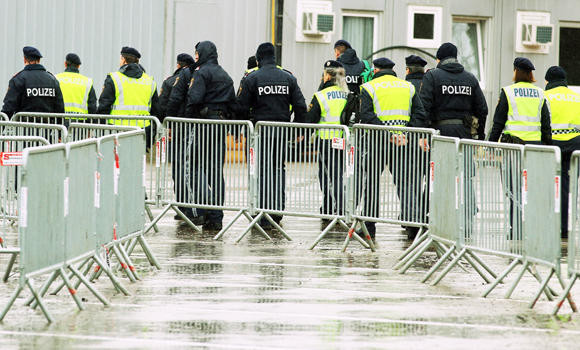
Austria says will cut migrant quotas further

Updated 19 February 2016
Follow

Austria says will cut migrant quotas further

VIENNA: Austria, which angered other European Union states by announcing a daily cap on immigration and asylum claims, said on Friday it would have to introduce even stricter limits in future.
The daily limits of 3,200 migrants crossing the border and 80 asylum claims, announced on the eve of an EU summit, were widely seen as undermining Germany’s quest for a joint EU solution to the bloc’s refugee crisis in tandem with Turkey.
European Commission President Jean-Claude Juncker expressed exasperation on Thursday, and the EU’s migration chief said the cap on asylum claims would break EU and international law.
But Austria, the last stop on the way to Germany for hundreds of thousands of migrants who have flocked to Europe, appeared undeterred, and its interior minister said the daily caps had been introduced on Friday. “I am very happy with our decision and we will stick to it,” Johanna Mikl-Leitner told reporters at a conference on migration.
She said Austria had received around 11,000 asylum claims so far in 2016, putting it on course under the new daily limit to exceed its ceiling for the year of 37,500, less than half last year’s total.
“(So) we will have to reduce these upper limits further.” she said, adding that the daily cap on claims only applied to people arriving at the southern border on the main migrant route into Europe.
Austria also did not want to place too great a burden too soon on Balkan states between it and Greece, with which Vienna is coordinating a “domino effect” of restrictions, she said.
Austria has largely served as a conduit into Germany for the migrants who have streamed through the Balkans and onto its territory since the two countries threw open their borders to them in September. But, relative to its smaller population, Austria has taken a similar number of asylum seekers to Germany, and concerns about the influx have fueled a rise in support for the far right in both countries.
Austria’s coalition government has progressively tightened border restrictions, at first largely in step with Berlin and now apparently not.
Germany suggested on Friday the Austrian measures may violate European law. Mikl-Leitner, who says that Germany has for months had daily quotas of its own, which Germany has never confirmed, brushed the criticism aside.


UN peacekeepers defy South Sudan military’s order to leave opposition-held town

Updated 5 sec ago
Follow

UN peacekeepers defy South Sudan military’s order to leave opposition-held town

JUBA, South Sudan: The United Nations Mission in South Sudan said Monday that it would not comply with a government order to shut down its base in Akobo, an opposition stronghold near the Ethiopian border where tens of thousands of refugees have fled.
On Friday, the South Sudanese army ordered UN peacekeepers as well as NGOs and civilians to vacate the town ahead of a planned assault.
But the mission refused to leave and said it would provide “a protective presence for civilians” in the town, adding that the safety and security of its personnel “must be fully respected at all times.”
The UN Mission said it was engaging “intensively with national, state and local stakeholders” regarding this order. “Any military operations in and around Akobo gravely endanger the safety and security of civilians,” said mission chief Anita Kiki Gbeho.
The South Sudanese government has been fighting opposition forces since a 2018 peace deal broke down about a year ago.
A dramatic escalation took place in December 2025, when opposition forces seized several government outposts in northern Jonglei. A government counter-offensive repelled their forces a month later and displaced over 280,000 people. Tens of thousands have sought refuge in Akobo, where a small contingent of UN peacekeepers is stationed.
Fearing the looming government assault on Akobo, humanitarian workers were evacuated over the weekend, and a mass exodus of the population has also begun.
Local officials contacted by the The Associated Press said fleeing civilians faced danger and widespread shortages of essential supplies. Dual Diew, the Akobo County health director, who has fled to Ethiopia, said there were 84 wounded patients at the hospital. “We have most of them with us here now,” he said, adding that they lack medicine and basic nursing equipment.
Christophe Garnier, the leader of Doctors Without Borders in South Sudan said the organization had to evacuate its staff from Akobo on Saturday and learned of the subsequent looting of its hospital and the ransacking of its office.
“People in Akobo must now either flee without protection or remain at risk of being killed, while losing access to health care and other essential services,” he said.
The three Western governments that have played a major role in the peace process — the U.S, UK, and Norway — sent a letter to President Kiir on Monday urging that the army’s evacuation order be revoked and warning of “further deaths, displacement and suffering for the South Sudanese people” if the offensive on Akobo is implemented.