Mumbai plotter ‘says he worked for Pakistan spy agency’

Updated 10 February 2016
Follow

Mumbai plotter ‘says he worked for Pakistan spy agency’

MUMBAI : An American who helped survey targets for the deadly 2008 Mumbai attacks told a special Indian court Tuesday that Pakistan’s spy agency provides support to militants blamed for the atrocity, according to a prosecutor.
David Headley, who was sentenced in 2013 by a Chicago court to 35 years in a US prison for his role in the attacks that killed 166 people, also said he worked for Pakistan’s Inter-Services Intelligence (ISI).
“Today David Headley has given certain sensitive revelations,” Indian public prosecutor Ujjwal Nikam said outside Mumbai’s sessions court on Tuesday following the American’s testimony via video link.
“Firstly he said that he was working for ISI... David Headley further confirmed that ISI and Lashkar-e-Taiba (LeT) had a close nexus with each other,” Nikam told reporters.
“I did ask him how he could say that... and he said ‘ISI provides financial and moral as well as military support to Lashkar-e-Taiba’,” the prosecutor added.
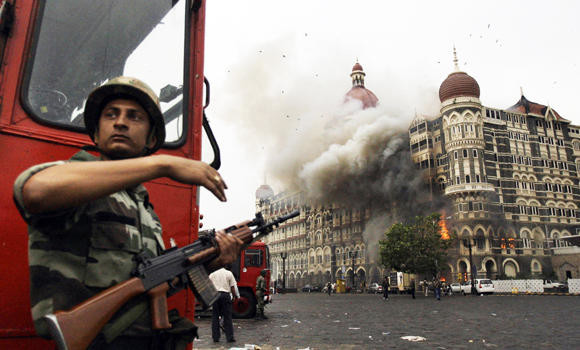
India has long blamed the LeT for the coordinated attacks on November 26, 2008 when Islamist gunmen stormed luxury hotels, the main railway station, a Jewish center and other sites in the country’s financial capital.
The attacks, which lasted for three days, have been a consistent source of acrimony between India and Pakistan as New Delhi has called for Islamabad to bring the alleged masterminds to justice.
Pakistan’s government has technically banned LeT but a number of its leaders, including Hafiz Saeed and Zaki-ur-Rehman Lakhvi, remain free.
India blames Saeed and Lakhvi for masterminding the attacks in 2008 and Pakistan’s reluctance to hand them over remains a continual source of friction between the nuclear rivals.
Analysts accuse the ISI of maintaining links with a range of militant groups in Pakistan, including the LeT, but Islamabad denies this.
Headley, 55, was giving evidence to the Indian court from an undisclosed location in America for the second day. The court is trying suspected plotter Sayed Zabiuddin Ansari, also known as Abu Jundal.
In December it pardoned Headley, the son of a former Pakistani diplomat, on condition that he testified to the court.
The pardon does not affect the US sentence. which came after he admitted scouting targets for the Mumbai attackers.
After initially denying involvement, Headley confessed and cooperated with US authorities to avoid the death penalty.
According to Nikam, Headley told the court Tuesday that he had surveyed various locations in Mumbai, including Chhatrapati Shivaji Terminus railway station, the Taj Mahal Palace hotel and Oberoi hotel.
All three were hit during the attacks.
On Monday, Headley testified that the Pakistan-based LeT had also been behind two failed attempted attacks on Mumbai in September and October 2008.
His testimony continues on Wednesday.


Ukraine drops NATO goal as Trump envoy sees progress in peace talks

Updated 57 min 18 sec ago
Follow

Ukraine drops NATO goal as Trump envoy sees progress in peace talks

  • The move marks a major shift for Ukraine, which has fought to join NATO as a safeguard against Russian attacks and has such an aspiration included in its constitution

BERLIN/KYIV: President Volodymyr Zelensky offered to drop Ukraine’s aspirations to join the NATO military alliance as he held five hours of talks with US envoys in Berlin on Sunday to end the war with Russia, with negotiations set to continue on Monday.
Trump’s envoy Steve Witkoff said “a lot of progress was made” as he and Trump’s son-in-law Jared Kushner met Zelensky in the latest push to end Europe’s bloodiest conflict since World War Two, though full details were not divulged.
Zelensky’s adviser Dmytro Lytvyn said the president would comment on the talks on Monday once they were completed. Officials, Lytvyn said, were considering the draft documents.
“They went on for more than five hours and ended for today with an agreement to resume tomorrow morning,” Lytvyn told reporters in a WhatsApp chat.
Ahead of the talks, Zelensky offered to drop Ukraine’s goal to join NATO in exchange for Western security guarantees.
The move marks a major shift for Ukraine, which has fought to join NATO as a safeguard against Russian attacks and has such an aspiration included in its constitution. It also meets one of Russia’s war aims, although Kyiv has so far held firm against ceding territory to Moscow.
“Representatives held in-depth discussions regarding the 20-point plan for peace, economic agendas, and more. A lot of progress was made, and they will meet again tomorrow morning,” Witkoff said in a post on X.
The talks were hosted by German Chancellor Friedrich Merz, who a source said had made brief remarks before leaving the two sides to negotiate. Other European leaders are also due in Germany for talks on Monday.
“From the very beginning, Ukraine’s desire was to join NATO, these are real security guarantees. Some partners from the US and Europe did not support this direction,” Zelensky said in answer to questions from reporters in a WhatsApp chat.
“Thus, today, bilateral security guarantees between Ukraine and the US, Article 5-like guarantees for us from the US, and security guarantees from European colleagues, as well as other countries — Canada, Japan — are an opportunity to prevent another Russian invasion,” Zelensky said.
“And it is already a compromise on our part,” he said, adding the security guarantees should be legally binding.
Russian President Vladimir Putin has repeatedly demanded Ukraine officially renounce its NATO ambitions and withdraw troops from the about 10 percent of Donbas which Kyiv still controls. Moscow has also said Ukraine must be a neutral country and no NATO troops can be stationed in Ukraine.
Russian sources said earlier this year that Putin wants a “written” pledge by major Western powers not to enlarge the US-led NATO alliance eastwards — shorthand for formally ruling out membership to Ukraine, Georgia, Moldova and other former Soviet republics.
Sending Witkoff, who has led negotiations with Ukraine and Russia on a US peace proposal, appeared to be a signal that Washington saw a chance of progress nearly four years after Russia’s 2022 invasion.
Under pressure from Trump to sign a peace deal that initially backed Moscow’s demands, Zelensky accused Russia of dragging out the war through deadly bombings of cities and Ukraine’s power and water supplies.
A ceasefire along the current front lines would be a fair option, he added.

‘CRITICAL MOMENT’
Germany’s Defense Minister Boris Pistorius said it was a “good sign” Trump had sent his envoys while fielding questions in an interview with the ZDF broadcaster on the suitability of Witkoff and Kushner, two businessmen, as negotiators.
“It’s certainly anything but an ideal setup for such negotiations. That much is clear. But as they say, you can only dance with the people on the dance floor,” Pistorius said.
On the issue of Ukraine’s offer to give up its NATO aspirations in exchange for security guarantees, Pistorius said Ukraine had bitter prior experience of relying on security assurances. Kyiv had in 1994 agreed to give up its Soviet-era nuclear arsenal in exchange for territorial guarantees from the US, Russia and Britain.
“Therefore, it remains to be seen to what extent this statement Zelensky has now made will actually hold true, and what preconditions must be met,” Pistorius said.
“This concerns territorial issues, commitments from Russia and others,” he said, adding mere security guarantees, especially without significant US involvement, “wouldn’t be worth much.”
Britain, France and Germany have been working to refine the US proposals, which in a draft disclosed last month called for Kyiv to cede more territory, abandon its NATO ambitions and accept limits on its armed forces.
European allies have described this as a “critical moment” that could shape Ukraine’s future, and sought to shore up Kyiv’s finances by leveraging frozen Russian central bank assets to fund Kyiv’s military and civilian budget.