BERLIN: German Chancellor Angela Merkel Monday defended her open-door policy to refugees in the face of falling poll ratings, saying it was “part of the basic humanity of our country.”
It was not her job to “spread worry” but “to work on finding solutions to the problems,” Merkel told mass-market daily Bild in a lengthy interview.
She voiced understanding for citizens’ fears given the record influx, expected to reach 800,000 to one million this year.
But she stressed that “for me it is part of the basic humanity of our country that one deals with a refugee in a friendly way, as with every other human being.”
Asked whether she could imagine sheltering a refugee at her home, however, she said: “Although I have great respect for the people who do that, I could not imagine that for me now.”
To manage the migrant wave, Germany would have to quickly repatriate rejected asylum-seekers fleeing poverty not war, said the chancellor.
“Newly arrived people without hopes of being allowed to stay will be sent back directly,” she said.
Despite mounting criticism within her conservative party, Merkel said she was “firmly convinced” that the Christian Democrats were behind her, adding that polls “are not my gauge.”
The chancellor also reiterated it was impossible to immediately end the influx of asylum-seekers.
“If someone wants to say ‘let’s stop it now’, then they have to be able to stop it, but it’s not that simple,” she told Bild.
The greatest migration crisis since World War II could only be solved together with Germany’s European and international partners, she said, pointing at the war in Syria.
“The diplomacy of the entire West — but also of the Arab states, Russia and regional powers — has so far been unsuccessful in Syria,” she said.
Merkel added that “the whole of Europe must work to secure the EU’s external borders, while distributing the refugees fairly between the member states.”
She stressed that no new taxes would be raised in Germany to pay for handling the migrant influx.
“We can be pleased that we have managed the economy well for years and that our current economic situation is good,” said Merkel.
She also sought to ally fears that the majority Muslim refugees presented a threat to German society.
Germany would continue to be defined by “the constitution, the social market economy, the freedoms of religion and expression,” she said.
“To the people who come here, we make clear from day one that we have laws and rules that govern communal life which they must follow.
“Only in this way can Germany be a safe haven to them.”


![]()
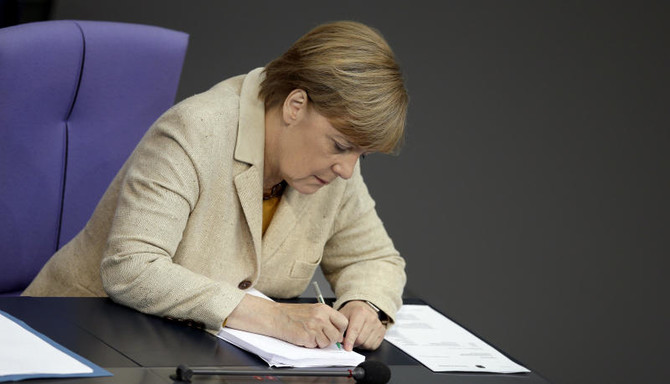

Merkel defends refugee policy as expression of ‘humanity’
Merkel defends refugee policy as expression of ‘humanity’
UK’s Starmer urges ‘sleeping giant’ Europe to curb dependence on US
MUNICH, Germany: British leader Keir Starmer will tell the Munich Security Conference that Europe is “a sleeping giant” and must rely less on the United States for its defense, his office said Friday.
In a speech on Saturday at the summit, the UK prime minister will argue that the continent must shift from overdependence on the United States toward a more European NATO.
“I’m talking about a vision of European security and greater European autonomy that does not herald US withdrawal but answers the call for more burden sharing in full and remakes the ties that have served us so well,” Starmer is expected to say.
The gathering comes as European leaders remain concerned that a United States led by President Donald Trump can no longer be relied upon to be the guarantor of their security.
Since returning to the White House last year, Trump has frequently criticized European countries for not sharing enough of the burden on common defense, and raised questions about the future of NATO.
European members of the transatlantic military alliance are rushing to build up their defenses in the face of an increasingly belligerent Moscow, whose war in Ukraine is set to enter its fifth year this month.
“As I see it — Europe is a sleeping giant. Our economies dwarf Russia’s, 10 times over,” Starmer will tell allies, according to excerpts released ahead of his address.
“We have huge defense capabilities. Yet, too often, all of this has added up to less than the sum of its parts,” he was to say, citing fragmented planning and procurement problems.
Late last year, talks on Britain joining the bloc’s new 150-billion-euro (£130 billion) rearmament fund broke down, reportedly because London baulked at the price for entry.
Downing Street said Starmer would use his speech to call for closer UK-EU defense cooperation.
“There is no British security without Europe, and no European security without Britain. That is the lesson of history — and it is today’s reality too,” Starmer was to say.
The UK government announced on Friday that Britain will spend more than £400 million this financial year on hypersonic and long-range weapons, including through joint projects with France, Germany and Italy.
Starmer, whose center-left Labour party is being squeezed on opposite ends of the political spectrum by the anti-immigrant Reform UK group and the more leftwing Greens, was to say leaders “must level with the public” about the defense costs they face.
He was due to hit out at “peddlers of easy answers on the extreme left and the extreme right,” according to the excerpts.
“The future they offer is one of division and then capitulation. The lamps would go out across Europe once again. But we will not let that happen,” Starmer was expected to say.
In a speech on Saturday at the summit, the UK prime minister will argue that the continent must shift from overdependence on the United States toward a more European NATO.
“I’m talking about a vision of European security and greater European autonomy that does not herald US withdrawal but answers the call for more burden sharing in full and remakes the ties that have served us so well,” Starmer is expected to say.
The gathering comes as European leaders remain concerned that a United States led by President Donald Trump can no longer be relied upon to be the guarantor of their security.
Since returning to the White House last year, Trump has frequently criticized European countries for not sharing enough of the burden on common defense, and raised questions about the future of NATO.
European members of the transatlantic military alliance are rushing to build up their defenses in the face of an increasingly belligerent Moscow, whose war in Ukraine is set to enter its fifth year this month.
“As I see it — Europe is a sleeping giant. Our economies dwarf Russia’s, 10 times over,” Starmer will tell allies, according to excerpts released ahead of his address.
“We have huge defense capabilities. Yet, too often, all of this has added up to less than the sum of its parts,” he was to say, citing fragmented planning and procurement problems.
Late last year, talks on Britain joining the bloc’s new 150-billion-euro (£130 billion) rearmament fund broke down, reportedly because London baulked at the price for entry.
Downing Street said Starmer would use his speech to call for closer UK-EU defense cooperation.
“There is no British security without Europe, and no European security without Britain. That is the lesson of history — and it is today’s reality too,” Starmer was to say.
The UK government announced on Friday that Britain will spend more than £400 million this financial year on hypersonic and long-range weapons, including through joint projects with France, Germany and Italy.
Starmer, whose center-left Labour party is being squeezed on opposite ends of the political spectrum by the anti-immigrant Reform UK group and the more leftwing Greens, was to say leaders “must level with the public” about the defense costs they face.
He was due to hit out at “peddlers of easy answers on the extreme left and the extreme right,” according to the excerpts.
“The future they offer is one of division and then capitulation. The lamps would go out across Europe once again. But we will not let that happen,” Starmer was expected to say.
Latest updates


Recommended



© 2026 SAUDI RESEARCH & PUBLISHING COMPANY, All Rights Reserved And subject to Terms of Use Agreement.