SYDNEY: A prominent Australian Muslim leader criticized the government’s $1 billion program to deradicalize Muslim youth on Wednesday, saying it put too much emphasis on law enforcement and not enough on factors that drive young people to fight overseas.
About 100 Australians are fighting in Iraq and Syria but Samier Dandan, president of Australia’s Lebanese Muslim Association, branded the conservative government’s 9-month-old program to stop the flow of radicalized Muslims “a mess.”
The problem is faced by many Western countries, especially members of US-led coalitions that fought in Afghanistan and Iraq. On Monday, British Prime Minister David Cameron pledged to unveil a five-year counter-extremism strategy he described as “struggle of our generation.”
“Almost universally, research points to the enormous influence that wider social, economic and political issues have on the process of radicalization,” Dandan said.
“Yet, the focus of the government’s strategy seems to rest heavily on how best it can strip people of their rights in the name of ‘security’,” he wrote in an opinion piece shown to Reuters before it was published later.
Australia is on “high” alert for attacks by radicalized Muslims or by homegrown militants returning from fighting in the Middle East, and has carried out a series of high-profile raids in major cities.
Australian citizens now face up to a decade in prison for travel to overseas areas declared off-limits and Prime Minister Tony Abbott earlier this month introduced legislation to strip citizenship from dual nationals found to have engaged in militant acts.
Dandan said the government was missing an opportunity to address the root causes that drive radicalization — inequality.
At least half of Australia’s Muslims live in Sydney’s west, which was transformed in the mid-1970s from white working-class districts into majority-Muslim areas by a surge of immigration from Lebanon.
The most recent 2011 national census found that areas in Sydney most associated with Lebanese ancestry — Auburn, Lakemba, Punchbowl, Granville — lag far behind the rest of New South Wales state on indicators such as income and employment.
A spokesman for the Australian Attorney General’s office did not immediately respond to a request for comment.


Muslim outcry over ‘deradicalization’ drive in Australia
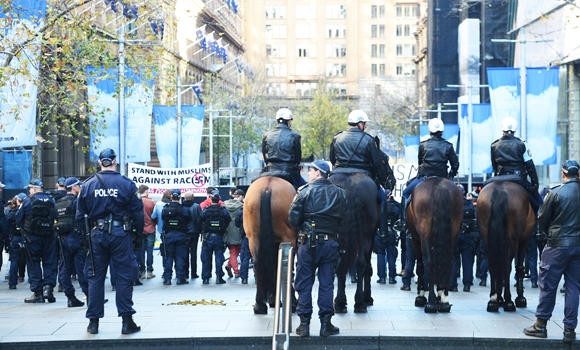
Muslim outcry over ‘deradicalization’ drive in Australia

Treason trial of South Sudan’s suspended VP is further eroding peace deal, UN experts say
- The experts said forces from both sides are continuing to confront each other across much of the country
- “Years of neglect have fragmented government and opposition forces alike,” the experts said
UNITED NATIONS: The treason trial of South Sudan’s suspended vice president is further eroding a 2018 peace agreement he signed with President Salva Kiir, UN experts warned in a new report.
As Riek Machar’s trial is taking place in the capital, Juba, the experts said forces from both sides are continuing to confront each other across much of the country and there is a threat of renewed major conflict.
UN peacekeeping chief Jean-Pierre Lacroix told the UN Security Council last month that the crisis in South Sudan is escalating, “a breaking point” has become visible, and time is running “dangerously short” to bring the peace process back on track.
There were high hopes when oil-rich South Sudan gained independence from Sudan in 2011 after a long conflict, but the country slid into a civil war in December 2013 largely based on ethnic divisions, when forces loyal to Kiir, an ethnic Dinka, battled those loyal to Machar, an ethnic Nuer.
More than 400,000 people were killed in the war, which ended with the 2018 peace agreement that brought Kiir and Machar together in a government of national unity. But implementation has been slow, and a long-delayed presidential election is now scheduled for December 2026.
The panel of UN experts stressed in a report this week that the political and security landscape in South Sudan looks very different today than it did in 2018 and that “the conflict that now threatens looks much different to those that came before.”
“Years of neglect have fragmented government and opposition forces alike,” the experts said, “resulting in a patchwork of uniformed soldiers, defectors and armed community defense groups that are increasingly preoccupied by local struggles and often unenthused by the prospect of a national confrontation. ”
With limited supplies and low morale, South Sudan’s military has relied increasingly on aerial bombings that are “relatively indiscriminate” to disrupt the opposition, the experts said.
In a major escalation of tensions in March, a Nuer militia seized an army garrison. Kiir’s government responded, charging Machar and seven other opposition figures with treason, murder, terrorism and other crimes.
The UN experts said Kiir and his allies insist that, despite having dismissed Machar, implementation of the peace agreement is unaffected, pointing to a faction of the opposition led by Stephen Par Kuol that is still engaged in the peace process.
Those who refused to join Kuol and sided with Machar’s former deputy, Natheniel Oyet, “have largely been removed from their positions, forcing many to flee the country,” the experts said in the report.
The African Union, regional countries and the Intergovernmental Authority on Development, or IGAD, have all called for Machar’s release and stressed their strong support for implementation of the 2018 agreement, the panel said.
According to the latest international assessment, 7.7 million people — 57 percent of the population — face “crisis” levels of food insecurity, with pockets of famine in some communities most affected by renewed fighting, the panel said.