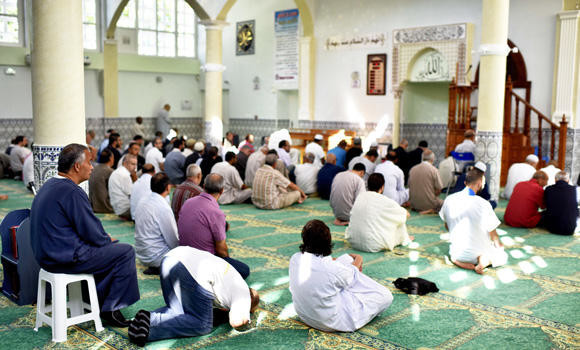
PARIS: France has deported 40 foreign imams for “preaching hatred” in the past three years, a quarter of them in the last six months, Interior Minister Bernard Cazeneuve said Monday.
The minister vowed to clamp down on mosques and preachers inciting hatred after a suspected Islamist beheaded his boss during an attack on a gas factory last week.
The attack, which had the hallmarks of a terrorist act but is also believed to have personal motivations, was the second in six months in France which is battling to curb radicalization that has seen hundreds of citizens leave to wage jihad in Iraq and Syria.
Any “foreign preacher of hate will be deported,” said Cazeneuve, adding that several mosques were being investigated for inciting terrorism and if found to be doing so, “will be shut down.”
“We have deported 40 preachers of hatred since 2012. Since the beginning of the year we have examined 22 cases, and around 10 imams and preachers of hatred have been expelled,” said Cazeneuve.
Yassin Salhi, 35, on Sunday confessed during interrogation to killing his boss and pinning his head to a fence of the Air Products factory near the eastern city of Lyon.
The severed head was discovered flanked by two Islamic flags and it later emerged he had sent a selfie of himself with the head to a number believed to belong to a French jihadist currently in Syria.
While Salhi was known to security services for links to radical Islamists in France, and his crime bore the hallmarks of a terrorist act, sources close to the investigation have suggested a personal dimension after a dispute with his employer two days earlier.
“There is no doubt of the personal motivations but there is a symbolism taken from the most atrocious, abject images of terrorism,” said Cazeneuve.

40 imams deported from France since 2012 for ‘preaching hatred’
Hungary to release 1.8 million barrels of crude oil from strategic reserves
- Croatia’s JANAF pipeline operator, however, said there was no need for Budapest to tap its reserves
- Hungary and Slovakia have been trying to secure supply since flows were halted on January 27
BUDAPEST: Hungary’s government will release about 1.8 million barrels of crude oil from its strategic reserves after a drone attack on the Druzhba pipeline late last month stopped oil flow, according to a government decree published late on Thursday.
Croatia’s JANAF pipeline operator, however, said there was no need for Budapest to tap its reserves after Hungary’s oil company MOL said on Friday JANAF must allow transit of Russian seaborne oil to Hungary and Slovakia during the Druzhba outage.
“At this moment, a significant quantity of non-Russian crude oil is being transported via JANAF’s pipeline for MOL Group, while three additional tankers carrying non-Russian oil, also for MOL Group, are on their way to the Omisalj Terminal,” JANAF said in a statement.
“There was no need to tap into (their) reserves since oil transport via the JANAF pipeline toward MOL’s refineries is being carried out continuously and without delays.”
Hungary and Slovakia, which have the only remaining refineries in the EU using Russian oil through Druzhba, have been trying to secure supply since flows were halted on January 27 following what Ukraine said was a Russian drone attack that damaged pipeline infrastructure.
Both countries have blamed Ukraine for the delay in restarting the flows for political reasons.
SCRAMBLE FOR CRUDE SUPPLIES
MOL is entitled to priority access to released crude oil reserves, and it will have access to the freed reserves until April 15 and has to return them by August 24, the Hungarian government decree said.
At the end of January, Hungary had enough crude oil and petroleum product reserves to cover 96 days, according to data on the Hungarian Hydrocarbon Stockpiling Association’s website.
As the two countries scramble to ensure supplies, MOL ordered tankers delivering Saudi, Norwegian, Kazakh, Libyan and Russian oil to supply its Hungarian and Slovak refineries and halted diesel deliveries to Ukraine earlier this week.
MOL said that first shipments were expected to arrive at the port of Omisalj in Croatia in early March. After that, it will take a further 5-12 days for the crude oil to reach its refineries.
The Slovak government has also declared an oil emergency situation and has pledged to release 1.825 million barrels of oil following a request from Slovakia’s Slovnaft refinery, which is owned by MOL.