Hopes fade for hundreds missing from Chinese ship

1 / 2
2 / 2
Updated 03 June 2015
Follow

Hopes fade for hundreds missing from Chinese ship

JIANLI: Relatives of more than 400 people missing from a cruise ship which capsized in central China clashed with police on Wednesday as hope that survivors would be found turned to anger at a lack of new information.
Just 14 people have been rescued from the “Eastern Star” which overturned late Monday in a storm leaving only a section of its hull emerging from the Yangtze river, state-media said.
While 26 bodies have been found so far, according to state broadcaster CCTV, hundreds of mostly elderly passengers are still missing and feared possibly trapped within the ship.
Witnesses and state-media said the cruiseliner — which was carrying a total of 456 people, most aged over 60 on a holiday cruise — sank in a matter of seconds after it was hit by bad weather.
Around 20 bodies appeared to have been found on Wednesday as rescue efforts continued more than 40 hours after the accident, with dozens of divers searching each of the ship’s rooms one by one, CCTV said.
Fields around the site of the capsized boat were heavily waterlogged and many of the pathways being used by rescue workers were ankle-deep in mud and rainwater.
A Transport Ministry spokesman told AFP that rescuers were facing low visibility in the muddy waters, but would keep searching even as hopes of finding survivors dwindled.
“We will never give up our last efforts,” Xu Chengguang said.
Information on the disaster has been tightly controlled and officials gave little away during a news conference on Wednesday afternoon, providing no figures on deaths or survivors and taking no questions.
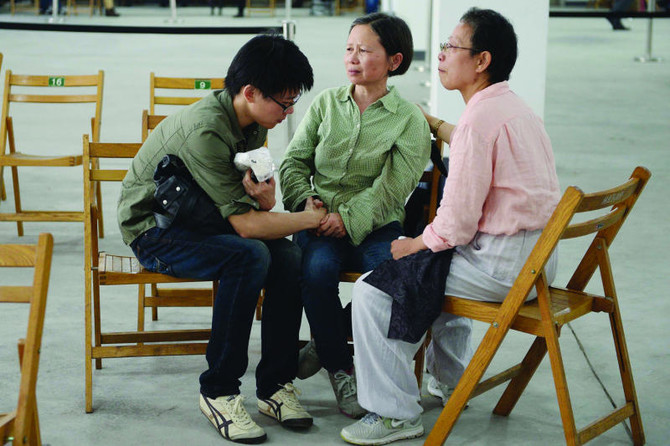
Anger at the lack of news boiled over outside local government building in China’s commercial hub of Shanghai, where many of the passengers hailed from, where a video shared on social media showed pushing and shoving between police and angry relatives.
“The police first formed a human wall and didn’t let us in. Then the relatives got excited and started to shout. Some policemen hit people,” said one young woman whose mother was on the boat.
The mother of seven-year-old Yang Chenlin who was on the boat with her grandparents, said relatives were desperate for more information. “We need to go to the site. That’s our common appeal,” she said.


At the Jianli County People’s Hospital, frantic relatives arrived searching for missing loved ones.


“We drove from 10 p.m. last night to 6 a.m. this morning to get here,” a woman who looked pale and warn told AFP at the hospital, adding that her uncle and aunt had been on board.
“We don’t really know anything,” said a man who had traveled with her.
Hospital officials by late Wednesday had sealed off the facility from reporters, along with a local funeral parlour.
China tightly controls its domestic media and a government directive posted online by the US-based China Digital Times said local outlets had been ordered to only use reports from state-media.
Roadblocks were sited about two kilometers from the capsized vessel, with cars being turned back even before that point. Authorities also limited access for foreign journalists to a brief river trip.
At the site of the disaster, CCTV images showed grim images of what appeared to be a dead woman being pulled from the water, her body already rigid.
Later, the channel showed China’s Premier Li Keqiang bowing to bodies covered in white sheets as rain poured down.
CCTV said the 250-foot vessel had floated three kilometers down river after it capsized in Jianli county, part of the central province of Hubei.
Passengers seemed to have little warning before the ship sank, with Zhang Hui, a 43-year-old tour guide on board, telling Xinhua that he had “30 seconds to grab a life jacket.”
The captain and chief engineer, who were among the survivors and were being questioned by police, both reportedly said the ship was caught in a freak storm.
The ship was cited for safety infractions two years ago along with five other vessels, according to a notice by the Nanjing Maritime Bureau, which gave no details on why the boat was detained or subsequent actions taken.
Condolences for the disaster came from the United States, European Union, the UN and the Vatican.
“I wish to express my closeness to the Chinese people in these difficult moments after the ferry disaster in the Yangtze River,” said Pope Francis.


Two high-speed trains derail in Spain, police sources say 21 people killed

Updated 19 January 2026
Follow

Two high-speed trains derail in Spain, police sources say 21 people killed

  • The accident happened near Adamuz, in Cordoba province. So far, 21 people ​have been confirmed dead by police

MADRID: A high-speed train derailed and smashed into another oncoming train in southern Spain on Sunday, pushing the second train off the tracks in a collision that police sources confirmed to Reuters had killed at least 21 people.
The accident happened near Adamuz, in Cordoba province. So far, 21 people ​have been confirmed dead by police, with state broadcaster Television Espanola adding that 100 people had been injured, 25 seriously. The driver of one of the trains, which was traveling from Madrid to Huelva, was among those who died, the TV station added.
“The Iryo 6189 Malaga — (to Madrid) train has derailed from the track at Adamuz, crashing onto the adjacent track. The (Madrid) to Huelva train which was traveling on the adjacent track has also derailed,” said Adif, which runs the rail network, in a social media post.
Adif said the accident happened at 6:40 p.m. (1740 GMT), about 10 minutes after the Iryo train left Cordoba heading toward Madrid.
Iryo is a private rail operator, majority-owned by Italian state-controlled railway group Ferrovie dello Stato. The train involved was a Freccia 1000 train which was traveling between ‌Malaga and Madrid, ‌a spokesperson for Ferrovie dello Stato said.
The company said in a statement that it ‌deeply ⁠regretted what ​had happened ‌and had activated all emergency protocols to work closely with the relevant authorities to manage the situation.
The second train was operated by Renfe, which also did not respond to a request for comment.
Adif has suspended all rail services between Madrid and Andalusia.

HORRIFIC SCENE
The Iryo train had more than 300 passengers on board, while the Renfe train had around 100.
Paco Carmona, Cordoba fire chief, told TVE the first train heading to Madrid from Malaga had been evacuated.
The other train’s carriages were badly damaged, he said, with twisted metal and seats. “There are still people trapped. We don’t know how many people have died and the operation is concentrating on getting people out of areas which are very narrow,” he ⁠said. “We have to remove the bodies to reach anyone who is still alive. It is proving to be a complicated task.”
Transport Minister Oscar Puente said he was following events ‌from rail operator Adif’s headquarters in Madrid.
“The latest information is very serious,” ‍he posted on X. “The impact was terrible, causing the first two ‍carriages of the Renfe train to be thrown off the track. The number of victims cannot be confirmed at this time. ‍The most important thing now is to help the victims.”
The mayor of Adamuz, Rafael Moreno, told El Pais newspaper that he had been among the first to arrive at the scene of the accident alongside the local police and saw what he believed to be a badly lacerated body several meters from the accident site.
“The scene is horrific,” he said. “I don’t think they were on the same track, but it’s not clear. Now ​the mayors and residents of the area are focused on helping the passengers.”

CALLS FOR MEDICS
Images on local television showed a reception center set up for passengers in the town of Adamuz, population 5,000, with locals coming ⁠and going with food and blankets amid nighttime temperatures of around 42 degrees Fahrenheit (6 degrees Celsius).
A woman named Carmen posted on X that she had been on board the Iryo train to Madrid. “Ten minutes after departing (from Cordoba) the train started to shake a lot, and it derailed from coach 6 behind us. The lights went out.”
Footage posted by another Iryo train passenger, also on X, showed an Iryo staffer in a fluorescent jacket instructing passengers to remain in their seats in the darkened carriages, and those with first aid training to keep watch over fellow passengers. He also urged people to maintain mobile phone batteries to be able to use their torches when they disembarked.
Salvador Jimenez, a journalist for RTVE who was on board the Iryo train, shared images showing the nose of the rear carriage of the train lying on its side, with evacuated passengers sitting on the side of the carriage facing upwards.
Jimenez told TVE by phone from beside the stricken trains that passengers had used emergency hammers to smash the windows and climb out, and they had seen two people taken ‌out of the overturned carriages on stretchers.
“There’s a certain uncertainty about when we’ll get to Madrid, where we’ll spend the night, we’ve had no message from the train company yet,” he said. “It’s very cold but here we are.”