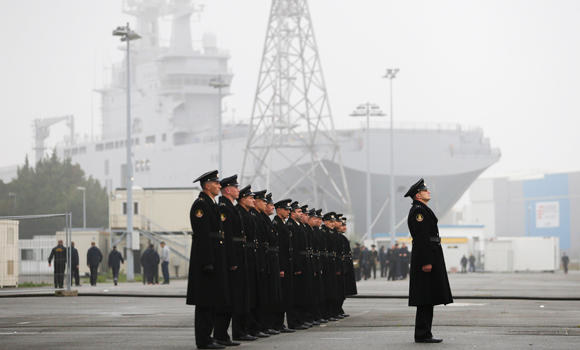
Russian warships enter English Channel

Updated 28 November 2014
Follow

Russian warships enter English Channel

MOSCOW: A flotilla of Russian warships led by a large submarine hunting ship entered the English Channel on Friday in what naval officials said were preparations for a regular series of exercises.
Russia’s Northern Fleet said in a statement released to the RIA Novosti government news agency that its four vessels were led by the Severomorsk destroyer and the Alexander Otrakovsky amphibious landing ship.
It said the detachment had passed through the narrowest part of the channel between England and France at Pas-de-Calais and would begin a series of planned manuevers shortly.
The quoted statement said a storm had forced the detachment to take temporary shelter at the Bay of the River Seine off the northwestern coast of France.
“During its stay, the ships’ crew will perform a series of maneuvers aimed at combating underwater vessels and technology,” the news agency quoted the Russian statement as saying.
Both British and French officials told AFP that such Russian naval detachments visit the region on a nearly-annual basis and that they usually do not extend their stay beyond a few days. But a NATO spokesman said the ships “are not exercising in the channel, as some Russian headlines would have us believe.”
“Our information indicates that the ships are transiting and have been delayed by weather conditions,” NATO spokesman Jay Janzen told AFP.


Italian PM pledges to deepen cooperation with African states

Updated 14 February 2026
Follow

Italian PM pledges to deepen cooperation with African states

  • The plan, launched in 2024, aims to promote investment-led cooperation rather than traditional aid

ADDIS ABABA: Italy pledged to deepen cooperation with African countries at its second Italy-Africa summit, the first held on African soil, to review projects launched in critical sectors such as energy and infrastructure during Italy’s first phase of the Mattei Plan for Africa.

The plan, launched in 2024, aims to promote investment-led cooperation rather than traditional aid.

Italy’s Prime Minister Giorgia Meloni addressed dozens of African heads of state and governments in Ethiopia’s capital, Addis Ababa, and reiterated that a successful partnership would depend on Italy’s “ability to draw from African wisdom” and ensure lessons are learned.

“We want to build things together,” she told African heads of state.  “We want to be more consistent with the needs of the countries involved.”

Ethiopian Prime Minister Abiy Ahmed said Italy had provided Africa with a gateway to Europe through these partnerships.

“This is a moment to move from dialogue to action,” he said. 

“By combining Africa’s energetic and creative population with Europe’s experience, technology, and capital, we can build solutions that deliver prosperity to our continents and beyond.”

After the Italy-Africa summit concluded, African leaders remained in Addis Ababa for the annual African Union Summit.

Kenyan writer and political analyst Nanjala Nyabola said tangible results from such summits depend on preparations made by countries.

African governments often focus on “optics instead of actually making summits a meaningful engagement,” she said.

Instead of waiting for a list of demands, countries should “present the conclusions of an extended period of mapping the national needs” and engage in dialogue to determine how those needs can be met.

Since it was launched two years ago, the Mattei Plan has directly involved 14 African nations and has launched or advanced around 100 projects in crucial sectors, including energy and climate transition, agriculture and food security, physical and digital infrastructure, healthcare, water, culture and education, training, and the development of artificial intelligence, according to the Italian government.