Serbia, Lithuania to contest Eurobasket semifinals

Updated 17 September 2015
Follow

Serbia, Lithuania to contest Eurobasket semifinals

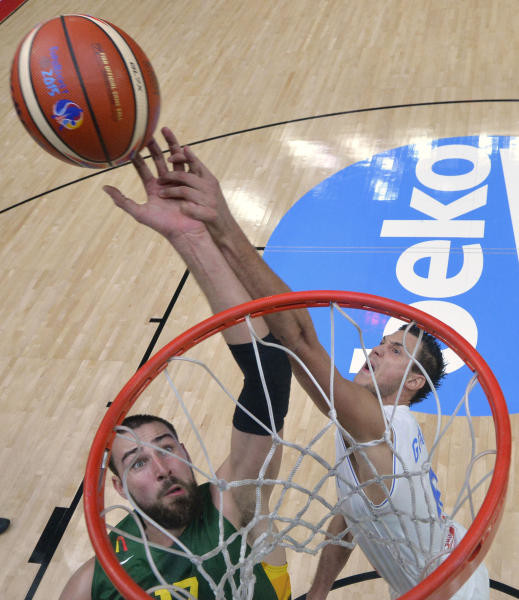
LILLE, France: Jonas Valanciunas scored 26 points and had 15 rebounds to help Lithuania overcome Italy 95-85 in overtime on Wednesday for a place in the semifinals of the European basketball championship.
Lithuania, a three-time champion and silver medalist two years ago, will next play Serbia, which beat the Czech Republic 89-75.
Zoran Erceg scored 20 points and Milos Teodosic had 14 assists for Serbia, which is undefeated in seven straight games.
Jonas Maciulis had another double-double for Lithuania with 19 points and 10 rebounds. He went 3-for-4 from the 3-point range as Lithuania made 11 of 18 attempts from beyond the arc.
Danilo Gallinari, who finished with 17 points, forced overtime with a drive inside, but Lithuania dominated in the extra five minutes despite three turnovers as Italy began to tire.
Matas Kalnietis sank a 3-pointer for a six-point Lithuania lead with 1:49 left and Valanciunas followed with four straight points as Lithuania pulled away for a 90-83 lead to secure the victory.
Lithuania also beat Italy in the quarterfinals two years ago. Andrea Bargnani led Italy with 21 points.
Defending champion France plays Spain in the first semifinal on Thursday and Serbia and Lithuania meet on Friday.
Serbia’s bench contributed 50 points and Erceg was nearly perfect from the field as the Serbs overcame 23 points and 10 rebounds from Jan Vesely, the Czech center who played club basketball in Serbia, which won the silver medal at last year’s World Cup.
Guard Tomas Satoransky kept the Czechs in the game by scoring 14 of his 20 points in the third quarter, when Serbia led by 10 but went into the final period with only a four-point lead.
Teodosic, who finished with 12 points, made a three-point play to make it 75-64 with seven minutes remaining and Serbia sailed from then on.
“He is an incredible player. I really enjoy watching him in practice because I see things I’ve never seen in my life,” said Serbia’s coach Sasa Djordjevic, once one of the most popular and best players in Serbia. “His vision is incredible. He is special, unique.”
Serbia is playing its first semifinal since 2009, when it took the silver medal.
“It wasn’t a brilliant victory but we won and that’s the main thing,” Raduljica said. “Erceg had a fantastic game and kept us in it with his points.”
Center Miroslav Raduljica added 16 points for Serbia and Nemanja Blejica had another Serbian double-double with 14 points and 10 rebounds.
Erceg’s only miss from the field was one of his four 3-point attempts.
“We knew that it was going to be a tough game and the Czechs confirmed that they are a good, hard team,” said Erceg, a power forward whose career has been plagued by injuries. “I hit some important shots today but it’s a matter of team play. One of us always steps up and today I was the one. This is just another step on our path.”
The Serbs kept Satoransky to two points in the first half, but the Czech guard exploded after the break.
He and Vesely were giving Serbia a hard time, but they got little support. Guard Blake Schilb, who also played club basketball in Belgrade, had 11 points, but all came in the first quarter. The Czech bench produced only 14 points.


Staging the Africa Cup of Nations part of Morocco’s bid to become a soccer superpower

Updated 4 sec ago
Follow

Staging the Africa Cup of Nations part of Morocco’s bid to become a soccer superpower

  • Officials have framed this Africa Cup as a high-visibility dress rehearsal for the World Cup in 2030
  • Morocco’s most promising young stars are being provided with all of the facilities they need to thrive

RABAT: Staging the Africa Cup of Nations from Sunday is another major step in Morocco’s road to becoming a global soccer power and a dry run as a co-host for the 2030 World Cup.
Three years after reaching the semifinals of the 2022 World Cup, the North African kingdom will host 24 teams from across the continent and welcome spectators to nine new or renovated stadiums in six cities.
It’s only the second time Morocco have hosted the biennial tournament, but it comes at a time when they regularly stage other African nations’ “home” games for World Cup qualifiers, and after they secured the rights to host five Under-17 Women’s World Cups in a row. They also hosted the Women’s Africa Cup of Nations in July.
Curtain-raiser for greater ambitions
Officials have framed this Africa Cup as a high-visibility dress rehearsal for the World Cup in 2030, when Morocco will be one of the main co-hosts alongside Spain and Portugal. Argentina, Uruguay and Paraguay will also host a game each.
Morocco harbor high hopes of staging the final in Hassan II Stadium, set to be the largest soccer arena in the world with a capacity of 115,000 after its planned completion in 2028.
The new national stadium is arguably the highlight of one of the most aggressive infrastructure buildouts in African sporting history. Morocco have pursued rapid development in other sectors as well, with airports updated, high-speed rail lines expanded and major tourism investments to welcome visitors to cities like Marrakech and Tangier.
The Royal Moroccan Football Federation has also invested in youth development and coaching to raise standards across the game, including the lavish new Mohammed VI Football Complex near Rabat, where the senior team are based for the Africa Cup.
Morocco’s most promising young stars are being provided with all of the facilities they need to thrive. It’s already paying off. Morocco’s run to the semifinals of the 2022 World Cup was the first by any African or Arab side. The country also won the Under-20 World Cup in October.
“It’s not dreaming, we have legitimate ambitions,” Fouzi Lekjaa, the president of the Royal Moroccan Football Federation, told French sports paper L’Equipe in July.
Lekjaa, who also oversees budget issues in the Moroccan prime minister’s cabinet, sees sport as a lever of economic development.
Not everyone is on board
The investments have not come without tension, sparking heated debate about the country’s priorities. While thousands of visitors will see areas dense with hotels, restaurants, new roads and other tourist infrastructure, large swaths of the country present a stark contrast. In rural regions far from financial centers, residents complain of neglect and lack of investment. Key issues include health, literacy and employment.
When “Gen Z” demonstrations swept Morocco this year, protesters chanted, “Stadiums are here but where are the hospitals,” drawing a direct line between the soccer investments and broader inequalities.
Regional strains
The tournament also comes as Morocco works to cement its role as a regional power. As part of the country’s “Atlantic Initiative,” it has worked to deepen ties with landlocked countries in West and Central Africa, expanding the footprint of its banking and telecom industries and providing those without a coastline access to newly built ports.
Morocco’s normalization of ties with Israel brought it closer to the United States and it has also won backing from most European Union members to keep sovereignty over the disputed Western Sahara.
Morocco has offered tourist visas to spectators attending the Africa Cup, even as it has moved in recent years to curb migration from some of the countries whose teams are participating. Visa requirements for people from Ivory Coast, for example, were reinstated last year for reasons including to curb irregular attempts at migration.
Morocco has long been seen as an easier way to reach Europe — it shares a border with the EU through the Spanish territories of Ceuta and Melilla on the North African coast, and Spain’s Canary Islands are about 100 kilometers (60 miles) away.
The kingdom has faced criticism from migrant rights groups for clearing encampments, moving migrants to remote areas far from Europe’s borders and other aggressive enforcement measures.
The Moroccan Association for Human Rights’ Rabat branch said this week there has been an uptick in arbitrary arrests and forced expulsions of migrants in the lead-up to the Africa Cup.
The final on Jan. 18 in Rabat will be at Prince Moulay Abdellah Stadium, which opened in September.