MADRID: Spain is considering freezing pensions and speeding up a planned rise i n the retirement age as it races to cut spending and meet conditions of an expected international sovereign aid package, sources with knowledge of the matter said.
The measures would save at least 4 billion euros a year as well as fulfil European Union policy recommendations issued in May which senior euro zone sources said were being used as a blueprint for the terms of a sovereign aid program.
The accelerated raising of the retirement age to 67 from 65, currently scheduled to take place over 15 years, is a done deal, the sources said. The elimination of an inflation-linked annual pension hike is still being considered.
Spain, the new epicenter of the euro zone debt crisis after Greece, Ireland and Portugal, is hesitating to apply for external aid to handle a high public deficit and soaring debt. Its borrowing costs fell on Thursday at an auction of a 10-year benchmark bond but relief may be short-lived. The new pensions steps, which could be announced as soon as next week along with the 2013 budget, would send a strong signal to investors that Spain is serious about implementing structural reforms it has delayed because of the political cost.
Prime Minister Mariano Rajoy, who was forced earlier this year to break campaign pledges such as not raising taxes, has repeatedly said he would not touch pensions, but he has few options left to trim the budget after drastic cost cuts.
He toned down his language last week and said it would be "the last thing" he would do. On Tuesday, Deputy Prime Minister Soraya Saenz de Santamaria said the government was not implementing any cut on the pensions "for the time being".
Sources with knowledge of the government's thinking said Rajoy's comments were a sign that his stance was shifting.
"He just said that he would not cut the pensions. But did you hear anything else? We both know that there are several ways of cutting. One is to simply leave them steady against inflation," said one of the sources.
A second source said the acceleration in the change in the retirement age was backed by the government while a third source, who discussed the issue with senior Spanish officials, said a freeze was expected.
"Not increasing them is also an adjustment," the third source said.
Many economists also believe a freeze is inevitable.
The 2012 budget earmarks a 1 percent inflation review — or about 1 billion euros — but inflation is running close to 3 percent, meaning an extra 4 billion euros that would be paid to pensioners in January but booked to the 2012 budget.
So canceling this year's inflation-linked raise would save the government about 5 billion euros.
For following years, based on annual inflation of 2 percent, the reference used by the European Central Bank to set its main rates, the adjustment would cost 4 billion euros.
"There is no way around it. You have to cut the link with inflation and freeze the pensions next year," said Jose Carlos Diez, chief economist at Intermoney brokerage in Madrid.
"And to me, that would be just a start... The pensions, the unemployment benefits and the borrowing costs are eating up all the efforts on the spending side so you need to act in those areas," he added.
Both removing the inflation adjustment and accelerating the retirement age increase are long-standing European Union demands and any bond-buying program to help Spain finance its debt would insist on this, senior euro zone sources said.
Countries which were previously rescued, such as Greece, Ireland and Portugal all had to pass steep cuts on pensions.
In Greece, the cuts ranged from 20 percent to 40 percent, while new pensioners had a 10 percent pay cut in Ireland and Portugal scrapped the Christmas and summer extra payments.
While an announcement could be made next week when the government adopts the first draft of the 2013 budget, political analysts say Rajoy may be tempted to wait until after a regional election in his native north-western Galicia.
The timing of any request for European aid is in Rajoy's hands. Some pointers suggest he could make the move along with the budget package to preempt a credit review by ratings agency Moody's, due by end-September, which might otherwise downgrade Spanish debt to junk status. Moody's has said it would welcome a Spanish aid request.
However in Brussels, EU officials close to the discussion said they did not expect Madrid to seek an assistance program before the Oct. 21 regional vote. That would mean Spain would have to get over a 27.5 billion euro refinancing hump at the end of October without the euro zone rescue fund or the ECB buying its bonds.
The spread between Spanish and German benchmark 10-year bonds , a measurement of the perceived risk of investing in Spain, widened a few basis points yesterday to 417.
As Reuters reported first last month, Spanish officials led by Economy Minister Luis de Guindos have been talking discreetly to the European Commission since at least early August about possible conditions and supervision for a precautionary program that would keep Spain in capital markets.
De Guindos made clear at a meeting of euro zone finance ministers in Cyprus last weekend that Spain, keen to avoid having terms imposed from outside, would announce its own reform measures and timetable on Sept. 28, a day after a draft 2013 budget is approved by the cabinet.
Rajoy performed especially well among pensioners when he was elected in a landslide last year and his first move after taking office was to restore the inflation adjustment his predecessor Jose Luis Rodriguez Zapatero had removed in May 2010 when Spain entered in the eye of the storm of the euro zone debt crisis.
Zapatero also passed last year a law to add two years to the retirement age by 2027. Rajoy's People's party, then in the opposition, voted against the change.
With unemployment soon to top 25 percent and set to remain at high levels until at least 2015, the number of people contributing to the state pension system has fallen to its lowest level in 10 years. There are now 2.39 workers contributing fees to support one pensioner.
As unemployment is expected to grow and the population to age, this ratio is set to fall to 2 in the next months, a level the OECD in 2011 expected Spain to reach only in 2011.
A spokesman for Spain's Employment Ministry said yesterday EU authorities were no longer pushing to speed up the raising of the retirement age, since they May recommendations were revised in July. A parliamentary committee would soon begin debating other ways to make the pension system sustainable, he said.
The government tapped 4.4 billion euros from an insurance fund to make July and August payments to the 8.1. million pensioners, about a fifth of the population.
It also said it could not rule out using the pension guarantee fund — meant only for emergencies — by the end of the year to pay the pensioners their monthly check.


Spain plans pension reform with aid package in sight
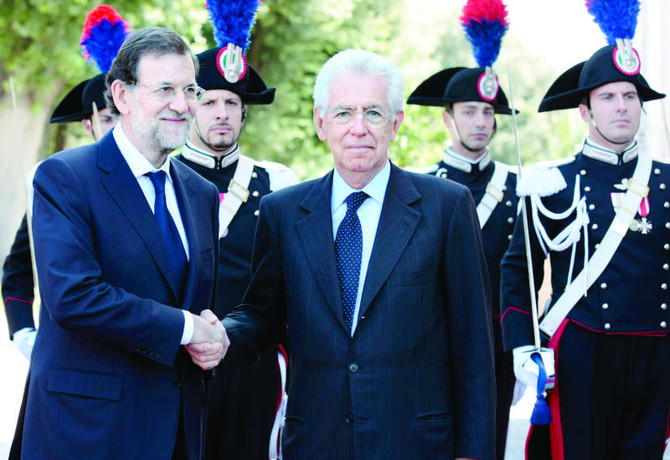
Spain plans pension reform with aid package in sight

Manufacturing and trade drive 5% rise in Saudi operating revenue
RIYADH: Saudi Arabia’s Operating Revenue Index rose 5 percent year on year in November, supported by growth in manufacturing, trade and construction, official data showed.
In its latest report, the General Authority for Statistics noted that the rise was “supported by an increase in manufacturing activities by 6.5 percent,” while wholesale and retail trade, including the repair of motor vehicles, increased by 9.5 percent.
Construction activity expanded 7.4 percent, while financial activities grew 14.4 percent and insurance activities rose 8.6 percent.
The data underline the Kingdom’s broader economic diversification drive under Vision 2030, with non-oil activities such as manufacturing, construction, finance and trade continuing to expand and contribute a larger share to overall economic activity.
On a monthly basis, the index fell 1.2 percent from October, according to the preliminary figures released by GASTAT, pointing to uneven momentum across sectors at the end of the year.
The fall was attributed to weaker performance in some sectors, including a 3.8 percent decrease in mining and quarrying activities and a 25.8 percent drop in electricity, gas, steam and air conditioning supply activities.
In the labor market, the Employees Compensation Index recorded strong annual growth, rising 13.6 percent compared to November 2024. The increase was supported by an 18.8 percent rise in manufacturing activities and a 10.5 percent increase in wholesale and retail trade activities.
On a monthly basis, employee compensation edged up 0.1 percent, reflecting modest gains across several sectors.
Indicators linked to construction activity also strengthened. The number of issued building permits increased 28.4 percent year on year in November 2025, reaching 8,034, compared to 6,258 in the same month a year earlier.
The surge in building permits indicates robust investment in physical infrastructure, a key pillar of Saudi Vision 2030, while rising wages support its aim of improving citizen prosperity.
The report stated this was “a result of the increase in the number of issued building permits during November.” Furthermore, permits showed strong momentum from the previous month, increasing by 7.7 percent compared to October 2025.


