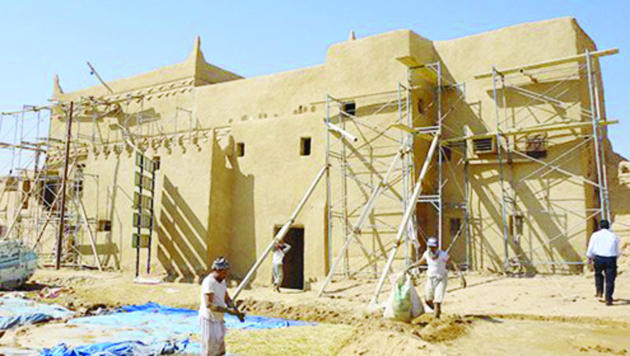
RIYADH: The National Urban Heritage Center (NUHC) is restoring four historic palaces in order to transform them into cultural and heritage centers which, besides hosting events, will also house museums to exhibit local culture and heritage, and promote domestic tourism.
Given by their owners to the Saudi Commission for Tourism and National Heritage, the SCTNH will use these historic palaces after restoration to house local museums and will periodically host cultural and heritage events for tourism purposes, which will help the local population with jobs, an SCTNH official said Thursday.
The donated mansions are Bin Raghoosh Palace in Al-Baha Province, Therban Palace in Al-Nammas municipality, Al-Asskar Palace in Al-Majm’a and Al-Rashid Palace in Al-Qassab.
The official pointed out that the restoration work is progressing at speed at all these palaces to transform them into significant landmarks in their respective regions.
He said that land survey and architectural documentation for the Bin Raghoosh Palace has been completed and all required schemes have been finalized in a way that is compatible with its architectural elements and local identity, including protecting the building’s existing elements, plus strengthening works on the foundation.
SCTNH President Prince Sultan bin Salman visited the palace to inspect the work in progress.
Moreover, the work at Therban Palace is ongoing, where the project consists of a number of heritage and architectural elements including a museum on Al-Nammas history, a heritage restaurant, handicraft and productive family’s souk, old mosque and celebration yards.
Prince Sultan visited the palace during the 4th Urban Heritage Forum in Asir in December 2013, during which he laid the foundation stone of the palace’s restoration project at a total cost of SR5 million.
The SCTNH recently concluded restoration of Al-Asskar Palace and studies related to its operation are underway.
The palace illustrates old Najdi architectural features and is considered one of the most famous palaces in the region which had been visited by King Abdul Aziz.
Al-Rashid Palace, which is located in Al-Qassab city, northwest of Riyadh, represents a tourist landmark that could be invested in for tourism and cultural purposes. Hence studies are underway by SCTNH.

Four historic palaces to be turned into heritage centers, museums
Saudi reserve given ‘dark sky’ listing in boost to astrotourism ambitions
- Imam Turki bin Abdullah Royal Reserve Development Authority announced on Monday that the desert received official accreditation from DarkSky International
RIYADH: Saudi Arabia’s Nafud Desert has been listed as one of more than 250 Dark Sky Sites worldwide, which authorities say marks a commitment to protecting the environment from light pollution.
Imam Turki bin Abdullah Royal Reserve Development Authority announced on Monday that the desert received official accreditation from DarkSky International, the global body committed to tackling light pollution in urban and rural areas.
Welcoming the accreditation, Ahmed Al-Qarni, official spokesperson at the royal reserve, told Arab News: “It’s a new achievement in the journey of protecting nature and astronomy in Saudi Arabia.
“The adoption of the Great Nafud Desert in Imam Turki bin Abdullah Royal Reserve by the International DarkSky Association, as the largest site in the Middle East, (represents) a culmination of a precise scientific path, and another step that enhances the Kingdom’s position as a leading destination in sustainability, nature protection, and astronomical tourism.”
Abouazza El-Mhamdi, associate professor in the physics and astronomy department at King Saud University’s College of Science, said that the announcement is a “a major achievement for both science and tourism.
“This accreditation protects the pristine night sky from light pollution, creating an invaluable natural laboratory for astronomers,” he added.
“It provides an ideal Saudi location for adequate Earth-based telescopes and is a prime candidate for detailed site surveys, enabling sensitive observations of stars and galaxies.
“At the same time, it establishes the reserve as a premier global destination for stargazing and astrotourism, supporting sustainable economic growth.”
The reserve development authority also posted on X: “Away from the clamor of the lights ... there is a darkness that shines.
“We are proud of the adoption of the Great Nafud Desert within the Imam Turki bin Abdullah Royal Reserve as one of the dark sky places certified by the DarkSky International.”
Located within the reserve east of the Hail-Al Jawf road, the Great Nafud Desert covers an area of about 13,416 sq. km, making it one of the largest accredited Dark Sky Sites in the region and one of the least light-polluted sites in the Kingdom, the Saudi Press Agency reported.
Fulfilling the organization’s criteria was the result of comprehensive scientific work that included field studies, precise astronomical observations, advanced nighttime analyses, and the implementation of specialized engineering practices for managing nighttime lighting and controlling light pollution sources.
These efforts, undertaken by the authority, are part of its commitment to protecting the desert’s natural nighttime landscapes, enhancing the sustainability of ecosystems and preparing the site to serve as a global model for preserving the natural sky.
CEO of the Imam Turki bin Abdullah Royal Reserve Development Authority, Engineer Mohammed Al-Shaalan, said in a statement that the accreditation is a culmination of the interest of the country’s leadership in the environment and the protection of natural sites.
It also reflects the support of Prince Turki bin Mohammed bin Fahd bin Abdulaziz, chairman of the authority’s board of directors, he added.
Al-Shaalan said that the accreditation represents a significant step that enhances the reserve’s presence on the international map and contributes to the development of astronomical tourism, scientific research, and specialized environmental experiments.
The area provides visitors and researchers with unique opportunities to observe the night sky and to monitor astronomical phenomena in a natural environment with low light pollution.
He added that the authority has developed tourism facilities in the desert such as “The Leaf” camp located near the dark sky zone.