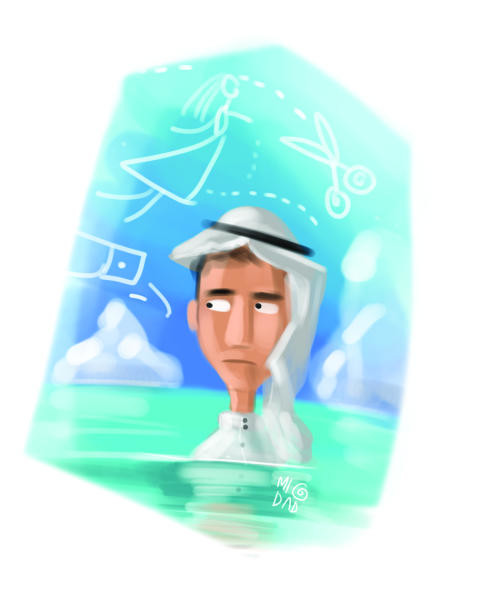
JEDDAH: Several Saudi men and women working as models want fellow citizens to understand that they are simply trying to earn a living, and that their jobs are not unlawful.
Wedyan Khaled, a woman model, said she had to face several problems because many people are opposed to what she is doing. “I have paid a high price. My fiancé left me the moment he heard I was a model,” she was quoted as saying recently in a local publication.
Khaled said she cannot understand why people react in this manner because she models abayas and is constantly surrounded by her women friends and colleagues, with no men around.
Two models, Samar Khayat and Raghdan Al-Ghamdi, said they have also faced several problems. “It is not easy for a woman model to find a husband, not to mention the negative manner in which society views the modeling profession. This is so even though fashion shows are in closed areas with only women allowed entry,” said Al-Ghamdi.
Mohammad Fuhmi, a model, said: “My work has been very successful so far. I first focused on my studies and got a master’s degree. Then I dedicated myself to modeling. I love this profession very much and I cannot imagine doing anything else.”
However, he said that models face many problems including companies refusing to pay them properly. This is because there are no laws regulating the industry, he said.
Mansour Jamal, a model, said there is an urgent need for laws to oversee the industry so that people are not exploited by individuals and companies. However, in response to a question on how he views women models, he said: “To be honest, I will never marry a model.”
Mohammad Fahmi, a fellow model, said he would under certain conditions. “If the woman only models decent clothes, in line with Arab tradition, I would probably marry her,” he said.
Fayez Al-Qahtani, a fashion photographer, said: “There is no doubt that people working in the modeling business face many difficulties. I have been detained and my camera was confiscated many times. But the biggest problem has been people denying us our rights. There is no regulatory body overseeing this work.”
Umaimah Azoz, a businesswoman and head of the committee for fashion design at the Jeddah Chamber of Commerce and Industry, said: “We should consider the issue from the financial side. Saudis spend a fortune on fashion, in fact I think we spend the most in the world.”
“This business generates huge profits that’s why we set up a committee which is helping industry players reach their goals.” Despite all these efforts, she added, the industry is still not properly regulated.
However, she said that measures are taken to abide by local customs. “We respect and abide by our Arab and Islamic traditions in terms of decency,” she said.

Saudi models seek ‘understanding’
Ziryab bridges Arab musical heritage with modern electronic sound
- Location and visual identity carry equal weight with audio elements in Ziryab’s content strategy, says co-founder
MAKKAH: Saudi Arabia’s music landscape is experiencing significant evolution as independent initiatives emerge to reshape how tradition intersects with contemporary styles, reflecting the Kingdom’s wider cultural renaissance.
Among these ventures, the Ziryab platform has distinguished itself as a Saudi musical project delivering modern artistic expressions rooted in Arab identity.
It is fusing heritage music with electronic rhythms while maintaining distinctly local elements in its sonic palette, visual aesthetic, and production locations.
Platform co-founder Abdulaziz Al-Aqeel, working alongside partners Abdullah Al-Aujan and Hamad Al-Aidhani, described how the project originated from a deep engagement with Arab identity as the essential foundation for any contemporary musical endeavor.
“This philosophical approach permeates the platform’s character and output, positioning music as a universal language capable of carrying local culture to international audiences without diluting its unique qualities.”
The platform’s namesake carries deliberate historical weight, Al-Aqeel explained.
Ziryab — the legendary Arab musician renowned for innovation and expanding art beyond conventional boundaries — embodies the project’s mission.
It presents Arab music through a modern lens that honors tradition while engaging with today’s global music conversation.
Merging Arab musical traditions with contemporary electronic production presented genuine challenges, Al-Aqeel acknowledged.
“The project encountered contrasting perspectives — some critics viewing the fusion as threatening authenticity, while others embraced it as creative exploration,” he said.
Rather than retreat, the team responded by refining their artistic approach while maintaining cultural identity as an unwavering cornerstone of every composition.
Modern technology has proven instrumental in advancing Ziryab’s musical production, Al-Aqeel said.
Digital tools enable sophisticated experimentation, seamlessly weaving traditional sounds into electronic frameworks while streamlining workflows and elevating production quality.
Yet throughout this technological integration, Saudi identity remains central through deliberate use of local rhythmic patterns, Arab maqamat scales, and traditional instrumental textures.
The outlook for heritage-electronic fusion music in Saudi Arabia appears exceptionally promising, Al-Aqeel said, citing support from the Music Commission and heightened emphasis on national identity within Saudi Vision 2030’s framework.
These factors have cultivated an ecosystem favorable to musical innovation and homegrown talent cultivation.
Ziryab has broadened its mission beyond pure performance to actively nurture emerging artists through the “Ziryab Community” initiative, Al-Aqeel said.
“The program empowers Saudi DJs to explore Arab sonic traditions and reinterpret them through contemporary production, providing professional filming sessions and promotional support.”
All video content has been captured at the family residence with technical assistance from Al-Aqeel’s father, a television cinematographer.
Location and visual identity carry equal weight with audio elements in Ziryab’s content strategy, Al-Aqeel stressed. The platform treats cinematography as music’s natural extension — an integral component of the complete artistic experience.
“Every aspect — from site selection and directorial choices to meticulous visual composition — works to communicate Saudi identity to viewers.”
This deliberate synthesis of sound and image represents a calculated strategy toward producing comprehensive musical content meeting international standards while preserving cultural authenticity, Al-Aqeel said.
The platform aspires to construct an audiovisual archive capturing a defining moment in Saudi Arabia’s contemporary music evolution.