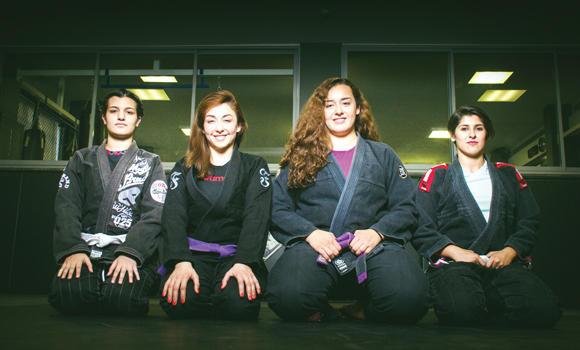
Representing one’s country in an international competition is an accomplishment in itself, but add on to that being the first woman to represent her country, and that is the situation Saudi Brazillian Jiu Jitsu (BJJ) practitioner Farah Al-Zahrani finds herself in. In April 2015, Al-Zahrani participated in Abu Dhabi’s World Professional Jiu Jitsu Champsionship, which was her first tournament. She qualified in the semi finals in her weight class; in addition she qualified in the open weight division. Now that she has experienced what she considers to be an achievement that she is extremely proud of at a prominent international tournament, she is eager to continue to participate in more such events in the future.
Born and raised in Jeddah, Al-Zahrani moved to Riyadh at the age of 7. When she was 13, she moved yet again, but to another country. This time, she moved to Amman, Jordan where she completed her high school education. Currently, she is 21-years-old, and is in her senior year of studying Political Science and International Relations at the University of Jordan. Al-Zahrani took the time from her busy schedule of studying and training to discuss her journey in BJJ so far and what it means to her.
What first drew you to Brazilian Jiu Jitsu?
I was first introduced to Jiu Jitsu through a friend. I was learning Tae-Kwon-Do at the time, and I was told that Jiu Jitsu is the most superior form of martial arts. I wasn’t very interested at first, but Jiu Jitsu kept finding its way back into my life. I took up a Kick Fit class, and my instructor — who is now my teammate — encouraged me to give Jiu Jitsu a chance. I could also see the Jiu Jitsu class in training from across the dojo, and I was struck by the grace of their movements. I think getting to watch them train day in and day out was what finally convinced me that this is something I should try.
How long have you been training now? Also, what motivates you?
I started back in 2012 but unfortunately had to stop after two months. I knew I had to continue at some point, but did not get the chance until the beginning of 2014. I have been fully committed since. What has especially motivated me is the Saudi community. I hope to inspire young Saudi women to be able to express themselves through sport. There is currently no existing platform for women to practice sport in Saudi Arabia outside of private gyms. We need professional women’s teams that allow them to participate in championships internationally. I hope to inspire the young women of Saudi Arabia to actively strive for this. I am optimistic however that this will not require many years to accomplish, since there are young Saudi Arabian women already trying to explore and expand their horizons in search for new ways of self expression, such as Adwa Al-Dakheel and Rotana Tarabzouni, who are breaking stereotypes and are not afraid to express themselves through art. And Jiu Jitsu, to me, is my art form of choice.
What has been the most challenging part of your training?
My size usually poses as a challenge since I am one of the smallest people in my dojo. However, this has proven to be beneficial in the long run, since I now appreciate the power of technique over size a lot more. This has also driven me to work much more on my physical strength, because if I encounter an opponent who is double or triple my weight, technique wouldn’t be enough on its own.
If you could train or spar with anyone, who would that be?
I am already training with who I believe to be one of the top teams in the world, The Source MMA under Fabricio International Team (FIT JIU JITSU). My head coach is Samy Al-Jamal, who is a 4th degree black belt. My teammates are world champions that I look up to, and I believe when you train with sharks you become one.
Who do you look up to? In other words, do you have a hero?
I thought long and hard about this question, and I eventually realized that I don’t have a specific hero. I do, however, admire certain qualities in people that I consider to be “heroic.” In this, I think of my father, and I think of my coach. I think of how they can focus all their energy into getting what they want and how that almost always results in success for them. I think of how they are always striving to be better, and how the word “average” does not enter their dictionary. Those are absolutely qualities that I look up to, that I think are heroic in nature.
Who are your biggest supporters?
My teammates and coach, as well as my family and friends of course! I am very lucky to have awesome teammates of girls who support and lift each other up. Communication is the key to having an open and safe atmosphere for training, and I am very grateful to be a part of that.
Which is more of a responsibility in your opinion: representing your country in a competition or demonstrating to young women how to follow their dreams?
In my case, these two are not mutually exclusive. I am very proud to be representing my country, and even more so because so few women get to do that in Saudi Arabia. This, I think, demonstrates greatly to all those young women over there that I want to inspire to follow their dreams, that everything is possible.
Farah Al-Zahrani is paving her way toward her dreams simultaneously making her country proud and leading a trail for young Saudi and Arab women to follow. Witness her practice self-expression as a dedicated athlete and BJJ practitioner on her Instagram account @thefoofster.
• [email protected]


![]()
![]()
![]()

Self-expression through Jiu Jitsu

Self-expression through Jiu Jitsu
Latest updates


© 2026 SAUDI RESEARCH & PUBLISHING COMPANY, All Rights Reserved And subject to Terms of Use Agreement.