The Art of Falconry’ is an exquisite book written by Patrick Morel, an eminent master falconer, renowned worldwide. With the help of enthusiastic colleagues, he succeeded in having the UNESCO declare falconry a living cultural heritage.
“Falconry, like food, music, literature and art, has its own unique culture which is part of our wider culture. Hawking is one of the only recreational activities that has survived today almost unchanged since the dawn of time; it has preserved its language, its gestures and its values and, consequently, has a special place in our cultural heritage,” explains Patrick Morel.
Falconry remains popular among Saudis who seek to revive an aspect of their Bedouin history. Falconry is practiced with passion and joy as it remains an important aspect of the region’s cultural heritage. Falconry in the Kingdom has changed the least from its origins because it is practiced in an environment untouched by agriculture or urban development. Falconry enthusiasts usually head to desert places during weekends to witness the raptors hunt for prey, a chase that can last for days.
Of all Middle Eastern states that practice falconry, Saudi Arabia is probably the last country to have preserved the original tradition of taking wild quarry with a wild hawk. In the past however, falcons were not used as a sport or a pastime but mainly to supplement a sparse diet. Traditionally, in Saudi Arabia, falconry begins with the capture of falcons during the migration season. This is an important ritual which is as important as the hunt itself. Preparation for the trapping season begins early in June and July with the capture or acquisition of falcons. The best raptors are wild falcons caught when they are a couple of years old to ensure they have naturally honed hunting skills. Many passionate falconers are ready to pay a high price ranging from SR25,000 up to SR250,000 and more for a rare breed. The majority of the falcons in Saudi Arabia are imported from the United States and Canada. The price is linked to the color and the size of the bird. Female falcons are considered the best because they are bigger and thus bring bigger prey.
Training a falcon requires time and patience but wild hawks are manned rapidly because Arab falconers live in the presence of their birds. The falcons are hooded and detained in a cool place and every afternoon, they make their entry in the majlis, a room where only the men meet. During these friendly gatherings, the falconers surrounded by family members and friends, stroke their birds on the chest, take off their hoods and replace them to greet a newcomer. Children are even encouraged to carry a falcon. Its talons gripped around a thick protective leather glove, the falcon looks proud and beautiful. In less than a week, these fierce and noble birds are familiar.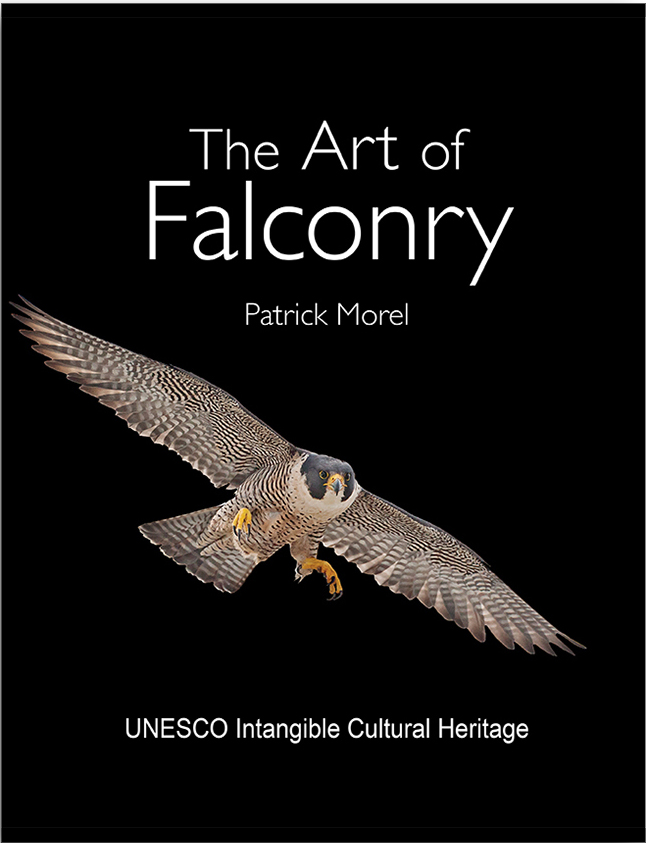
In mid-August, falconers begin training their birds in the desert.
The falcon is placed in a 4 x 4 whilst an assistant calls her from a distance to a lure consisting of pigeon wings. This exercise is repeated several times and when the falcon leaves immediately in the direction of the lure, followed by the car, he is ready for the next stage. The following day, the assistant will release a free pigeon, and whilst driving the falconer will unhood his bird. This is when the falcon shows off his hunting skills especially if the pigeon is able to select escape routes which lengthens the pursuit. It should be said that the quality of the pigeons is paramount for a successful training, therefore wild pigeons are preferably used. Once the falcon has spotted the movement of the pigeon, he flies with only one thought in mind. He gathers speed quickly rising high above the prey and then dives in to attack. Escape is futile.
By mid-September, the trained falcons are ready for their role in the capture of large falcons. Trapping follows a strict code of rules. The first one to spot a wild falcon turns on his car’s headlights to signal he has made a sighting. The remaining falconers will all come over to help. The falconer releases a pigeon which is attacked by the wild falcon. When the wild falcon starts plucking its prey, he unhoods his falcon which immediately flies toward the wild falcon. The latter upon spotting the intruder takes off instantly with its prey but most often this ends up in a short chase and the two raptors are found on the ground screeching and holding each other by their talons. The two falcons are immediately hooded. The trained falcon regains its perch in the car while the wild falcon is wrapped in a straightjacket keeping its wings closed.
A falcon caught is Saudi Arabia is highly regarded because it is assumed that it has traveled long distances, flown across deserts and mountains and captured varied prey. The captured bird spends from two days up to a week in a tent. An assistant takes care of it, frequently spraying it with fresh water. The wet feathers encourage her to calm down. In the evening, the falconer puts the falcon, always hooded, onto his fist; he caresses her chest while talking to her and then places a ready-plucked quail at her feet. A little later, the falcon will be unhooded, surprised the falcon will try and fly and will then regain its place on the fist and will be re-hooded. Only females are used in Arab falconry, and they are generally released at the end of the hunting season.
By the end of October or mid November, the wild falcons are ready to catch large prey and trained to return from any distance to a lure created by the rustling of dried bustard wings. An interesting fact is that the trained wild falcons know their name. Upon calling her name, the bird will bate to the end of her leash toward the falconer. This shows the amazing skills of the Arabian falconers who can train a wild raptor in such a short time. One of the reasons falcons are used for hunting is because they have such a remarkable vision. They are able to distinguish, even at considerable distances, the movements of the smallest prey as well as hidden birds which men cannot see. Falcons can see the movement of their victim from a distance of more than a mile. The resolution of the falcon’s retina is seven to eight times higher than that of man.
During the last forty years, the quality of falconry has increased on a global level. In the Arabian Peninsula, huge projects have been established to breed houbara bustards in captivity and restock houbara bustards in their natural habitats. The UAE funded the Emirates Center for Wildlife Propagation in Missour, eastern Morocco, which produced more than 20, 000 houbara bustards in 2014. This remarkable survival rate of released birds suggests a second wind for Arab Falconry.
This exquisite book highlights the Art of Falconry which promotes the sustainable use of the environment by its very practice. The stunning photographs and an engaging text celebrate the unique and fascinating relationship between a human and a free-flying hawk which has developed over several millennia and is still practiced in Saudi Arabia.


![]()

Falconry: An ancient tradition that is still flying high
Falconry: An ancient tradition that is still flying high
Latest updates


© 2026 SAUDI RESEARCH & PUBLISHING COMPANY, All Rights Reserved And subject to Terms of Use Agreement.