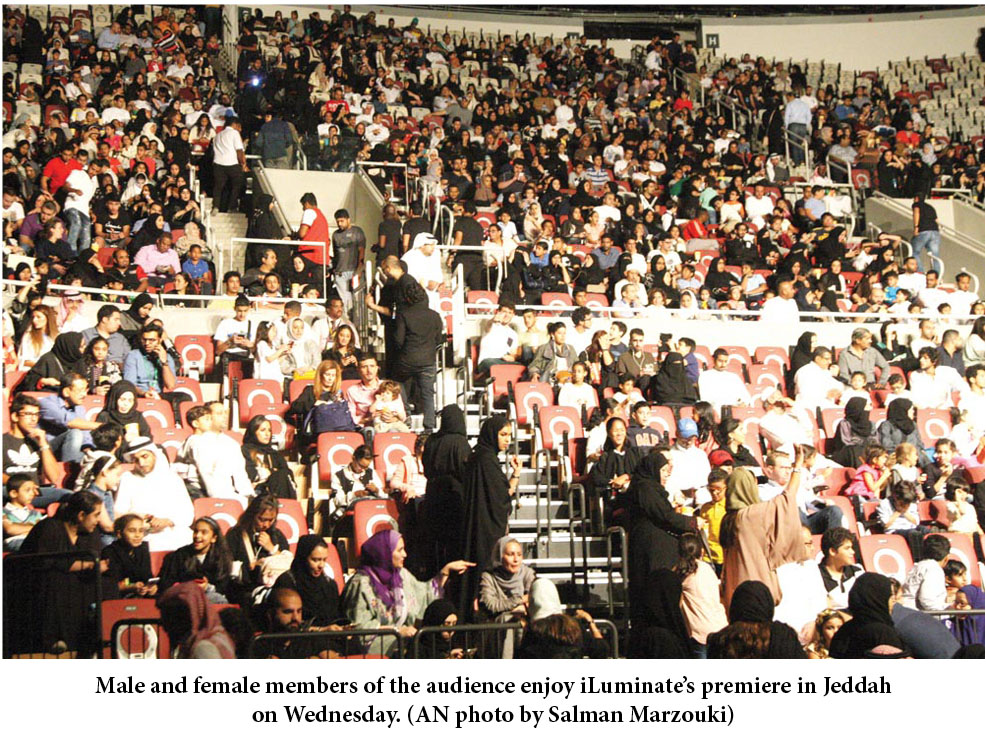
JEDDAH: It was a fabulous performance — one that left thousands of attendees mesmerized. The spectacular LED hit show from New York, “iLuminate,” kicked off at the King Abdullah Sports City with men, women and children sitting together and enjoying a dazzling show, full of music, dance moves and amazing special effects.
The show combined the latest technology and the best talents to create an exceptional experience in the field of performing arts.
Since its establishment a few months ago, the General Authority for Entertainment (GAE) has been working relentlessly to introduce the Saudi public to a new form of entertainment, one that takes Saudi cultural life to new dimensions.
With a view to changing local and international perceptions, a royal decree was issued which ordered the creation of GAE. The decree was very much in tune with the announcement of the Kingdom’s Vision 2030 for the future.
The show played to a packed conference hall at Riyadh’s Princess Nourah University from Sept. 28 to Oct. 8. It arrived in Jeddah on Wednesday and will run until Oct. 22.
Prominent among those who attended and enjoyed the premiere, and were given a red carpet welcome, were US Consul General Matthias J. Mitman, British Council Country Director Amir Ramzan, Saudi TV news anchor Weam Al-Dakheel and Inga Litvinsky and Gledisa Sanxhaku of the US Consulate in Jeddah and Arab News Editor in Chief Faisal J. Abbas.
US Consul General Matthias Mitman said: "What an illuminating show! US Consulate General staff is honored to have joined Arab News at the premiere of the New York-based iLuminate entertainment show here in Jeddah! It was a mesmerizing combination of technology and dance. It was great to be in the audience and enjoy the beautiful choreography, lights, and illusions."
“I am so honored to bring this show to Jeddah. The reaction we have received has been incredibly warm and welcoming,” said Miral Kotb, director of the dazzling show.
James Craven, managing director of Live Nation Middle East, said: “As part of our ongoing commitment to delivering the best of family entertainment in the region, Live Nation Middle East is proud to present iLuminate. We are working hard to showcase the highest quality entertainment and we look forward to sharing more in the near future.”
Speaking to Arab News, Fawaz Farooqui of GAE said: “We aim to change people’s perceptions of entertainment with these world-class shows.”
“This is the first time I have heard about iLuminate and I am very excited,” said Sarah Ahmed.
An American family was equally enthusiastic.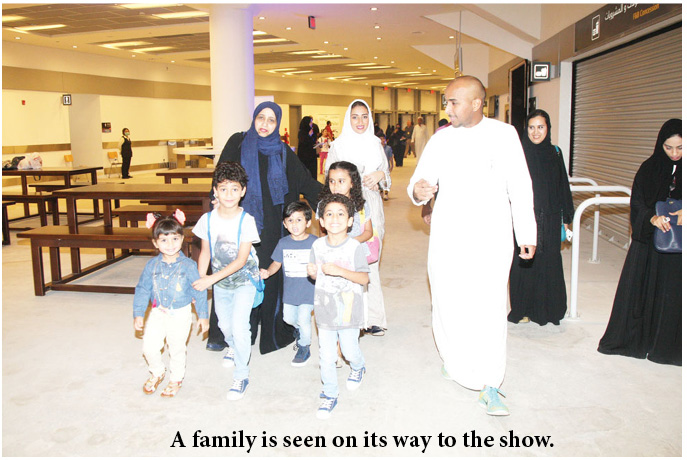
“I am looking forward to seeing them perform. I am familiar with iLuminate and they are great. It is wonderful to see them live, here in Jeddah,” said Trasey Eisel, an American mother of two.
“For a family-oriented society like this, such shows are good to attend with the entire family,” Eisel said.
“It is beautiful to see these kinds of events taking place in the Kingdom,” said Ohoud Al-Subaihi, a Saudi mother. “We don’t have to go abroad to see these shows; I brought my children to the show to enjoy and experience real entertainment.”
“What I loved most about this event is the fact that it is a family show so the children won’t have to choose where to sit! They won’t be torn between their parents,” she said.
“This is a new beginning and a good start,” said a Saudi woman. “I heard so much from my friends about this event, and this why I am here so I can enjoy myself.”
“I brought all my family members with me,” said Khaled Ramadan. “I am really impressed by the perfect organization. We enjoyed everything in this show from the beginning to the end. I think everyone should come and have fun.”
“I am really happy that we are seeing this new show in Saudi Arabia. It projects a new image of Saudi Arabia to the outside world,” a Saudi woman said.
“I have been living in Dubai for seven years. One of the reasons I enjoy being there is the shows they have. I am very excited that I am watching this entertainment here in my own Saudi Arabia,” said Yahya Shihabuddin, a Saudi youngster.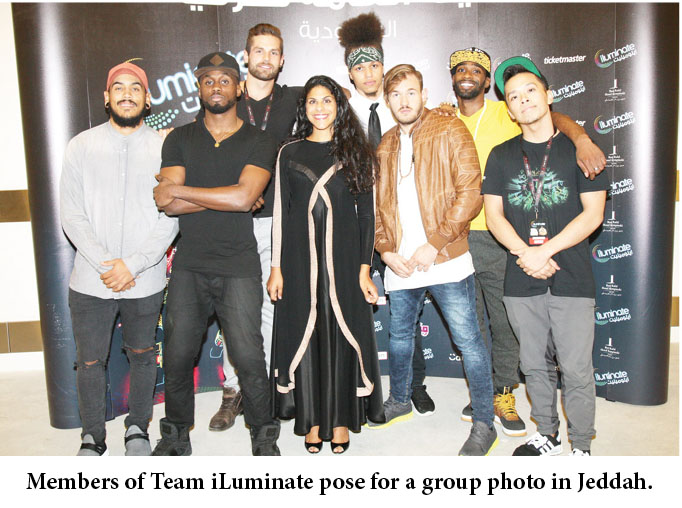
Speaking to Arab News earlier, Ziad Al-Suhaibani, a member of the GAE’s organizing team and an official at the advisory unit of the Ministry of Economy and Planning, said: “Our goal is to change the stereotypical image of the cultural entertainment that was previously available to the local audience. What is unique in these activities is that they are not catering to only one type of audience. We open the door to families as well as to young single Saudi men and women who can attend and enjoy.”
“Change is happening in Saudi Arabia. A new face of Saudi Arabia is emerging — one that is modern, young and open-minded,” he said. “Our goal is to link this change with Vision 2030; through entertainment we can help achieve the objectives of the vision,” he said.
Al-Suhaibani pointed out that the entertainment industry is a new field but customer experience of this event is world class; he stressed that the activities are in total harmony with the Kingdom’s Vision 2030.
“The concept of live shows is new to the Kingdom. I imagine this is the first international live show brought to the Kingdom,” he said.
GAE was created with several objectives in mind: decreasing the unemployment rate from 11.6 percent to 7 percent which is closer to the international figure; increasing domestic tourism in harmony with Saudi Vision 2030, and supporting local festivals and activities as tourism for entertainment purposes; activating the use of government funds to establish and develop entertainment centers; encouraging local and international investors to invest in Saudi Arabia and create partnerships; allocating lands for libraries and museums; and supporting talented writers, directors and actors.