French prosecutors seek trial for Sarkozy

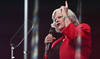
Former French President Nicolas Sarkozy. (AP)
Updated 05 September 2016
Follow

French prosecutors seek trial for Sarkozy

PARIS: Prosecutors have recommended that French ex-president Nicolas Sarkozy stand trial over alleged illegal campaign financing, legal sources said Monday, in a potentially major blow to his bid for re-election next year.
The 61-year-old Sarkozy, who was president from 2007-2012, had seen his poll ratings rise recently after taking a hard-line on Islam and immigration following a truck massacre in Nice in July which saw 86 people killed.
The campaign financing case, one of several investigations which have dogged Sarkozy since leaving office, involves allegedly false accounting used in 2012 to conceal campaign overspending by his office.
Sarkozy’s lawyer Thierry Herzog, reacting to news the prosecution had recommended a trial, dismissed the development as a “shoddy new political maneuver” that would not withstand scrutiny.
“Two years of investigation have shown (Sarkozy’s) total lack of involvement” in the affair, Herzog said in a statement.


An investigating magistrate must now decide whether to order a trial, with a decision possible as early as the end of this month — just as the right-wing Republicans party is preparing to choose its presidential candidate.
Sarkozy’s chief rival in the Republican primaries, set for November 20 and 27, is 71-year-old former premier and Bordeaux mayor Alain Juppe, who is seen as a moderate.
The outcome of France’s election in April and May next year is seen as difficult to forecast.
Socialist President Francois Hollande, suffering historically low ratings due to high unemployment and a string of terror attacks, is yet to say if he will seek re-election.
Both the Socialists and the Republicans, France’s traditional parties, have seen support steadily eroded by the far-right National Front and they might also face challenges from independents, such as former economy minister Emmanuel Macron.
Sarkozy has positioned himself on the right of the Republican party and has waded into a recent heated national debate over the burkini, speaking out in favor of a short-lived ban on the Muslim body-concealing swimsuit.


The campaign financing case hinges on the activity of public relations firm Bygmalion, which organized some of Sarkozy’s campaign appearances in 2012 in his doomed bid for a second term.
Bygmalion allegedly charged 18.5 million euros ($20.7 million) to Sarkozy’s party — then called the UMP, but since renamed The Republicans — instead of billing the president’s re-election campaign.
As a result, the campaign was able to greatly exceed a spending limit of 22.5 million euros, according to the prosecution.
There are 13 other potential defendants in the case including campaign officials and Bygmalion employees.
Bygmalion executives have acknowledged the existence of fraud and false billing, but no one has directly accused Sarkozy of having been aware or taken decisions about it.
However, the former president’s campaign director, Guillaume Lambert, has told police he warned Sarkozy of the risk of breaching financing limits.
Questioned by police in September 2015, Sarkozy said he did not remember the warning, and described the controversy as a “farce,” putting the responsibility squarely on Bygmalion and the UMP.
While the campaign financing case is currently the most pressing, Sarkozy has been fighting legal problems on several fronts.
He still faces accusations of conspiring with his lawyer to bribe a magistrate in exchange for inside information on a separate corruption probe.
In the most sensational case against him, Sarkozy was cleared in October 2013 of accepting campaign donations in 2007 from France’s richest woman, L’Oreal heiress Liliane Bettencourt, when she was too frail to know what she was doing.
The son of a Hungarian immigrant father, Sarkozy was nicknamed the “bling-bling” president for his flashy displays of wealth.
After his humiliating 2012 defeat by Hollande, Sarkozy famously promised that “you won’t hear about me anymore” before he embarked the international conference circuit.
Few observers were surprised though when he returned to frontline politics in 2014, standing for and winning the leadership of the then UMP.
arb-gd/adp


Trump says Iran ‘want to negotiate’ after reports of hundreds killed in protests

Updated 4 sec ago
Follow

Trump says Iran ‘want to negotiate’ after reports of hundreds killed in protests

  • US President Donald Trump said Sunday that Iran’s leadership had called him seeking “to negotiate” after he repeatedly threatened to intervene militarily if Tehran killed protesters
WASHINGTON: US President Donald Trump said Sunday that Iran’s leadership had called him seeking “to negotiate” after he repeatedly threatened to intervene militarily if Tehran killed protesters.
For two weeks, Iran has been rocked by a protest movement that has swelled in spite of a crackdown rights groups warn has become a “massacre.”
Initially sparked by anger over the rising cost of living, the demonstrations have evolved into a serious challenge of the theocratic system in place since the 1979 revolution.
Information has continued to trickle out of Iran despite a days-long Internet shutdown, with videos filtering out of capital Tehran and other cities over the past three nights showing large demonstrations.
As reports emerge of a growing protest death toll, and images show bodies piled outside a morgue, Trump said Tehran indicated its willingness to talk.
“The leaders of Iran called” yesterday, Trump told reporters aboard Air Force One, adding that “a meeting is being set up... They want to negotiate.”
He added, however, that “we may have to act before a meeting.”
The US-based Center for Human Rights in Iran (CHRI) said it had received “eyewitness accounts and credible reports indicating that hundreds of protesters have been killed across Iran during the current Internet shutdown.”
“A massacre is unfolding,” it said.
The Norway-based NGO Iran Human Rights (IHR) said it confirmed the killing of at least 192 protesters but that the actual toll could be much higher.
“Unverified reports indicate that at least several hundreds, and according to some sources, more than 2,000 people may have been killed,” said IHR.
More than 2,600 protesters have been arrested, IHR estimates.
A video circulating on Sunday showed dozens of bodies accumulating outside a morgue south of Tehran.
The footage, geolocated by AFP to Kahrizak, showed bodies wrapped in black bags, with what appeared to be grieving relatives searching for loved ones.
- Near paralysis -
In Tehran, an AFP journalist described a city in a state of near paralysis.
The price of meat has nearly doubled since the start of the protests, and many shops are closed. Those that do open must close at around 4:00 or 5:00 pm, when security forces deploy en masse.
There were fewer videos showing protests on social media Sunday, but it was not clear to what extent that was due to the Internet shutdown.
One widely shared video showed protesters again gathering in the Pounak district of Tehran shouting slogans in favor of the ousted monarchy.
The protests have become one of the biggest challenges to the rule of supreme leader Ayatollah Ali Khamenei, 86, coming in the wake of Israel’s 12-day war against the Islamic republic in June, which was backed by the United States.
State TV has aired images of burning buildings, including a mosque, as well as funeral processions for security personnel.
But after three days of mass actions, state outlets were at pains to present a picture of calm returning, broadcasting images of smooth-flowing traffic on Sunday. Tehran Governor Mohammad-Sadegh Motamedian insisted in televised comments that “the number of protests is decreasing.”
The Iranian government on Sunday declared three days of national mourning for “martyrs” including members of the security forces killed.
President Masoud Pezeshkian also urged Iranians to join a “national resistance march” Monday to denounce the violence.
In response to Trump’s repeated threats to intervene, Iran’s parliament speaker Mohammad Bagher Ghalibaf said Iran would hit back, calling US military and shipping “legitimate targets” in comments broadcast by state TV.
- ‘Stand with the people’ -
Reza Pahlavi, the US-based son of Iran’s ousted shah, who has emerged as an anti-government figurehead, said he was prepared to return to the country and lead a democratic transition.
“I’m already planning on that,” he told Fox News on Sunday.
He later urged Iran’s security forces and government workers to join the demonstrators.
“Employees of state institutions, as well as members of the armed and security forces, have a choice: stand with the people and become allies of the nation, or choose complicity with the murderers of the people,” he said in a social media post.
He also urged protesters to replace the flags outside of Iranian embassies.
“The time has come for them to be adorned with Iran’s national flag,” he said.
The ceremonial, pre-revolution flag has become an emblem of the global rallies that have mushroomed in support of Iran’s demonstrators.
In London, protesters managed over the weekend to swap out the Iranian embassy flag, hoisting in its place the tri-colored banner used under the last shah.