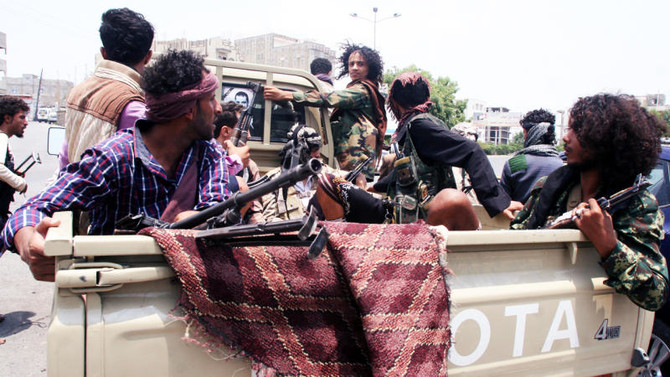
JEDDAH: The Saudi-led coalition’s Apache helicopters attacked several Houthi targets on Thursday, killing 64 Iran-backed rebels. A number of them were arrested and their weapons seized.
The coalition said it lured the Houthis to attack some border areas near Najran before targeting them.
On Friday, Houthi shelling injured five expats in Tawal, Jazan, according to the Civil Defense. This followed Thursday’s Saudi military action.
Meanwhile, the coalition expressed deep regret over a decision by Medecins Sans Frontieres (MSF) to evacuate staff from northern Yemen and said it was trying to set up “urgent meetings” with the medical aid group.
MSF said on Thursday it was evacuating its staff from six hospitals in northern Yemen.
“The coalition to support the legitimacy in Yemen expresses its deep regret over MSF decision to evacuate its staff from six hospitals in northern Yemen and asserts its appreciation for the work the group is undertaking with the Yemeni people in these difficult circumstances,” the coalition said in a statement to SPA.
The coalition said it was committed to respecting international humanitarian law in all its operations in Yemen and had set up an independent team to investigate incidents in which civilians are killed.
“The coalition is seeking to hold urgent meetings with MSF to find a way on how to jointly find a solution to this situation,” the statement said.
Separately, in the besieged city of Taiz, an eastern neighborhood, which includes a military camp, was liberated on Friday from the Houthi militia, a resident and a TV correspondent reported.
Forces loyal to the internationally recognized government of President Abed Rabbo Mansour Hadi with backing from the coalition freed Sala neighborhood, Mohamed Al-Muntasir, a local resident, said.
Al-Muntasir said the advancement of Yemeni forces has been slow due to density of population and the mountainous terrain.
In another development, Othman Majli, Yemen’s minister of state for parliamentary affairs and Shoura council, told the media that Sanaa, which the rebels seized in a 2014 coup, has fallen militarily.
Majli said tribal elders and local leaders have started siding with the legitimate government amid battles.

MSF leaving Yemen ‘unhelpful’
Riyadh emerges as Gulf evacuation hub for wealthy amid regional escalation
- Saudi capital’s King Khalid International Airport is among the few major airports in the region still operating normally after Iranian missile and drone strikes
RIYADH: Riyadh has become a principal evacuation hub for wealthy residents and senior executives seeking to leave the Gulf amid escalating regional tensions, according to a report by Semafor.
The Saudi capital’s King Khalid International Airport is among the few major airports in the region still operating normally after Iranian missile and drone strikes targeted cities including Dubai and Abu Dhabi over the weekend, as well as locations in Qatar and Bahrain.
With airspace closures elsewhere, stranded executives and high-net-worth individuals have been travelling overland to Riyadh, in some cases undertaking a roughly 10-hour journey from Dubai, in order to board private or commercial flights out of the region.
Citing people familiar with the arrangements, Semafor reported that private security firms have been hiring fleets of SUVs to transport clients to the Saudi capital before arranging chartered aircraft departures.
Those being evacuated include senior figures at global financial institutions as well as affluent individuals who had been in the Gulf for business or leisure.
The surge in demand has sharply increased costs.
Ameerh Naran, chief executive of private jet brokerage Vimana Private, told Semafor that Riyadh is currently “the only real option” for those seeking to exit the region, with private jet charters from the Saudi capital to Europe reaching as much as $350,000.
Alternative routes have narrowed. Security providers initially explored using Oman as an exit corridor, but that option became unviable after reported Iranian strikes on the country’s port infrastructure and a tanker, leaving Riyadh as the most accessible transit point, the report said.
Riyadh’s role marks a notable shift in regional risk perception. In previous years, security concerns — including cross-border Houthi attacks during the Yemen conflict and earlier periods of regional instability — had led many expatriates and business leaders to favour other Gulf cities as transit hubs.
However, Saudi Arabia’s more flexible visa regime, which now allows many nationalities to obtain visas on arrival, combined with the kingdom’s ability so far to keep its airspace open, has reinforced its position as a temporary gateway out of the region.
While some schools have moved to remote learning and certain companies have advised staff to work from home, Semafor reported that daily life in Riyadh has largely continued uninterrupted compared with other Gulf cities that have faced direct attacks.