Iraq MPs vote to fire speaker

Updated 14 April 2016
Follow

Iraq MPs vote to fire speaker

BAGHDAD: Iraqi lawmakers voted Thursday to remove the Parliament speaker and his deputies from office, increasing political turmoil as the country battles radicals and struggles with a financial crisis.

The chaos at Parliament is a significant setback for Prime Minister Haider Al-Abadi, overshadowing his efforts to replace the current Cabinet and preventing nominees from being brought to a vote.
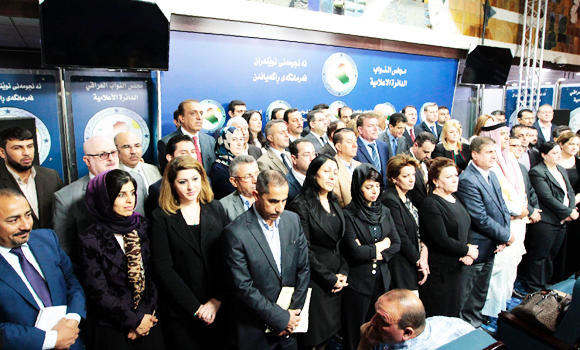
The turmoil has escalated over three successive sessions this week: the first ended in a sit-in, the second with a fistfight among lawmakers, and the third with the vote to remove parliament speaker Salim Al-Juburi.
Juburi, one of the country’s leading Sunni Arab politicians, issued a statement saying that the session, which he did not attend, was unconstitutional and that the required quorum was not reached.
The session held “in the absence of the presidency of parliament is unconstitutional and lacked the necessary quorum,” the statement said.
But Niyazi Oghlu, the official responsible for taking roll at parliament, put the number of lawmakers present at 173, while two lawmakers also said more than 170 attended.
The main Sunni bloc condemned the effort to remove Juburi.
“These calls will lead to the end of the concept of political partnership and the principle of consensus on which the political process was based,” it said in a statement read out by MP Ahmed Al-Misari.
Abadi has called for the party-affiliated Cabinet to be replaced by a government of technocrats, but has faced significant resistance from the powerful parties that rely on control of ministries for patronage and funds.
An “emergency” session on Wednesday ended with lawmakers shouting, shoving and throwing punches in the Parliament hall, leading Juburi to call a recess.
The speaker’s office said earlier in the day that Abadi was to give a revised list of nominees to Parliament on Thursday, but the move to sack Juburi stole the spotlight instead.
Abadi presented a first list of Cabinet nominees at the end of March, but the political blocs put forward their own candidates, and most of the premier’s original list was replaced on a second presented to MPs on Tuesday.
Some MPs demanded the opportunity to vote on Abadi’s original list — from which at least two candidates had already withdrawn — but the session was adjourned Tuesday without a vote.
Dozens of lawmakers then began a sit-in and spent the night at Parliament.
Iraqi ministries have for years been shared out between powerful political parties that run them as their personal fiefdoms, relying on them for patronage and funds.
But even if the current Cabinet line-up is replaced with independent, technocratic ministers — a change that faces major obstacles — that would only be the beginning of the process.


Trump claims Iran working on missiles that could hit US

Updated 42 min 42 sec ago
Follow

Trump claims Iran working on missiles that could hit US

  • Trump says his preference is diplomacy, but would never allow Tehran to have a nuclear weapon

WASHINGTON: US President Donald Trump on Tuesday claimed Iran is seeking to develop missiles that can strike the United States and accused Tehran of working to rebuild a nuclear program that was targeted by American strikes last year.

The United States and Iran are engaged in high-stakes negotiations over Iran’s atomic program and other issues including missiles, with Trump saying he prefers diplomacy but is willing to use force if talks fail.

“They’ve already developed missiles that can threaten Europe and our bases overseas, and they’re working to build missiles that will soon reach the United States of America,” Trump said during his State of the Union address.

In 2025, the US Defense Intelligence Agency said Iran could potentially develop a militarily viable intercontinental ballistic missile by 2035 “should Tehran decide to pursue the capability,” but did not say if it had made such a decision.

Tehran currently possesses short- and medium-range ballistic missiles with ranges that top out at about 1,850 miles (3,000 kilometers), according to the US Congressional Research Service.

The continental United States is more than 6,000 miles from Iran’s western tip.

Washington and Tehran have concluded two rounds of talks aimed at reaching a deal on Iran’s nuclear program to replace the agreement that Trump tore up during his first term in office.

 ‘Preference’ is diplomacy

The United States has repeatedly called for zero uranium enrichment by Iran but has also sought to address its ballistic missile program and support for armed groups in the region — demands Iran has rejected.

Iran has also repeatedly rejected that it is pursuing nuclear weapons.

Trump ordered strikes on three Iranian nuclear sites last year, claiming afterward that Tehran’s atomic program was obliterated.

On Tuesday, he said Iran wants “to start all over again,” and that it is “at this moment again pursuing their sinister nuclear ambitions.”

Trump has sent a massive US military force to the Middle East, deploying two aircraft carriers as well as more than a dozen other ships, a large number of warplanes and other assets to the region.

He has repeatedly threatened to strike Iran if negotiations fail to reach a new agreement. Talks with Tehran are currently set to continue on Thursday.

“My preference is to solve this problem through diplomacy but one thing is certain: I will never allow the world’s number one sponsor of terror, which they are by far, to have a nuclear weapon,” Trump said.

The US president’s speech primarily focused on domestic issues, making no mention at all of China — Washington’s primary military and economic rival — and only briefly referring to Russia.

Trump said he was working to end the bloody conflict between Russia and Ukraine, and repeated his inaccurate claim that he had brought eight other wars to an end since returning to office in January 2025.

He also hailed NATO’s decision to spend five percent of gross domestic product on defense — a move made under heavy pressure from Trump and his administration.