BRUSSELS: Belgium launched a huge manhunt Tuesday after a series of bombings claimed by the Daesh group ripped through Brussels airport and a metro train, killing around 35 people in the latest attack to bring carnage to the heart of Europe.
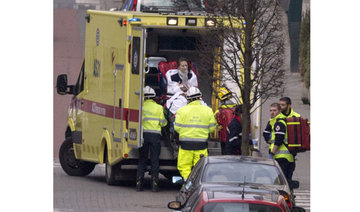
Two huge blasts, both possibly caused by a suicide bomber, hit the check-in hall at Zaventem Airport, strewing the scene with blood and mangled bodies and sending hundreds of terrified travelers fleeing in terror.
Belgian authorities released pictures of two of the suspected suicide attackers pushing trollies through the terminal and said they were “actively searching” for a third whose bomb failed to go off.
The fact that extremists were able to hit high-profile targets in Brussels, Europe’s symbolic capital, just months after IS militants killed 130 people in Paris, will raise fresh questions about the continent’s ability to cope with the terror threat.
It also underscores doubts about how Belgium has allowed extremism to develop unchecked, coming just four days after the dramatic arrest in Brussels of key Paris suspect Salah Abdeslam after four months on the run.
“This is a day of tragedy, a black day,” Belgian Prime Minister Charles Michel said and announced three days of national mourning after the “deadliest attacks we have ever seen in Belgium.”
Belgian King Philippe condemned the “cowardly and odious” assault.
The Islamic State claimed the bombings, saying “soldiers of the caliphate” had carried out the attack against “the crusader state” of Belgium.
'We won't be cowed'
Hundreds of flights and trains were canceled Tuesday as security across Europe was tightened after the bombings, which Michel branded “blind, violent and cowardly.”
But he insisted Belgium would not be cowed.
“People were just going to work, to school and they have been cut down by the most extreme barbarity,” Michel told a news conference. “We will continue to protect liberty, our way of life.”
About an hour after the airport blasts at around 8 a.m. (0700 GMT), a third explosion rocked Maalbeek metro station, in the heart of the city’s EU quarter, just as commuters were making their way to work.
The city is the headquarters of both NATO and the European Union.
Belgian authorities published surveillance camera images showing three male suspects pushing trollies with suitcases past the check-in area. Two have dark hair and were both wearing a glove on only one hand, and a third, being hunted by Belgian police, is wearing a hat and a white coat.
Several raids were also under way across Belgium, the federal prosecutor said, adding that a bomb, an Islamic State flag and chemicals had been found in one apartment.
Belgian authorities had been on alert after Abdeslam, Europe’s most wanted man, told investigators he had been planning an attack on Brussels.
Pierre Meys, spokesman for the Brussels fire brigade, told AFP at least 14 people had been killed at the airport, while Brussels mayor Yvan Mayeur said “around 20” died in the metro blast.
Witnesses described horrific scenes at the airport, with victims lying in pools of blood, their limbs blown off.
There were chaotic scenes as passengers fled in panic, and plumes of dark smoke could be seen rising from holes punched through the roof of the building by the blasts.
“A man shouted a few words in Arabic and then I heard a huge blast,” airport baggage security officer Alphonse Lyoura told AFP, his hands bloodied.
“A lot of people lost limbs. One man had lost both legs and there was a policeman with a totally mangled leg.”
An army team later blew up a third unexploded suspect package at the shuttered airport.
'An attack on entire Europe'
At Maalbeek station, paramedics tended to commuters with bloodied faces as the city’s normally peaceful streets filled with the wailing of sirens.
Airports across Europe swiftly announced they were boosting security, while across the Atlantic, New York and Washington ordered security personnel to crowded areas and train stations.
Leaders across Europe reacted with outrage, urging closer counter-terror cooperation on a continent that has been on high alert for months.
The 28 EU leaders issued a rare joint statement saying they would combat terrorism “with all necessary means” after what they called “an attack on our open democratic society.”
“The whole of Europe has been hit,” said French President Francois Hollande, whose country is still reeling from November’s attacks.
British Prime Minister David Cameron warned of the “very real” terrorist threat faced by countries across Europe, declaring: “We will never left these terrorists win.”
US President Barack Obama said Washington stood with Belgium in the face of the “outrageous” attacks while UN chief Ban Ki-moon said those responsible for the “despicable” bombings” should face justice.
Russia and Turkey — also targets of deadly attacks in the last eight months — said the blasts highlighted the need to fight terrorism of every hue and across all borders.
Security was beefed up at Belgium’s nuclear plants and at EU buildings in the French city of Strasbourg, home to the European Parliament.
Interior Minister Jan Jambon announced that Belgium’s terror threat had been raised from three to a maximum of four.
Messages of solidarity poured out on social media, with thousands of people sharing images of beloved Belgian cartoon character Tintin in tears.
It has been a week of drama in Brussels. Last Tuesday saw a shootout in the city’s south that saw a Kalashnikov-wielding man killed and four police officers wounded.
Investigators believe Abdeslam slipped out of the apartment as the gunbattle erupted. He was arrested three days later in Brussels’ gritty Molenbeek district — just around the corner from his family home.
Foreign Minister Reynders said at the weekend that Abdeslam — believed to have played a key logistical role in the Paris carnage — had told investigators he was planning some sort of new attack in Brussels.
Shiraz Maher, a radicalization expert at Kings College London, said it was “very likely that this attack will have been planned and prepared well in advance of last week’s arrest of Salah Abdeslam” and pointed to a much larger network.
RELATED STORIES:
• Many dead in bombings of Brussels airport, metro