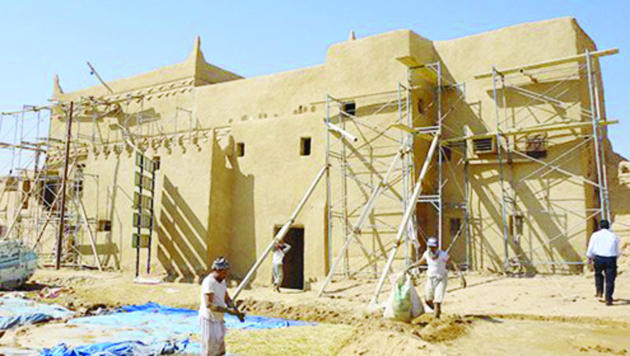
RIYADH: The National Urban Heritage Center (NUHC) is restoring four historic palaces in order to transform them into cultural and heritage centers which, besides hosting events, will also house museums to exhibit local culture and heritage, and promote domestic tourism.
Given by their owners to the Saudi Commission for Tourism and National Heritage, the SCTNH will use these historic palaces after restoration to house local museums and will periodically host cultural and heritage events for tourism purposes, which will help the local population with jobs, an SCTNH official said Thursday.
The donated mansions are Bin Raghoosh Palace in Al-Baha Province, Therban Palace in Al-Nammas municipality, Al-Asskar Palace in Al-Majm’a and Al-Rashid Palace in Al-Qassab.
The official pointed out that the restoration work is progressing at speed at all these palaces to transform them into significant landmarks in their respective regions.
He said that land survey and architectural documentation for the Bin Raghoosh Palace has been completed and all required schemes have been finalized in a way that is compatible with its architectural elements and local identity, including protecting the building’s existing elements, plus strengthening works on the foundation.
SCTNH President Prince Sultan bin Salman visited the palace to inspect the work in progress.
Moreover, the work at Therban Palace is ongoing, where the project consists of a number of heritage and architectural elements including a museum on Al-Nammas history, a heritage restaurant, handicraft and productive family’s souk, old mosque and celebration yards.
Prince Sultan visited the palace during the 4th Urban Heritage Forum in Asir in December 2013, during which he laid the foundation stone of the palace’s restoration project at a total cost of SR5 million.
The SCTNH recently concluded restoration of Al-Asskar Palace and studies related to its operation are underway.
The palace illustrates old Najdi architectural features and is considered one of the most famous palaces in the region which had been visited by King Abdul Aziz.
Al-Rashid Palace, which is located in Al-Qassab city, northwest of Riyadh, represents a tourist landmark that could be invested in for tourism and cultural purposes. Hence studies are underway by SCTNH.

Four historic palaces to be turned into heritage centers, museums
Surviving the sands: The battle to save Arabian wolves
- Exploring the wolf’s role in Arabia’s heritage and ecosystem
RIYADH: Wolves are often portrayed in Western stories and films as dangerous, unpredictable predators. In contrast, Arabic perspectives offer a more nuanced view.
In Saudi Arabia, wolves are admired for their resilience, intelligence, and role in the natural environment. The Arabian wolf, or Canis lupus arabs, is one of the Peninsula’s iconic native predators.
For centuries, it shaped both ecological and cultural landscapes across Saudi Arabia. However, its population declined in recent decades. Today, conservation efforts led by the National Center for Wildlife aim to protect and restore this species.
Saudi regulations now make it illegal to display, sell, or transport wolves without authorization. NCW’s initiatives include studying wolf genetics, developing breeding programs to restore wild populations, raising public awareness, and imposing fines of up to SR80,000 ($22,000) for unlicensed hunters.
The Arabian wolf is a symbol of the desert and an important component of the Kingdom’s biodiversity. Historically, it inhabited deserts, mountains, and valleys across Saudi Arabia, Yemen, and Oman. Unlike wolves from colder regions, it evolved to survive extreme heat, scarce water, and fluctuating prey populations.
“Saudi Arabia’s vast and diverse ecosystems have enabled many wildlife species to thrive, including the Arabian wolf,” NCW notes. The wolf historically helped control populations of rodents, small mammals, and weak or diseased animals, maintaining a balanced ecosystem.
However, the shift from nomadic life to urban settlements and agriculture, alongside expanding human activity, put increasing pressure on the species.
Habitat loss, conflicts with herders, and hunting practices significantly reduced their natural range. NCW records show numerous cases of injured wolves rescued and rehabilitated, highlighting the challenges they face today.
DID YOU KNOW?
• In Saudi Arabia, hunting wolves without a proper license can result in fines of up to SR80,000.
• Mexican wolves, locally known as ‘El Lobo,’ are critically endangered, despite ongoing reintroduction efforts.
• While recent figures for Saudi Arabia’s wolf population are not available, a 2004 report estimated their numbers at 500-600.
Culturally, the Arabian wolf is admired and feared in equal measure. In Bedouin tradition, it symbolizes independence and intelligence, appearing in poetry and oral stories.
“Two cultures in the world share a similar view of the wolf: Native American and Arab cultures,” said Obaid Alouni, a Saudi environmentalist. “They admired wolves and respected wolves. For example, when they see a wolf and someone has a gun, they don’t kill it even though they could,” he added.
Alouni explained that despite being predators, wolves coexisted with humans in the Arabian Peninsula: “There was a kind of coexistence in the Arabian Peninsula.” Yet livestock owners often feared wolves for preying on sheep and goats, creating a tense relationship between humans and wolves.
This dual perception shaped the wolf’s role in cultural metaphors: it was seen as a mirror of the desert itself — tough, resilient, and adaptable. “Arabs have always sought positive qualities in wolves. For example, one of their characteristics is that wolves understand their pack and sacrifice themselves for them. They do not betray their pack and fight for it, in addition to their loyalty to it,” Alouni explained.
Physically, the Arabian wolf is one of the smallest gray wolf subspecies, adapted to desert life. It weighs 18-25 kilograms and measures 100-110 cm in length. Its large ears reduce heat, a light sandy-gray coat reflects sunlight and camouflages it in the desert, and its diet includes small mammals, birds, and occasionally livestock.
Sadly, the Arabian wolf is classified as endangered due to habitat loss, human conflict, and historical hunting. Alouni noted that hybridization has further reduced the population of purebred Arabian wolves: “Unfortunately, a species is now being circulated that is not the true size of the Arabian wolf. The National Center for Wildlife is currently conducting extensive research to learn more about the Arabian wolf and its true size. The species currently prevalent is shorter in stature.”
Other wolf subspecies include the Gray Wolf, found in North America, Europe, and Asia. It weighs 30–80 kilograms, measures up to 180 cm in length, and is known for its complex social packs.
Opinion
This section contains relevant reference points, placed in (Opinion field)
The Arctic Wolf, native to Arctic Canada and Greenland, has a thick white coat, short snout and ears, and survives extreme cold, preying on musk oxen, Arctic hares, and caribou.
The Indian Wolf, scientifically known as Canis lupus pallipes, inhabits South and West Asia, weighs 20-30 kilograms, and forms small, stealthy packs.
Finally, the Ethiopian wolf is fox-like, inhabits highlands above 3,000 meters, weighs 13–18 kilograms, and has a reddish coat with white markings. It is one of the world’s rarest wolves, with fewer than 500 individuals in the wild.

Protecting wolves is crucial for maintaining healthy ecosystems. As apex predators, they regulate prey populations, prevent overgrazing, maintain plant diversity, and reduce disease spread by feeding on sick or weak animals. Their presence influences herbivore behavior, supporting a balanced environment.
The Arabian wolf is more than a desert predator. It is a cultural symbol, a survivor of harsh landscapes, and a vital component of Saudi Arabia’s ecological identity. The work of the NCW is essential: protecting the Arabian wolf means conserving biodiversity, preserving heritage, and sustaining ecological systems across the Arabian Peninsula.