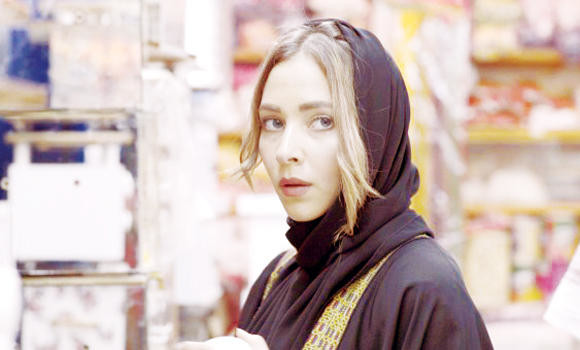
BERLIN: ‘Barakah yoqabil Barakah’ (Barakah Meets Barakah), a quirky Saudi comedy made by young independent filmmakers from Jeddah, which debuted at this year’s Berlin Film Festival, generated a lot of buzz with its first international screening attracting a sold-out crowd.
It is one of the 18 films that have been nominated for the Best First Feature Award at the Berlinale.
The film follows an amateur actor in a theater company and an adopted daughter of a rich couple, as they try to navigate their relationship.
Mahmoud Sabbagh, the director of the film, told Al Jazeera that the movie is a “love story and in the background there is the story of the city and of public space.”
The film casts Hisham Fageeh, Fatima AlBanawi and Sami Hifny in lead roles.
The young Saudi team behind the movie financed it themselves and the entire film was shot inside Saudi Arabia.
“When I was in character, people would see me and they wouldn’t see Bibi [the character]. They would see me, Fatima and ask me what I was doing, so I had to deal with that,” Fatima Al-Banawi, the leading female character of the film, told Al Jazeera.
Barakah Meets Barakah, which got a great reaction from the Berlin audience, shows traditional Saudi culture in a positive light.
Tthe film gives an insightful look into a time and place where tradition clashes with the modern world of smartphones and social-media. Featuring breakout performances from Fageeh and Al-Banawi the film marks an inspiring debut by first-time feature writer/director Sabbagh.
The director and the actors said they hope they will inspire other filmmakers to follow in their footsteps.
The Saudi film is not the only Arab contender at the festival.
This year, a love story set against the aftermath of Tunisia’s watershed revolution kicked off the competition at the Berlin film festival Friday as the first Arab-produced contender in two decades.
Hailing from the North African country that triggered the Arab Spring, “Hedi” is the debut feature-length film of Tunisian filmmaker Mohamed Ben Attia.
It is the first Arab production set in the Arab world since 1996 to vie for prizes at Europe’s first major cinema showcase of the year, a festival spokeswoman said.

Saudi comedy impresses at Berlinale
Cambodia takes back looted historic artifacts handled by British art dealer
- The objects were returned under a 2020 agreement between the Ministry of Culture and Fine Arts and the family of the late Douglas Latchford, a British art collector and dealer who allegedly had the items smuggled out of Cambodia
PHNOM PENH, Cambodia: Cambodian officials on Friday received more than six dozen historic artifacts described as part of the country’s cultural heritage that had been looted during decades of war and instability.
At a ceremony attended by Deputy Prime Minister Hun Many, the 74 items were unveiled at the National Museum in Phnom Penh after their repatriation from the United Kingdom.
The objects were returned under a 2020 agreement between the Ministry of Culture and Fine Arts and the family of the late Douglas Latchford, a British art collector and dealer who allegedly had the items smuggled out of Cambodia.
“This substantial restitution represents one of the most important returns of Khmer cultural heritage in recent years, following major repatriations in 2021 and 2023 from the same collection,” the Culture Ministry said in a statement. “It marks a significant step forward in Cambodia’s continued efforts to recover, preserve, and restore its ancestral legacy for future generations.”
The artifacts were described as dating from the pre-Angkorian period through the height of the Angkor Empire, including “monumental sandstone sculptures, refined bronze works, and significant ritual objects.” The Angkor Empire, which extended from the ninth to the 15th century, is best known for the Angkor Wat archaeological site, the nation’s biggest tourist attraction.
Latchford was a prominent antiquities dealer who allegedly orchestrated an operation to sell looted Cambodian sculptures on the international market.
From 1970 to the 1980s, during Cambodia’s civil wars and the communist Khmer Rouge ‘s brutal reign, organized looting networks sent artifacts to Latchford, who then sold them to Western collectors, dealers, and institutions. These pieces were often physically damaged, having been pried off temple walls or other structures by the looters.
Latchford was indicted in a New York federal court in 2019 on charges including wire fraud and conspiracy. He died in 2020, aged 88, before he could be extradited to face charges.
Cambodia, like neighboring Thailand, has benefited from a trend in recent decades involving the repatriation of art and archaeological treasures. These include ancient Asian artworks as well as pieces lost or stolen during turmoil in places such as Syria, Iraq and Nazi-occupied Europe. New York’s Metropolitan Museum of Art is one of the prominent institutions that has been returning illegally smuggled art, including to Cambodia.
“The ancient artifacts created and preserved by our ancestors are now being returned to Cambodia, bringing warmth and joy, following the country’s return to peace,” said Hun Many, who is the younger brother of Prime Minister Hun Manet.