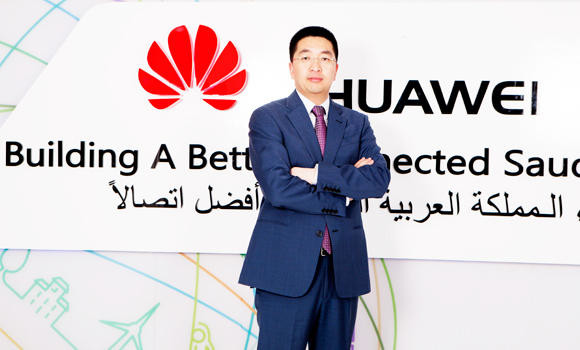
RIYDAH: For several years, Saudi Arabia has been an early adopter of new technology, and today the ICT sector has become a key enabler for Saudi Arabia’s transition to a digital and more diverse economy. If one looks at projects like King Abdullah Economic City and the numerous other smart cities under planning and construction, it is clear that ICT infrastructure will have the ability to foster social development and improve people’s lives.
Businesses in the Kingdom are already active in transitioning to this digital industrial era. According to Huawei’s latest Global Connectivity Index, last year Saudi Arabia was ranked 19th globally in terms of creating a competitive market, affordable services and excellent quality of service, thanks to the country’s significant investment in ICT. These investments are driving the upgrade of nearly all traditional industries in the Kingdom.
As Saudi Arabia’s leadership pushes forward efforts to diversify the national economy, enterprises in financial services, tourism and real estate in particular will be able to use ICT advancements to strengthen their information-analysis capabilities, enhance collaboration, and launch new products into the market in a better and faster way. Solutions that drive cost efficiency and flexibility are expected to see strong demand from local enterprises.
Saudi Arabia is not only a strategic hub between the worlds of trade, finance and energy. Government leaders and authorities such as Saudi Arabia General Investment Authority (SAGIA) are committed to creating a more technology-focused economy, unveiling ambitious investment plans across key sectors. At Huawei, we have worked with various institutes such as King Fahd University of Petroleum and Minerals (KFUPM) as well as training institutions like the Technical and Vocational Training Corporation (TVTC) providing labs and, in some cases, training students and teachers for specific vertical industries.
Amidst this dynamic environment, Huawei is privileged to be a trusted technology partner to government entities, operators, enterprises as well as a consumer brand of choice. For over 15 years, we have viewed Saudi Arabia as a significant market where we can contribute to the development of the ICT industry and collaborate with our partners to build a better connected world. Since the beginning, our values have largely remained the same: we exist to serve our customers. Their demands are the driving forces behind our development. Then, like now, we can only succeed through our customers’ success.
Along that journey, we have expanded in line with the needs of our local partners. In Saudi Arabia alone we now have around 1,300 employees who have contributed to some incredible achievements in serving the Saudi public. As just one example, last year Huawei commemorated the 11th anniversary of our Haj services partnership together with Saudi Telecom Company (STC). The annual Haj is a serious test of the nation’s telecommunication services. To guarantee pilgrims and residents have smooth access to telecommunication services during Haj, Huawei has mobilized and transferred experts from all over the world to Saudi Arabia in the last 11 years.
Yet a large part of what makes these achievements possible is the wealth of talent within the Kingdom that is capable of pushing the boundaries of technology— not only for the region, but also for the world. Investing in local talent through regional training centers and joint innovation centers has been a defining characteristic of our journey during the last 15 years. One of the particularly exciting aspects of Saudi Arabia is that there is a large population of youth who have grown up as digital natives— born into a world where technology and connectivity have always been at their fingertips. It is imperative that we focus on bringing these highly-skilled young people into the industry.
This past year alone Huawei invested greatly in this area. Together with the Saudi Communications and Information Technology Commission (CITC) for example, we cemented an agreement for cultural and educational exchanges aiming to support young talent and encourage the use of technology thereof to boost productivity and raise the efficiency of the national economy. The collaboration was part of Huawei’s Seeds for the Future CSR program which gives top students the opportunity to develop their practical skills at Huawei’s global headquarters. Thanks to the new opportunities provided by scientific development in the ICT market, the priority of national skills development in technical fields has enjoyed high priority from groups like CITC, Huawei, and many more.
In the last few months, we have also launched a Joint Innovation Center with Saudi Aramco and King Fahd University of Petroleum and Minerals (KFUPM), enabling ICT technologies for the oil and gas industry. We even have another innovation center in the pipeline with King Abdulaziz City for Science and Technology (KACST) focused on the advancement of mobile technologies.
In light of all this, Huawei is often asked about what we believe the future holds for Saudi’s ICT sector over the next 15 years. We believe that a new technological transformation is actually just around the corner, and I think three major advancements will characterize that ICT landscape. First, a fully connected world will be established as 5G mobile broadband changes our lives. 5G will be deployed as a mainstream technology to support applications and IoT scenarios. In addition, we anticipate seeing at least 20 smart cities emerging in the GCC, including Saudi Arabia, to support the aspirations of the public to live more comfortably and efficiently. Third, more cross-sector innovations will appear in the form of new energy technologies, artificial intelligence, Industry 4.0, and smart homes.
Innovations in ICT will become an enabler for all of these socio-economic advancements, and today’s investments are key to the development of the technology industry, the economy, and future generations of professionals in the Kingdom.
—
(The author is CEO of Huawei Saudi Arabia)

Expanding possibilities in Saudi digital economy
Saudi Arabia’s $346 million lifeline for Yemen
- New SR 1.3 billion package targets salaries, liquidity shortages and state stability at pivotal moment for Aden government
- Economic backing reinforces reform momentum and positions security as a foundation for Yemen’s long-term recovery
LONDON: When Riyadh announced on Wednesday a new SR 1.3 billion ($346.6 million) package to support Yemen’s government budget, salaries, and operational costs, it underscored more than a financial gesture. It reaffirmed a steady doctrine: diplomacy through economic stabilization.
Saudi Arabia’s military and humanitarian engagement in Yemen has long drawn global attention. Yet its economic role — through direct budgetary support, deposits, and large development projects — has been equally central to shaping the country’s fragile path toward recovery.
The latest aid signals Riyadh’s conviction that fiscal stability underpins enduring political and security progress.
The Kingdom has rolled out numerous economic and humanitarian initiatives in recent years.
Project Masam, a Saudi-funded demining program launched in June 2018 under KSrelief and in partnership with Yemen’s Executive Mine Action Center, has cleared more than 450,000 explosive devices.
In September 2025, KSrelief and the UN migration agency, IOM, launched two $4.45 million projects: one replacing costly water trucking in Ma’rib with permanent water systems and the other rehabilitating education facilities in Aden, Lahj, and Taiz for conflict-affected communities.
This builds on the Saudi Program for Development and Reconstruction of Yemen’s portfolio of hundreds of infrastructure projects spanning education, health, water, energy, transport, agriculture, fisheries, and governance capacity-building, offering a lifeline to millions amid what the UN has often called the world’s worst humanitarian crisis.
Yet this directive, guided by the Saudi leadership and channeled through the SDRPY, comes at a turning point for Yemen’s governance.
Fresh from recent leadership changes, the country faces acute economic strain. Public institutions grapple with severe liquidity shortages and salary arrears that threaten to erode what little trust remains in the state.
The SDRPY package is intended to strengthen economic, financial and monetary stability, enhance government capacity, improve governance and transparency, and empower the private sector to drive sustainable growth.
With a gross domestic product of just $19-20 billion, ranking roughly 125th in the world, the package is designed to kickstart Yemen’s derelict economy and break the vicious cycle whereby collapse fuels aid dependency, rendering the state all but ungovernable.
“There is no doubt that the recent Saudi support to the Yemeni government comes at an important time, following the formation of the new government headed by Dr. Shaea Al‑Zandani and its return to the interim capital Aden to manage affairs from within the country,” Gulf analyst Abdulhadi Al-Habtoor told Arab News.
“As Saudi Defense Minister Prince Khalid bin Salman announced, the support is meant to cover operational expenses and salaries, responding to the urgent needs of the Yemeni government.
“In my view, this assistance will also help the government continue the economic reforms it began in the past period, with a focus on transparency, combating corruption, and unifying state revenues under the Yemeni central bank.”
Yemen’s public payroll — the lifeline of any society — has nearly collapsed. Teachers, soldiers, medical staff, and administrative workers in government-controlled areas have gone months without pay.
Even when salaries do arrive, rampant depreciation of the Yemeni rial has eroded their value, forcing families to borrow money, sell belongings, or skip meals to survive.
Economically, the package targets Yemen’s gravest structural challenge: the inability to pay around half a million civil servants regularly.
Saudi officials said the funds will bolster the salary component of Yemen’s budget, ensure consistent disbursements, and lay the foundations for long-term financial stability.
“Yemen remains Saudi Arabia’s top regional priority,” Salman Al-Ansari, a Saudi geopolitical researcher, told Arab News. “Saudi Arabia is the world’s largest humanitarian and development partner to Yemen, providing more than $20 billion in support over the past decade.
“More than two million Yemenis live and work in the Kingdom, reflecting the deep human ties between our peoples. Paying salaries to our brothers and sisters in Yemen is only one part of a broader Saudi commitment to help Yemenis rebuild their lives and restore stability.”
The implications stretch beyond payroll. By circulating liquidity across Yemen’s regions, the package aims to restore purchasing power, stabilize household incomes, and revive confidence in local markets.
Over time, this could reactivate small businesses, strengthen supply chains, and weaken parallel economies run by militias and informal networks — bringing a semblance of normalcy to a country where despair once seemed all-consuming.
“We should also not forget that this Saudi support came after the recent events in eastern Yemen (Hadramout and Al‑Mahra) and the unrest caused there by the Southern Transitional Council before its dissolution — developments that negatively affected the living conditions of residents,” said Al-Habtoor.
“This latest support is expected to restore normalcy across the liberated provinces, reinforce the unity of the legitimate government’s ranks, and strengthen efforts to confront the Houthi terrorist group, which still controls the Yemeni capital, Sana’a.”
Riyadh’s approach stands out for its continuity.
Since 2012, Saudi Arabia has injected an estimated $12.6 billion in economic assistance to Yemen — through deposits at the central bank, monetary transfers, and direct grants — to avert fiscal collapse and curb the inflationary spiral that has undermined local governance.
The aid aligns with the Kingdom’s core regional narrative: security and development are inseparable.
Saudi Defense Minister Prince Khalid bin Salman recently emphasized that Riyadh’s support “embodies the Kingdom’s commitment to strengthening security and stability and contributing to building a better future for Yemen and its people.”
This logic has shaped much of Saudi Arabia’s current strategy in Yemen: prioritizing gradual economic rehabilitation — through liquidity support and targeted projects — over grand reconstruction pledges.
The Defense Ministry’s statement in January that Saudi Arabia had launched 28 developmental projects worth SR 1.9 billion across key sectors including health, energy, and education solidified this integrated approach: stabilizing essential services while re‑energizing public infrastructure.
In Yemen, such measures carry profound social and political weight. Regular salaries and operational funding signal legitimacy, keeping public employees connected to the state apparatus and preventing the hollowing out of governance.
In a landscape long defined by fractured authority, financial continuity becomes a simple act of state‑building.
Critics, however, note that the scale of need dwarfs the amount of aid. Yemen’s economy — operating at a fraction of pre-conflict capacity amid oil export blockades, inflation spikes, and declining donor support — is projected to have shrunk 1.5 percent in real GDP in 2025 and remains institutionally divided.
Yet, from Riyadh’s perspective, short‑term stabilization must precede structural change, a philosophy that echoes its domestic economic doctrines alike, where fiscal buffers unlock diversification.
The $346 million support, then, functions on two intertwined fronts: a humanitarian lifeline for millions facing wage insecurity, and a geopolitical anchor preserving Yemen’s sovereignty against further collapse.
Analysts view it as calibrated diplomacy: less transactional relief, more sustained leadership in a volatile neighborhood vital to Saudi interests.
As Yemen navigates yet another uncertain year, Saudi Arabia’s latest support may not solve the crisis, but it reiterates a principle increasingly central to Riyadh’s foreign policy: that economic endurance is the cornerstone of security.