Beijing: The billionaire chairman of one of China’s biggest private-sector conglomerates, Club Med owner Fosun, has disappeared from public and is being questioned over a corruption inquiry, reports said, as shares in the group’s companies were suspended Friday.
Guo Guangchang, 48, dubbed “China’s Warren Buffett,” has been out of contact since Thursday, respected business magazine Caixin reported on its website.
Police took Guo away at one of Shanghai’s airports, Caixin cited social media postings as saying, without making clear whether he was under investigation himself or assisting a probe.
“Many linked his disappearance to an investigation by the authorities,” the official Xinhua news agency reported.
Since coming to power Chinese President Xi Jinping has waged a much-publicized anti-corruption campaign that has ensnared a long list of officials, including the country’s former security chief Zhou Yongkang.
It has largely been confined to within the ruling Communist Party — with critics saying it has been used for internal faction-fighting — and Guo would be by far the highest-profile businessman to fall if he is brought down by it.
Chinese authorities have also launched wide-ranging probes into the financial sector following a market rout earlier this year when a debt-fueled bubble — encouraged by officials — burst.
Guo is China’s 17th richest person with a net worth of $5.6 billion, according to Bloomberg News.
He is a member of the Chinese People’s Political Consultative Conference, a debating chamber that is part of the Communist Party-controlled governmental structure.
The Fosun Group is one of the country’s biggest private companies and its flagship subsidiary, Fosun International, has net assets of 50 billion yuan ($7.8 billion).
Fosun has interests in property, finance, pharmaceuticals, steel and entertainment, and has been aggressively buying assets in Europe and North America.
It bought renowned French holiday company Club Med earlier this year and in April was part of a consortium that acquired Canadian entertainment juggernaut Cirque du Soleil.
It also has a stake in British-based tour operator Thomas Cook.
Fosun Group is due to hold its annual meeting on Monday, where Guo usually makes a speech, Chinese news portal Sohu said.
He was being questioned in connection with an investigation into former Shanghai vice mayor and director of the Shanghai Free Trade Zone Ai Baojun, it added.
The Communist Party’s internal anti-graft body announced last month Ai was under investigation for “severe disciplinary violations,” a euphemism for corruption.
Ai’s wife was reportedly investigated on suspicion of manipulating the stock market. She died of kidney failure a week before Ai fell.
Chinese media said previously that Ai was the highest level official in Shanghai — widely seen as the power base of former leader Jiang Zemin — to be brought down since Xi took over as Communist chief in 2012.
According to Caixin, Guo was named in a court verdict on Wang Zongnan, head of state-controlled Shanghai retailer Bailian, who was sentenced to 18 years in prison for embezzlement and bribery in August.
A Fosun subsidiary is Bailian’s second-largest shareholder, it added.
Both Wang and Ai are said to have links with Jiang. Wang is allegedly a close friend of the former head of state, according to overseas Chinese media, while Ai reportedly secured rapid promotions due to a close personal friendship of one of Jiang’s relatives.
Trading in the shares of Fosun International, the group’s main subsidiary, was halted “pending the release of an announcement containing inside information,” it said in a statement to the Hong Kong stock exchange, where it is listed, as did another unit, Fosun Pharmaceutical.
Several other Fosun Group subsidiaries also halted trading on the Shanghai stock exchange.
Tina Law, a spokeswoman for Fosun, declined to confirm reports that Guo could not be reached as it was “sensitive information that affects stock prices,” but told AFP that the company’s operations were “all normal.”


![]()
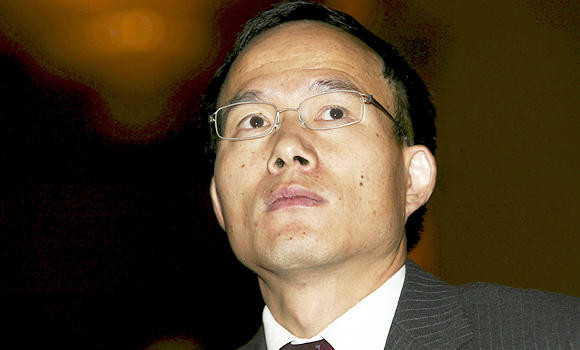
Billionaire head of China’s Fosun group ‘vanishes’
Billionaire head of China’s Fosun group ‘vanishes’
Latest updates


© 2026 SAUDI RESEARCH & PUBLISHING COMPANY, All Rights Reserved And subject to Terms of Use Agreement.