LONDON: Hyundai Genesis, a premium rear-wheel sedan, was introduced in 2008 and proved very successful in the Middle East region.
In its first generation, Genesis sold 250,000 units globally and secured a 24 percent year on year sales increase in the region to 3,112 units.
The top market for the model was Saudi Arabia, which accounted for 72 percent of these sales.
In fact the Middle East is the second largest market for Genesis after the US with 15 percent of sales.
The new generation Genesis was offered for a test drive in the UK and proved a worthy contender to German marks such as BMW 5 Series, Audi A6 and also to Lexus ES. Since its launch, Genesis was named Car of the Year in North America in 2009, best engine awards from 2009 to 2011 and reliability awards from J.D. Power.
Genesis target customer in the region is an Arab male aged 25-35 years old, most likely married with one to two children.
The typical customers seek high-tech products that improve their own personal sense of value, while emphasizing distinctive style and dynamic driving performance.
The new Genesis applies Hyundai’s Fluidic Sculpture 2.0, an evolution in the Fluidic Sculpture design philosophy that was introduced in 2009.
The result is the most aerodynamic design of any vehicle in its class with a CD value of 0.25.
The main features of the exterior design are the single-frame chrome 3D hexagonal grille, HID headlamps, LED day-time lights and fog lamps.
Sleek lines flow from the front to rear, completing the dynamic styling.
Genesis can be specified with a wide panoramic sunroof, while the door mirrors feature embedded LED side repeaters for that premium touch.
The test car was fitted with 19” alloy wheels, heated, folding exterior mirrors with Genesis logo puddle lamp, chrome dual exhaust pipes, rain-sensing wipers and LED day-time running lights.
The trunk capacity is decent at 433 liters.
Interior
Genesis offers a simple, stylish and de-cluttered interior that projects a premium and refined image.
The steering wheel design and grip have been improved and on-board switchgear redesigned; a number of switches previously found on the center console of the original Genesis were removed, redesigned or relocated on new Genesis.
The test car is equipped with light-color leather seats, heated steering wheel and leather gear knob.
Eight-way electrically-operated, heated and ventilated front and rear seats add a luxurious touch to being in a Genesis.
The driver seat has an extended cushion and memory functions.
The Genesis also benefits from automatic headlights, smart high beam and rear-cross traffic alert.
There is dual-zone climate control, a wide-screen for multiple functions including navigation — and smart cruise control.
For convenience, the Genesis has hands-free boot opening, power door latch, front and rear sensors, rear-view and surround cameras in addition to keyless entry and ignition.
On the technology front the Genesis is also well-equipped with blue-tooth connectivity with voice recognition; USB and AUX connections; eight-inch color TFT touchscreen satellite navigation; smart park assist system; steering wheel audio and phone controls and smart cruise control.
The new Genesis offers an abundance of new technologies and features, many of them Hyundai firsts such as the Smart Trunk function and Autonomous Emergency Braking. Other cutting-edge technologies that the model offers are a Head-Up Display, Blind Spot Detection, Around View Monitor and Lane Departure Warning System (available GCC only).
Safety and engines
When it comes to safety, Genesis is one of the most secured cars in the market with seven airbags and side curtains, including one for driver’s knees. Genesis is equipped with ABS, brake-assist system, downhill brake control, lane-keeping assist, electric parking brake, autonomous emergency braking, hill-start assist, impact-sensing auto door unlock, around view monitor and blind spot detector.
There is also a choice of engines between six and eight cylinders.
The test car has a 6-cylinder 3.8 GDI producing 315 PS mated to an automatic 8-speed gearbox pushing the rear wheels.
This translates into 0-100 kph in 6.5 seconds and top speed of 150 mph. Carbon dioxide emission is at a rather high 261 grams per kilometer which puts it in top band car tax in the UK.
Middle East and Africa customers will be able to choose from two impressive engines, each one designed for optimum low-end torque, responsiveness and fuel efficiency, and mated to an eight-speed automatic transmission with variable gear ratios and manual shifters on the steering wheel.
The flagship powertrain is Hyundai’s award-winning Tau 5.0-liter GDI, the brand’s most powerful V8 engine.
This engine produces maximum power of 413 PS and maximum torque of 505 Nm.
It can accelerate the new Genesis from 0-100 kph in 5.4 seconds and on to a maximum governed speed of 240kph
One useful feature (in the UK) is the legal-speed recognition and display which helps the driver to moderate speed accordingly.
The new Genesis has been developed on a totally new platform, sharing no components with its predecessor.
This platform uses even more advanced high-strength steel than before, and as a result it is stiffer in both torsional and bending rigidity than the BMW 5 Series. In fact, All-New Genesis has the strongest body of any vehicle in its class, making it one of the safest cars on the road.


![]()
![]()
![]()
![]()

Hyundai Genesis: Sleek premium sedan favored by Saudi drivers
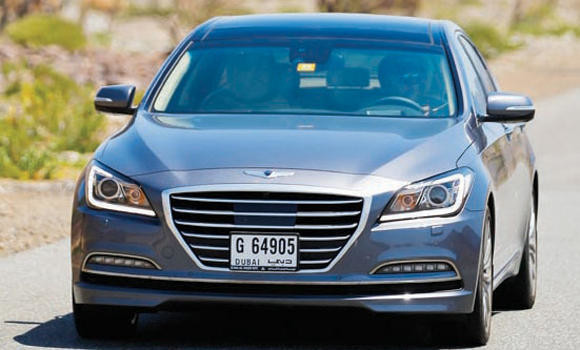


Hyundai Genesis: Sleek premium sedan favored by Saudi drivers
Latest updates


© 2026 SAUDI RESEARCH & PUBLISHING COMPANY, All Rights Reserved And subject to Terms of Use Agreement.