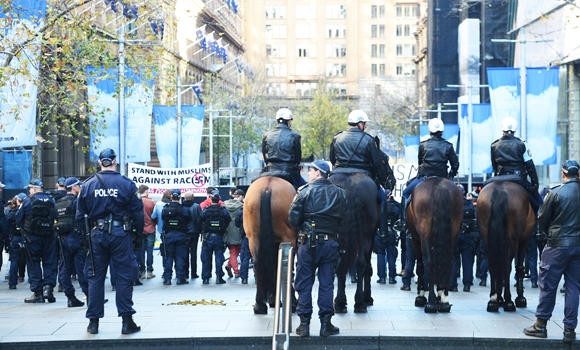
SYDNEY: A prominent Australian Muslim leader criticized the government’s $1 billion program to deradicalize Muslim youth on Wednesday, saying it put too much emphasis on law enforcement and not enough on factors that drive young people to fight overseas.
About 100 Australians are fighting in Iraq and Syria but Samier Dandan, president of Australia’s Lebanese Muslim Association, branded the conservative government’s 9-month-old program to stop the flow of radicalized Muslims “a mess.”
The problem is faced by many Western countries, especially members of US-led coalitions that fought in Afghanistan and Iraq. On Monday, British Prime Minister David Cameron pledged to unveil a five-year counter-extremism strategy he described as “struggle of our generation.”
“Almost universally, research points to the enormous influence that wider social, economic and political issues have on the process of radicalization,” Dandan said.
“Yet, the focus of the government’s strategy seems to rest heavily on how best it can strip people of their rights in the name of ‘security’,” he wrote in an opinion piece shown to Reuters before it was published later.
Australia is on “high” alert for attacks by radicalized Muslims or by homegrown militants returning from fighting in the Middle East, and has carried out a series of high-profile raids in major cities.
Australian citizens now face up to a decade in prison for travel to overseas areas declared off-limits and Prime Minister Tony Abbott earlier this month introduced legislation to strip citizenship from dual nationals found to have engaged in militant acts.
Dandan said the government was missing an opportunity to address the root causes that drive radicalization — inequality.
At least half of Australia’s Muslims live in Sydney’s west, which was transformed in the mid-1970s from white working-class districts into majority-Muslim areas by a surge of immigration from Lebanon.
The most recent 2011 national census found that areas in Sydney most associated with Lebanese ancestry — Auburn, Lakemba, Punchbowl, Granville — lag far behind the rest of New South Wales state on indicators such as income and employment.
A spokesman for the Australian Attorney General’s office did not immediately respond to a request for comment.


![]()

Muslim outcry over ‘deradicalization’ drive in Australia
Muslim outcry over ‘deradicalization’ drive in Australia
Families set off on migration journeys and find themselves torn apart
MIAMI: During the first Trump administration, families were forcibly separated at the border.
Now parents inside the United States are being arrested by immigration authorities and separated from their families during prolonged detention inside the country.
Three recent migrants told The Associated Press that their journeys were sources of deep pain and uncertainty because they marked the possible start of permanent separation between loved ones. Associated Press photographers documented the human toll.
___
Jakelin Pasedo
Jakelin Pasedo and her two young sons arrived in Miami in December 2024 and received refugee status while Pasedo cares for the boy and works cleaning offices. Their husband and father, Antonio Laverde, who left Venezuela in 2022, was arrested in June at his shared housing and detained for three months before asking to return to Venezuela. Fearing persecution if she goes back, Pasedo hopes to reunite with her husband in the US
Amavilia
Amavilia crossed from Guatemala in September 2023 and cares for two young children — breastfeeding and waking at 3 a.m. to cook lunches she sells for $10 while also selling homemade ice cream and chocolate‑covered bananas door to door. Her husband Edgar, who had lived and worked in South Florida for over 20 years, was detained on a 2016 warrant and deported to Guatemala on June 8, leaving the family unable to pay rent and reliant on donations at first.
She and her husband declined to provide their last names because they are worried about repercussion from US immigration officials.
Amavilia fears police, urges her daughter to stay calm, and keeps going “entrusting myself to God,” hoping to provide stability despite the uncertainty.
“I fell into despair. I didn’t know what to do,” said Amavilia, 31.
Yaoska
Yaoska, five months pregnant, lives in Miami with her two young sons, one a US citizen, with a 24‑hour GPS supervision bracelet. She fled Nicaragua in 2022. Her husband, a political activist who faced threats and beatings at home, was detained at an appointment with Immigration and Customs Enforcement and failed his credible fear interview.
Yaoska spoke on condition of anonymity and requested the same for her husband to protect him from the Nicaraguan government.
He was deported after three months of detention. Yaoska’s work authorization runs until 2028, but she fears for her family’s future and struggles to find stable work.
“It’s so hard to see my children like this. They arrested him right in front of them,” Yaoska said, her voice trembling.
Now parents inside the United States are being arrested by immigration authorities and separated from their families during prolonged detention inside the country.
Three recent migrants told The Associated Press that their journeys were sources of deep pain and uncertainty because they marked the possible start of permanent separation between loved ones. Associated Press photographers documented the human toll.
___
Jakelin Pasedo
Jakelin Pasedo and her two young sons arrived in Miami in December 2024 and received refugee status while Pasedo cares for the boy and works cleaning offices. Their husband and father, Antonio Laverde, who left Venezuela in 2022, was arrested in June at his shared housing and detained for three months before asking to return to Venezuela. Fearing persecution if she goes back, Pasedo hopes to reunite with her husband in the US
Amavilia
Amavilia crossed from Guatemala in September 2023 and cares for two young children — breastfeeding and waking at 3 a.m. to cook lunches she sells for $10 while also selling homemade ice cream and chocolate‑covered bananas door to door. Her husband Edgar, who had lived and worked in South Florida for over 20 years, was detained on a 2016 warrant and deported to Guatemala on June 8, leaving the family unable to pay rent and reliant on donations at first.
She and her husband declined to provide their last names because they are worried about repercussion from US immigration officials.
Amavilia fears police, urges her daughter to stay calm, and keeps going “entrusting myself to God,” hoping to provide stability despite the uncertainty.
“I fell into despair. I didn’t know what to do,” said Amavilia, 31.
Yaoska
Yaoska, five months pregnant, lives in Miami with her two young sons, one a US citizen, with a 24‑hour GPS supervision bracelet. She fled Nicaragua in 2022. Her husband, a political activist who faced threats and beatings at home, was detained at an appointment with Immigration and Customs Enforcement and failed his credible fear interview.
Yaoska spoke on condition of anonymity and requested the same for her husband to protect him from the Nicaraguan government.
He was deported after three months of detention. Yaoska’s work authorization runs until 2028, but she fears for her family’s future and struggles to find stable work.
“It’s so hard to see my children like this. They arrested him right in front of them,” Yaoska said, her voice trembling.
Latest updates




© 2025 SAUDI RESEARCH & PUBLISHING COMPANY, All Rights Reserved And subject to Terms of Use Agreement.