Saudi water mission tours Japan

Updated 12 June 2015
Follow

Saudi water mission tours Japan

JEDDAH: A Saudi water-related business mission, headed by Abdulrahman Jazzar of Abdulrahman A.B. Jazzar for Telecom & IT, Jeddah, recently toured Osaka and Tokyo.
In Osaka, the delegation visited Kubota Corporation’s Hirakata Plant (306,084 sqm), which manufactures valves, pumps (vertical and horizontal), steel casting, construction machine. They were briefed about the advanced technology on the effective use of energy. Kubota’s RO pump systems feature high efficiency, easy maintenance and high reliability, based on their technologies.
At Toray Industries’ Shiga Plant, the visitors were given a presentation on its products, RO/UF membrane and MBR (membrane bio-reactor) and its worldwide supply record.
The mission members discussed their products’ technical features and Saudi water quality.
The members next visited Toray Innovation Plaza, where they learned Toray’s various product lines and new products, including carbon textiles, plastics/chemical, films and materials for IT, and pharmaceutical equipment.
At the Toray Research Center (TRC), the visitors witnessed its engineers and experts doing surface, structural, material characterization, organic/inorganic and environmental analysis.
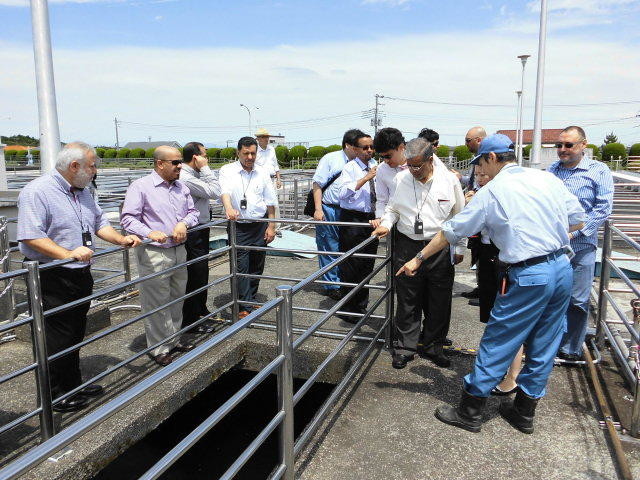
In Tokyo, the mission visited Yokohama’s Nishiya Water Purification Plant and Hokubu Sludge Treatment Center. In Nishiya, the mission members viewed examination of water leakage detection, utilizing conventional and mechanical equipment (demonstrated by Yokohama’s engineers), which were actually implemented out by Yokohama City’s Environmental Planning Bureau.
In Hokubu, the mission members learned the advanced technology of sludge treatment systems, which focused on the effective use of digestion gas for electricity and fuel, incinerated ash (for cement material and improved soil, and fuelization from sludge by a major Japanese municipality.
Saudi companies gave their presentations before participating in B2B meetings. They included Saudi Arabian Mining Company (Maaden), SAWEA, Skado GOCSA, Abdulrahman A.B. Jazzar for Telecom & IT, Global Solution for Leak Free, Saudi Bio-Acids Company, BMS Factories, WETICO, AAHD ALTAWEER Trading & Construction, and Kindasa Water Services.


Arab food and beverage sector draws $22bn in foreign investment over 2 decades: Dhaman 

Updated 28 December 2025
Follow

Arab food and beverage sector draws $22bn in foreign investment over 2 decades: Dhaman 

JEDDAH: Foreign investors committed about $22 billion to the Arab region’s food and beverage sector over the past two decades, backing 516 projects that generated roughly 93,000 jobs, according to a new sectoral report. 

In its third food and beverage industry study for 2025, the Arab Investment and Export Credit Guarantee Corp., known as Dhaman, said the bulk of investment flowed to a handful of markets. Egypt, Saudi Arabia, the UAE, Morocco and Qatar attracted 421 projects — about 82 percent of the total — with capital expenditure exceeding $17 billion, or nearly four-fifths of overall investment. 

Projects in those five countries accounted for around 71,000 jobs, representing 76 percent of total employment created by foreign direct investment in the sector over the 2003–2024 period, the report said, according to figures carried by the Kuwait News Agency. 

“The US has been the region's top food and beverage investor over the past 22 years with 74 projects or 14 projects of the total, and Capex of approximately $4 billion or 18 percent of the total, creating more than 14,000 jobs,” KUNA reported. 

Investment was also concentrated among a small group of multinational players. The sector’s top 10 foreign investors accounted for roughly 15 percent of projects, 32 percent of capital expenditure and 29 percent of newly created jobs.  

Swiss food group Nestlé led in project count with 14 initiatives, while Ukrainian agribusiness firm NIBULON topped capital spending and job creation, investing $2 billion and generating around 6,000 jobs. 

At the inter-Arab investment level, the report noted that 12 Arab countries invested in 108 projects, accounting for about 21 percent of total FDI projects in the sector over the past 22 years. These initiatives, carried out by 65 companies, involved $6.5 billion in capital expenditure, representing 30 percent of total FDI, and generated nearly 28,000 jobs. 

The UAE led inter-Arab investments, accounting for 45 percent of total projects and 58 percent of total capital expenditure, the report added, according to KUNA. 

The report also noted that the UAE, Saudi Arabia, Egypt, and Qatar topped the Arab ranking as the most attractive countries for investment in the sector in 2024, followed by Oman, Bahrain, Algeria, Morocco, and Kuwait. 

Looking ahead, Dhaman expects consumer demand to continue rising. Food and non-alcoholic beverage sales across 16 Arab countries are projected to increase 8.6 percent to more than $430 billion by the end of 2025, equivalent to 4.2 percent of global sales, before exceeding $560 billion by 2029. 

Sales are expected to remain highly concentrated geographically, with Egypt, Saudi Arabia, Algeria, the UAE and Iraq accounting for about 77 percent of the regional total. By product category, meat and poultry are forecast to lead with sales of about $106 billion, followed by cereals, pasta and baked goods at roughly $63 billion. 

Average annual per capita spending on food and non-alcoholic beverages in the region is projected to rise 7.2 percent to more than $1,845 by the end of 2025, approaching the global average, and to reach about $2,255 by 2029. Household spending on these products is expected to represent 25.8 percent of total expenditure in 13 Arab countries, above the global average of 24.2 percent. 

Arab external trade in food and beverages grew more than 15 percent in 2024 to $195 billion, with exports rising 18 percent to $56 billion and imports increasing 14 percent to $139 billion. Brazil was the largest foreign supplier to the region, exporting $16.5 billion worth of products, while Saudi Arabia ranked as the top Arab exporter at $6.6 billion.