Beijing: The Chinese government has more weapons in its arsenal to boost its flagging economy, the world's second-largest, Premier Li Keqiang said Sunday at his once-a-year press conference.
Li — who is second only to President Xi Jinping in the Communist hierarchy — was speaking at Beijing's Great Hall of the People, where he also addressed topics including Sino-Japanese relations, air pollution and the future of China's notorious one-child policy.
Fears are mounting that Chinese expansion, a key driver of the global economy, may slow further in the wake of official data showing production, consumption and investment growth have fallen to multi-year lows.
China's economy expanded 7.4 percent last year — the slowest pace in nearly a quarter of a century — and Li earlier this month reduced the Asian giant's annual growth target to "approximately seven percent", the lowest since a similar goal in 2004.
Authorities have so far avoided big-ticket incentives to bolster growth like the unprecedented four-trillion-yuan (now $640 billion) stimulus package Beijing deployed at the height of the global financial crisis.
But Li signaled that more measures could be taken, telling reporters after the close of the Communist-controlled National People's Congress parliament: "We still have a host of policy instruments at our disposal."
Top Chinese leaders have said the economy is in a delicate transition away from decades of double-digit annual growth to a new, slower model that authorities say is more sustainable, a stage that they have branded as the "new normal".
Li dismissed theories that China's boom has seen it overtake the US to become the world's number one economy, describing such purchasing power parity calculations as a "misleading exaggeration".
"According to authoritative standards, China is still the second-largest economy in the world," he said, stressing that it remained "behind about 80 countries in the world" in terms of per capita GDP. "China is still a developing country in every sense of this term," he added.
On China's notorious air pollution, which causes widespread public anger, Li told the assembled journalists that Beijing was falling short of expectations.
His remarks came one week after authorities blocked a scathing independent video on China's persistent air pollution, "Under the Dome," that racked up hundreds of millions of views before it was taken offline.
"The Chinese government is determined to tackle smog and pollution," Li said. "The progress we have made still falls short of the expectations of our people."
With the 70th anniversary of the end of World War II approaching, Li offered Japan a chance of improved relations — but only if Tokyo's leadership honestly confronts the country's wartime aggression against China.


![]()
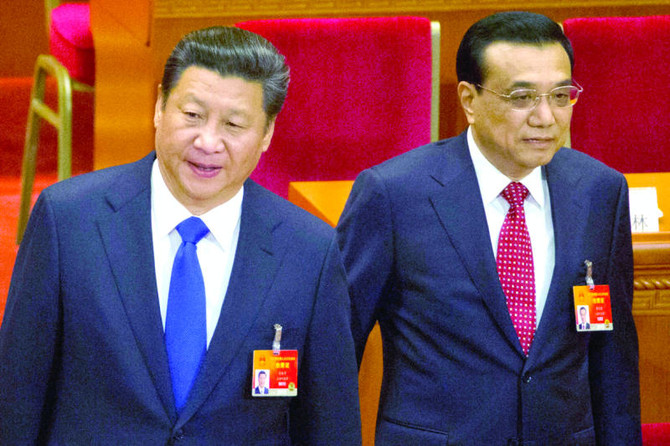
Chinese economy is in a ‘delicate transition’
Chinese economy is in a ‘delicate transition’
Latest updates


Recommended



© 2026 SAUDI RESEARCH & PUBLISHING COMPANY, All Rights Reserved And subject to Terms of Use Agreement.