BAGHDAD: The Islamic State group have begun bulldozing the ancient Assyrian city of Nimrud in Iraq, the government said, in the jihadists’ latest attack on the country’s historical heritage.
IS “assaulted the historic city of Nimrud and bulldozed it with heavy vehicles,” the tourism and antiquities ministry said on an official Facebook page.
An Iraqi antiquities official confirmed the news, saying the destruction began after noon prayers on Thursday and that trucks that may have been used to haul away artefacts had also been spotted at the site.
“Until now, we do not know to what extent it was destroyed,” the official said on condition of anonymity.
Nimrud, one of the jewels of the Assyrian era, was founded in the 13th century BC and lies on the Tigris River around 30 kilometers (18 miles) southeast of Mosul, Iraq’s second city and the IS group’s main hub in the country.
“I’m sorry to say everybody was expecting this. Their plan is to destroy Iraqi heritage, one site at a time,” said Abdulamir Hamdani, an Iraqi archaeologist from Stony Brook University.
“Hatra of course will be next,” he said, referring to a beautifully-preserved city in Nineveh province that is more than 2,000 years old and is a UNESCO world heritage site.
“I’m really devastated. But it was just a matter of time,” he said.
Nimrud is the site of what was described as one of the greatest archaeological finds of the 20th century when a team unearthed a collection of jewels and precious stones in 1988.
The jewels were briefly displayed at the Iraqi national museum before disappearing from public view. But they survived the looting that followed the 2003 US invasion and were eventually found in a Central Bank building.
Most of Nimrud’s priceless artefacts have long been moved to museums, in Mosul, Baghdad, Paris, London and elsewhere but giant “lamassu” statues — winged bulls with human heads — and reliefs were still on site.
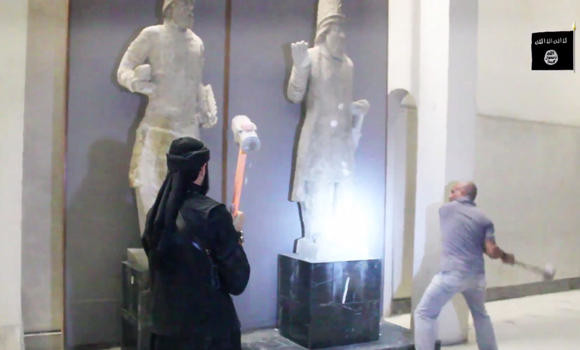
The destruction at Nimrud Thursday came a week after the jihadist group released a video showing militants armed with sledgehammers and jackhammers smashing priceless ancient artefacts at the Mosul museum.
That attack sparked widespread consternation and alarm, with some archaeologists and heritage experts comparing it with the 2001 demolition of the Bamiyan Buddhas in Afghanistan by the Taleban.
In the jihadists’ extreme interpretation of Islam, statues, idols and shrines amount to recognizing objects of worship other than God and must be destroyed.
The video released by IS last week showed militants knocking statues off their plinths and rampaging through the Mosul museum’s collection.
It also shows jihadists using a jackhammer to deface an imposing granite Assyrian winged bull at the Nergal Gate in Mosul.
“These artefacts behind me are idols for people from ancient times who worshipped them instead of God,” a bearded militant said in the video.
“The prophet removed and buried the idols in Makkah with his blessed hands,” he said, referring to the Muslim prophet Mohammed.
Many of the artefacts destroyed in the Mosul museum were from Nimrud and Hatra.
UNESCO director general Irina Bokova demanded an emergency meeting of the Security Council and called for the International Criminal Court to look into the Mosul museum destruction.
The IS group spearheaded a sweeping offensive last June that overran Nineveh province, where Mosul and Nimrud are located, and swept through much of Iraq’s Sunni Arab heartland.
The Mosul region was home to a mosaic of minorities, including the Assyrian Christians, who consider themselves to be the region’s indigenous people.
IS militants have systematically destroyed heritage sites in areas controlled by the group, including Sunni Muslim shrines that they also consider heretical, and they have repeatedly attacked members of religious minorities.
Iraqi security forces and allied fighters are battling to regain ground from the jihadists with backing from an international anti-IS coalition as well as neighboring Iran.
But major operations to drive IS out of Nineveh are likely months away, leaving the province’s irreplaceable historical sites at the mercy of militants who have no regard for Iraq’s past.
During the rule of now-executed dictator Saddam Hussein, Iraq enforced laws protecting historical sites.
But years of violence before the 2003 invasion and crippling international sanctions saw the maintenance of Iraq’s heritage take a back seat to other more urgent demands.
Since the overthrow of the Hussein regime, such laws have been patchily enforced and the government has prioritised reconstruction of the war-battered country over preservation of heritage buildings, and many have now fallen into neglect.
Iraq’s national museum in Baghdad officially reopened on February 28 after 12 years of painstaking efforts to recover nearly a third of the 15,000 pieces looted during the US-led invasion.
bur-wd/erf/as


![]()
IS ‘bulldozed’ ancient Assyrian city of Nimrud, Iraq says
IS ‘bulldozed’ ancient Assyrian city of Nimrud, Iraq says
Latest updates



© 2026 SAUDI RESEARCH & PUBLISHING COMPANY, All Rights Reserved And subject to Terms of Use Agreement.