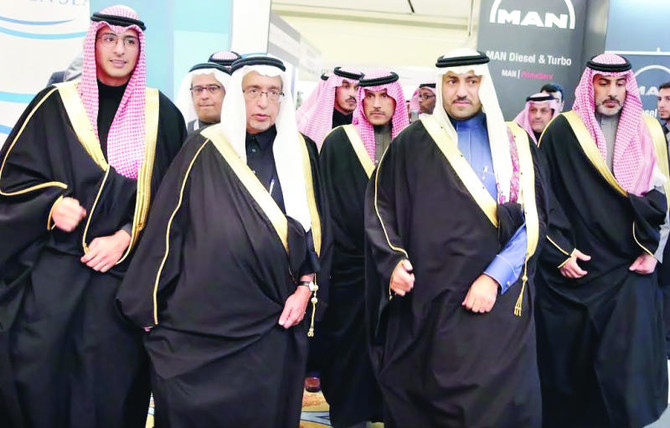
Riyadh Governor Prince Turki bin Abdullah bin Abdul Aziz, accompanied by Water and Electricity Minister Abdullah Al-Hussayen, opened the 10th Saudi Water and Power Forum (SWPF 2015) here on Monday night.
The forum is being organized by the CWC Group, a technology oriented, engineering, operation and maintenance company, in partnership with Moya Bushnak and Acwa power.
The minister was joined in the inaugural ceremony by Adil Bushnak, chairman of Moya Bushnak and director and past president, IDA, and Jean-Lou Chameau, president of the King Abdullah University of Science and Technology (KAUST), for opening keynote addresses.
The opening session included an awards ceremony. This ceremony brings together the Saudi water and power industry to celebrate excellence and outstanding achievements.
The award ceremony was followed by an exhibition to showcase 10 years journey of the forum and achievements and vision for sustainable development.
The theme for this year’s three-day annual forum and exhibition is, “Achieving sustainable development through innovation.”
The forum, attracting the water and power stakeholders from various countries, assumes greater significance this year due to its 10th year anniversary edition in Riyadh.
The technical session of the forum will begin on Tuesday with brainstorming meetings focusing on “Ten-year anniversary: success, priorities and 10 years strategies for water and power sectors in the Kingdom.”
Key speakers include Saleh Alawaji, deputy minister for electricity and chairman of the board of directors, Saudi Electricity company, Abdullah Al-Shehri, governor, electricity and co-generation Regulatory Authority (ECRA), Abdulrahman Al-Ibrahim governor, Saline Water Conversion Corporation (SWCC), Loya bin Ahmad Al-Musallam,CEO of the National Water Company (NWC) and Maher Al-Odan, head of research, development and innovation, King Abdullah City for Atomic and Renewable Energy (K.A.CARE).
Key government stakeholders will take part in technical sessions.
Among key speakers presenting the private perspective at these sessions include David Hobbs, research head at King Abdullah petroleum studies and research center and Mohammed Mohaisen, CEO of GE power generation products and services for MENA region.
Moreover, there will be a session on renewable energy with brainstorming on advances in renewable desalination, strategies to create green utilities by adding more value and showcasing the route to boost generating capacity, saving energy and maximizing efficiency to capture full energy value.
Besides technical sessions, the key attraction will be networking functions and an expanded exhibition space. The US, China, Germany, Japan and the UK have set up international pavilions.
Notably, it is the premier water and power forum in the Kingdom, which plays key role in establishing connections between various stakeholders and partners with substantial agenda for sustainable growth.
Significantly, water scarcity is a stark reality as freshwater makes up a very small fraction of the available water in the Kingdom and the sustainable availability of potable water is a major concern in the region mostly surrounded by sea full of saline water.
The government is working at various levels with ambitious plans to upgrade, expand and transform the power and water sector. It supports the development of desalination technologies for water.


![]()
Saudi Water & Power Forum focuses on industry challenges
Saudi Water & Power Forum focuses on industry challenges
Latest updates


© 2026 SAUDI RESEARCH & PUBLISHING COMPANY, All Rights Reserved And subject to Terms of Use Agreement.