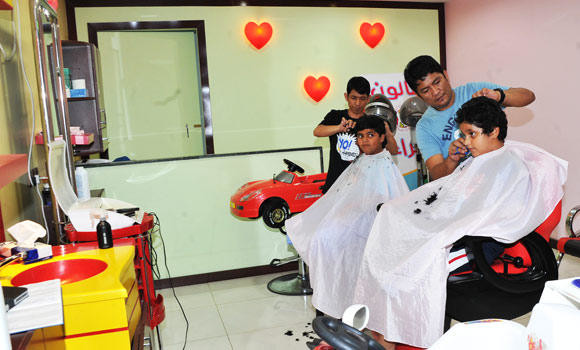
Barbershops here have seen a 50 percent decline in customers because of the practice of their older clientele to not cut their hair or shave their beards during the first 10 days of Dhul Hijjah.
The practice stems from a saying of the Prophet (peace be upon him), which recommends Muslims not cutting their nails or hair if they plan to sacrifice an animal on Eid Al-Adha.
More than 40 percent of hair salons and barbershops, close to 3,300 shops for males and 650 for females, are located in Jeddah. Several barbers contacted by Arab News said when there is such a sharp reduction in customers they use the time to either go on holiday or sort out any unfinished business.
Mohammed Yousef, an Egyptian barber, said this situation occurs every year. He usually cuts children’s hair during this time to compensate for the decline in the number of older customers.
Majeed Al-Rashidi, a Moroccan barber, said he usually takes his holiday every year during the Eid break so that he can spend time with his family back home. He also uses some of the time for maintenance work on the shop. Arshan Haseebullah, a barber from Pakistan, said some of the poorer barbers continue to work during this period because they need the money.
Azbak Hussain, a Turkish barber, usually relocates to Makkah from Dhul Hijjah 1 to 10 to work alongside his brother at a barbershop close to the Grand Mosque where there are many more customers. However, this year he could not get a permit to enter the city and has decided to spend time with his children in Turkey.
In a recent poll, 57 percent of respondents said they visit their barbershops at least once a week, 17 percent once a month, and 2 percent on special occasions and holidays.
According to the poll, 14 percent bring personal shaving kits along with them to their barbershops, while 11 percent keep shaving items at their homes. Forty-three percent of customers select barbers based on cleanliness, while 45 percent cited waiting periods as a key factor. Roughly 13 percent of respondents said they do not consider shaving as a major reason of disease transfer between people, while 5 percent said they visit their barbers for hair loss treatments.

10 no-haircut days leave barbers ‘sacrificing’ 50% business
Two Holy Mosques authority launches smart interactive map system
MADINAH: A new smart interactive map system has been inaugurated for the Grand Mosque and the Prophet’s Mosque.
CEO of the General Authority for the Care of the Affairs of the Grand Mosque and the Prophet’s Mosque Ghazi Al-Shahrani said that the smart interactive map facilitated the movement of visitors and worshipers while significantly enhancing navigational efficiency within the two holy mosques. The system is designed to guide visitors along the most suitable routes, support real-time updates, ensure safe navigation and enhance the overall quality of the experience.
Al-Shahrani said that the results achieved were part of the authority’s efforts to advance digital transformation and leverage smart technologies in serving pilgrims. He said that this system was one of dozens launched recently that contributed to generating operational data that supported decision-making, enhanced understanding of challenges and paved the way for developing future digital systems.
Interactive maps are part of a smart digital system that provides real-time spatial guidance, powered by live operational data linked to control rooms. This enables visitors to be directed to the most appropriate routes during closures or congestion, with immediate and accurate updates.
Executive vice president of digital transformation at the authority, Mohammed Al-Saqr, said that the pilot phase of the maps, which began during Ramadan, was integrated with the color coding and metric addressing system, which divided the Two Holy Mosques into clear geographical zones that supported smart operations and activated spatial data as part of an integrated services and analytics ecosystem. He said that this launch represented the first step in a project that would continue to evolve over the coming years, with further development planned through 2026.
Al-Saqr said that the system featured more than 950 points of interest across 13 service categories, supported by more than 650 QR codes for easy access. It could also generate more than 100,000 dynamic routes, automatically optimized in real time based on operational conditions and crowd flow.
Director of business solutions at the authority, Waheeb Al-Mutrafi, said that the maps enabled precise location-based reporting and contributed to accelerating access to electric carts through ticket numbers via a smart platform built on field data verified over several months, enhancing operational efficiency and improving the quality of services provided to worshippers.