WASHINGTON: An Al-Qaeda cell in Syria known as the Khorasan Group, which was targeted by US airstrikes this week, represents “a clear and present danger” to commercial flights to Europe and the United States, the Obama administration’s top aviation security official said Friday.
The purpose of the airstrikes was to disrupt an “imminent attack or attack entering the last phases of execution,” said John Pistole, head of the Transportation Security Administration. The Khorasan Group has been researching and testing improvised explosive devices designed to elude airport security, he said.
Pistole’s remarks, which came at a luncheon of the Washington Aero Club, were among the most detailed to date about potential terror threats posed by the group. The Obama administration on Sept. 18 publicly acknowledged for the first time the existence of the shadowy group of veteran Al-Qaeda members.
“The stakes are real and the threats are high,” Pistole said to members of the Aero Club, an organization that promotes aviation. “I see the Khorasan Group as being a very capable, determined enemy who was very much focused on getting somebody or something on a plane bound for Europe or the United States.”
Though the Khorasan Group was has been known to US intelligence officials, the name only recently became public after a series of articles about the threats it poses to the US. Officials said military strikes Monday night were intended to disrupt an imminent plot, but “imminent,” when used by the government in terms of intelligence, does not necessarily mean it was about to happen. There was no information about a specific target, for instance.
Intelligence officials have known for months that Khorasan Group extremists were scheming with bomb-makers from Al-Qaeda’s Yemen affiliate to find new ways to get explosives onto planes. Their plans were far enough along that the TSA in July asked for additional passenger screening at certain overseas airports with direct flights to the US, including that passengers be required to turn on laptops, tablets and other electronic devices, Pistole said.
The group has been recruiting Westerners to carry explosives onto a plane or put one on a cargo plane. There are some 8,850 people associated with “foreign terrorist fighter activity” on the terror watch list of people banned from flying to, from or within the US, according to the FBI. But Pistole said many of these western Khorasan recruits may not be on that list.
The TSA is looking at more steps that can be taken in the US and overseas to “increase aviation security without shutting down commerce, trade and the tourism business,” Pistole said. Some additional security measures have already been taken in the US, he said, but declined to describe them.
There are about 275 airports around the world with direct flights to the US Enhanced security measures are being used at “a couple dozen” airports in Europe, the Middle East and North Africa based on intelligence that those airports might be used by a terrorist to fly to the US, Pistole said. But he indicated those measures aren’t foolproof.
“We have medium-to-high confidence depending upon which airport and what day it is,” Pistole said.
Pistole pointed to the underwear bomb that Umar Farouk Abdulmutallab tried to detonate on a passenger jet over Detroit on Christmas Day in 2009, noting that Abdulmutallab traveled through three airports before getting on the flight to the US. Those airports used metal detectors, but Abdulmutallab’s underwear bomb didn’t contain metal.
“We audit and inspect all airports that have nonstop passenger or cargo service to the US and give them a passing grade for the day we were there so you can see what was is going on,” he said. “The concern is that, for any number of issues, they may not be on their A-game” on the day that a terrorist goes through the airport in route to the US
The TSA is looking at their list of overseas airports that might be used by a terrorist to see if there are other steps that can be taken “to buy down risk,” Pistole said. He declined to identify those airports or the steps under consideration.
Khorasan refers to a province under the Islamic caliphate, or religious empire, of old that included parts of Afghanistan. The group is a cadre of veteran Al-Qaeda fighters from Afghanistan and Pakistan who traveled to Syria to link up with the Al-Qaeda affiliate there, the Nusra Front.
The Khorasan Group’s plotting with Al-Qaeda’s Yemen affiliate, Al-Qaeda in the Arabian Peninsula, shows that, despite the damage that years of drone missile strikes has done to the leadership of core Al-Qaeda in Pakistan, the movement still can threaten the West. The Yemen affiliate has been able to place three bombs on US-bound airliners, though none has succeeded in downing the aircraft.


![]()
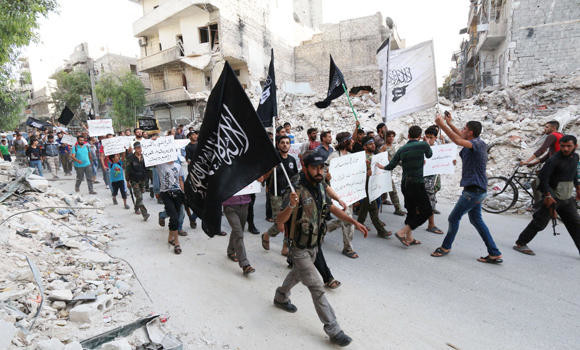
Khorasan group tagged as 'threat to aviation'
Khorasan group tagged as 'threat to aviation'
Latest updates


Recommended


© 2026 SAUDI RESEARCH & PUBLISHING COMPANY, All Rights Reserved And subject to Terms of Use Agreement.