ISLAMABAD: Pakistani soldiers and paramilitary forces secured the headquarters of the state TV channel PTV in Islamabad on Monday after a crowd of anti-government protesters stormed the building and took the channel off the air.
The protesters had stormed the TV building forcing the channel briefly off the air as they clashed with police and pushed further into a sprawling government complex in the capital, Islamabad, in an effort to reach the prime minister's residence.
Opposition leaders Imran Khan, a hero cricket player turned politician, and Tahirul Qadri, a firebrand cleric, have been at the forefront of the protests for weeks demanding the government of Prime Minister Nawaz Sharif to quit.
Protesters and police clashed in various areas of the city's Red Zone, a sprawling complex of government buildings and grassy lawns in the center of Islamabad. The protesters, armed with clubs and many wearing gas masks, hurled rocks at the policemen. Five police officers, including a senior Islamabad police chief, and three protesters were taken to hospital, bleeding.
Sharif, who was toppled by the army in a 1999 coup, has refused to quit while protest leaders have rejected his offers of talks, creating a dangerous deadlock.
Clashes broke out again early on Monday and the state PTV channel and its English-language PTV World service were taken off the air after protesters stormed its headquarters.
A PTV source told Reuters the protesters had occupied the main control room and smashed some equipment. Television pictures showed uniformed members of a paramilitary force and soldiers walking calmly into the building.
A Reuters witness said the soldiers escorted protesters out and placed the building under their protection. There were no signs of violence and the protesters were seen leaving peacefully. The station later came back on the air.
In the nuclear-armed nation where power has often changed hands through military coups rather than elections, the army is bound to play a key role in how the conflict unfolds but it has not directly intervened, apart from meeting the protagonists and calling on them to show restraint.
Army chief Gen. Raheel Sharif met Prime Minister Sharif on Monday, but it was unclear what they discussed.
The army chief, who is not related to the prime minister, late Sunday urged the government and opposition leaders to resolve the crisis through talks and warned against the use of force to end the demonstrations.
Protesters have camped out in Islamabad since mid-August, paralyzing life in the centre of the capital and creating massive traffic jams. The protest site, where many sleep rough every night, is littered with rubbish and reeks of human waste.
How the crisis ends will be ultimately decided by the army. If the protests get out of hand, the military could step in decisively, imposing a curfew or even martial law.
There is also a question mark over how much protest leaders are capable of controlling their own people, many of them frustrated after weeks of hardship and no solution in sight.
Alternatively, the army could side with the protesters and put pressure on Sharif to resign, in which case an interim government would have be put in place and early parliamentary elections held to elect a new government.
However, few observers believe the army is bent on seizing power again. A weakened Sharif would allow the army to remain firmly in charge of key issues such as relations with India and Afghanistan while allowing the civilian government to deal with day-to-day economic problems in which it has little interest.
Some ruling party officials have accused elements within the military of orchestrating the protests to weaken the government.
Khan and Qadri have instructed their supporters to avoid any confrontation with the armed forces and strictly follow their orders. As soldiers entered the PTV building, many protesters smiled and shook hands with them.
The military insists it does not meddle in politics but it was known to be frustrated with the government, in particular over the treason trial of former military chief and ex-President Pervez Musharraf, who deposed Sharif in 1999.
There has also been disagreement on how to handle Islamist militants, and on relations with old rival India.
On Monday morning, despite heavy rain, crowds of protesters fought running battles with retreating police after breaking the main gate into the Pakistan Secretariat area, which houses government ministries as well as Sharif's official residence.
The protesters made it to a gate that surrounds the prime minister's residence where they were met by paramilitary Rangers and army troops.
The rallies against Sharif constitute the biggest threat to his government little more than one year in office. Several rounds of negotiations between representatives of Khan and Qadri and the government have failed to make any headway.
The two opposition leaders allege widespread fraud in the country's May 2013 election, in which Sharif's party won by a landslide. International observers had found no evidence indicating rampant election tampering.


![]()
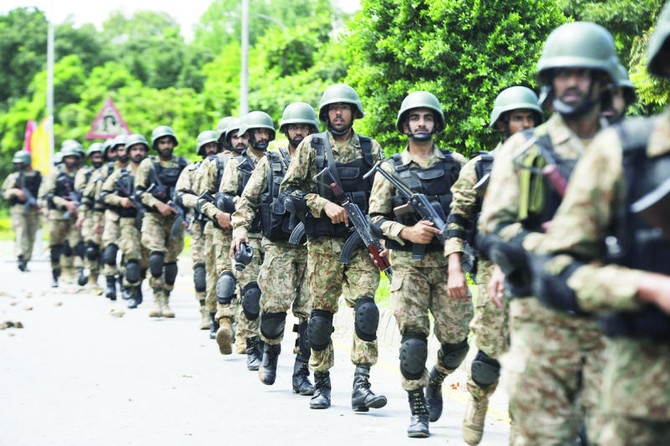
Pakistan Army secures TV station from protesters
Pakistan Army secures TV station from protesters
Latest updates


Recommended


© 2026 SAUDI RESEARCH & PUBLISHING COMPANY, All Rights Reserved And subject to Terms of Use Agreement.