LONDON: The leaders of Afghanistan and Pakistan said yesterday they would work to reach a peace deal within six months, while throwing their weight behind moves for the Taleban to open an office in Doha.
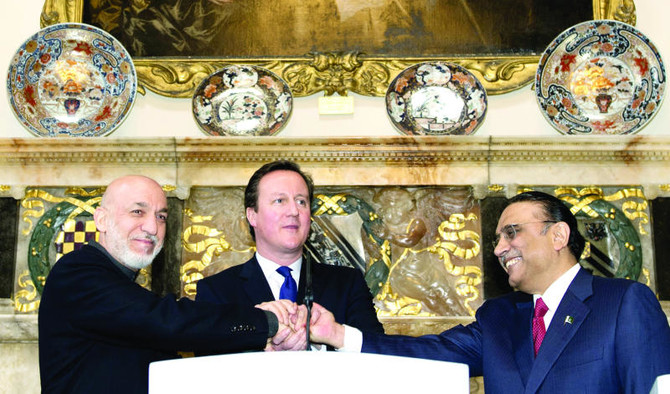
Following talks hosted by British Prime Minister David Cameron, Afghan President Hamid Karzai and his Pakistani counterpart Asif Ali Zardari also urged the hardliners to join the reconciliation process in Afghanistan.
But with no Taleban representative at the tripartite talks and with the militants still refusing to talk to Kabul, analysts said the commitment by the three leaders risked being one-sided.
They had a private dinner on Sunday and then full talks on Monday at Cameron’s Chequers country retreat near London, amid growing fears that a civil war could erupt when international troops leave Afghanistan in 2014.
“All sides agreed on the urgency of this work and committed themselves to take all necessary measures to achieve the goal of a peace settlement over the next six months,” they said in a joint statement issued by Cameron’s office.
“They supported the opening of an office in Doha for the purpose of negotiations between the Taleban and the High Peace Council of Afghanistan as part of an Afghan-led peace process,” the statement said.
Karzai had previously shunned the idea of a Taleban office in Doha because of fears that it would lead to the Kabul government being frozen out of talks between the United States and the Taleban.
The joint statement also said that the Afghan and Pakistani leaders had agreed arrangements to “strengthen co-ordination” of the release of Taleban detainees from Pakistani custody.
Afghan peace negotiators have welcomed Pakistan’s release of dozens of Taleban prisoners in recent months, a move they believe could help bring militants to the negotiating table. There was no immediate reaction from the Taleban.
The summit was the third trilateral meeting in a year following meetings in Kabul in July and New York last September — but the first in which Pakistani and Afghan army and intelligence chiefs took part.
Cameron, whose country is the second biggest contributor of troops to Afghanistan with 9,000 troops still in the country, appealed directly to the Taleban to join the reconciliation process.
“Now is the time for everyone to participate in a peaceful, political process in Afghanistan,” he told a press conference after the talks.
Karzai told the press conference he hoped in future to have “very close, brotherly and good neighborly” relations with Pakistan, which has been regularly accused by both Kabul and Washington of helping to destabilize Afghanistan.
Support from Pakistan, which backed Afghanistan’s 1996-2001 Taleban regime, is seen as crucial to peace after NATO troops depart — but relations between the neighbors remain uneasy despite some recent improvements.
Zardari said it was in Islamabad’s interests to support the initiative.
“Peace in Afghanistan is peace in Pakistan. We feel that we can only survive together,” he said. “We cannot change our neighborhood or our neighbors.” Pakistani political and security analyst Hasan Askari dismissed as “too ambitious” the prospect of securing in six months a settlement to end more than 11 years of war.
The lack of Taleban involvement in the talks was a particular problem, he said.
The Taleban in March 2012 suspended contacts with American representatives in Qatar over a potential prisoner exchange and opening a liaison office in the Gulf state, and publicly refuses to negotiate with Kabul.
Askari said the most realistic achievement in London would be better cooperation between Afghanistan and Pakistan, whose relations for years have been clouded by mutual blame for violence plaguing both countries.
Asked whether there could be a peace deal in six months, Askari said: “I don’t expect that, it would be a major upset of the calculation.”


Afghan-Pak peace deal in six months
Afghan-Pak peace deal in six months

Chinese visitors to Japan slump as spat rumbles on
TOKYO: Mainland Chinese visitors to Japan tumbled 60.7 percent in January year-on-year, figures showed Wednesday, in the continued fallout from the countries’ diplomatic spat.
“Last year, the lunar new year began in late January, but this year it fell in mid-February,” the Japan National Tourism Organization said as it published the data.
“Additionally, the Chinese government issued a warning advising against travel to Japan. Factors such as reduced flight frequencies also contributed to the number of foreign visitors to Japan falling below the level of the same month last year,” a statement said.
Previously Chinese visitors were the biggest contingent, contributing to a tourism boom in the land of cherry blossom and Mount Fuji that was fueled by a weak yen making shopping cheap.
But in January this year, South Korea was the biggest source with 1.2 million visitors, up 21.6 percent, compared with 385,300 from mainland China, down from 980,520 in January 2025.
Visitors from Hong Kong also tumbled 17.9 percent.
Overall the number of visitors to Japan fell 4.9 percent to 3.597 million in January compared to the same period last year.
Prime Minister Sanae Takaichi suggested in November that Japan could intervene militarily if Beijing sought to take Taiwan by force.
China, which regards the democratic island as part of its territory and has not ruled out force to annex it, was furious.
Beijing summoned Tokyo’s ambassador and on November 14 warned Chinese citizens against visiting Japan, citing “significant risks to the personal safety and lives of Chinese citizens.”
The number of Chinese visitors to Japan already tumbled 45 percent in December to 330,000.
In December, J-15 jets from China’s Liaoning aircraft carrier twice locked radar on Japanese aircraft in international waters near Okinawa, according to Japan.
China also tightened controls on exports to Japan for items with potential military uses, fueling worries that Beijing may choke supplies of vital rare-earth minerals.
Japan’s last two pandas were even returned to China last month.
Takaichi, 64, was seen as a China hawk before becoming Japan’s first woman prime minister in October.
She won a landslide victory in snap elections on February 8, putting her in a strong position for the next four years to stamp her mark on Japanese domestic and foreign policy.
Takaichi said after her election win that Tokyo would bolster its defenses and “steadfastly protect” its territory.
She also said she was “open to various dialogues with China.”
But China’s foreign ministry said “genuine dialogue should be built on respect for one another.”
“Proclaiming dialogue with one’s mouth while engaging in confrontation — no one will accept this kind of dialogue,” foreign ministry spokesman Lin Jian said Tuesday.
Beijing’s top diplomat Wang Yi told the Munich Security Conference on Saturday that forces in Japan were seeking to “revive militarism.”


