JEDDAH: Gold is not in a “bubble” at current prices, says a leading analyst.
The precious metal is up 9.7 percent this year. Gold closed on Friday at $1,716/oz on the London Bullion Market, flat over the previous day’s $ 1,715.50/oz.
Commodity prices ended broadly lower on Friday as weakness in corporate earnings reports dimmed the outlook for the US economy.
Deutsche Bank AG favors precious metals and is neutral on oil and industrial metals, Michael Lewis, head of commodities research at the bank, was quoted as saying by the Bloomberg news agency at the World Commodities Week conference in London.
Gold may outperform other commodities as the bull run in raw materials pauses amid slowing economies, while grains and oilseeds may jump on weather disruptions, said participants at the conference.
Gold won’t become a bubble unless prices rise to a record above $ 2,200 an ounce, while oil and industrial metals are vulnerable to risks associated with the so-called fiscal cliff in the US, said Lewis of Frankfurt-based Deutsche Bank.
He was referring to $ 607 billion in federal spending cuts and tax increases scheduled to take effect in January unless the US Congress intervenes.
Central banks have been expanding gold reserves after the metal climbed the past 11 years and investors boosted holdings in bullion-backed exchange-traded products to a record.
Nations bought 254.2 tons in the first half of 2012 and may add close to 500 tons for the year as a whole, the London-based World Gold Council said in August.
Commodities will likely lack direction for the next 12 months, meaning investors will focus more on relative-value trades, the Tiberius Asset Management says in the news report.
Spot gold prices eked out small gains on Friday after data showed US economic growth picked up in the third quarter.
Bullion reversed early losses as the week closed after the US Commerce Department said gross domestic product expanded at a better-than-expected 2 percent annual rate, driven by a late burst of consumer spending.
Analysts told Reuters, however, that uncertainty over global economic recovery and questions on the future of US monetary policy that has been ultra-loose under US Fed Chairman Ben Bernanke could dent gold’s appeal as an inflation hedge.
“I don’t believe gold is able to rally off of that (GDP) data for now. Gold is a momentum asset and its momentum is not there right now,” Jeffrey Sica, chief investment officer at SICA Wealth, which manages more than $1 billion in assets, told Reuters.
The news agency reported on Friday that spot bullion was set for a weekly drop of 0.5 percent, which would mark its first three-week consecutive loss in more than a year. Gold posted a four-week decline after a rally to a record above $1,920 an ounce in September 2011.
US COMEX gold futures for December delivery settled 0.06 percent lower at $ 1,711.9 an ounce, with trading volume on track to finish below its 30-day average, preliminary Reuters data showed.
Traders said the 0.7 percent decline in the December price this week stemmed partly from concerns over a report that Bernanke has told close friends that he probably will not stand for a third term at the central bank even if President Barack Obama wins the Nov. 6 election.
“Without Bernanke, monetary stimulus from the Federal Reserve could be greatly reduced, and that will weigh on the price of gold,” Sica said.
Gold’s outlook hinges on uncertainty related to the US election and the so-called “fiscal cliff,” a series of automatic spending cuts and tax increases in 2012 if Congress fails to reach a deficit-reduction deal by the end of the year.
On charts, gold has come under technical pressure after it several times ran near formidable resistance at $ 1,800, which it has not broken since November 2011, and failed each time, said Adam Sarhan, CEO of Sarhan Capital.
Silver was down 0.09 percent at $32.04 an ounce.
Bullion rallied to an 11-month peak above $1,795 an ounce in early October after the Fed’s latest program of purchasing mortgage-backed debt stirred inflation worries.
Momentum has since stalled, with weak global economic data helping send prices below $ 1,700 last week, when US durable goods data showed the first cutbacks in investment in more than a year by cautious businesses.
Year-to-date, gold is up nearly 10 percent, on track to gain for a 12th consecutive year. Bullion’s gains in the last several years have largely been powered by economic uncertainty related to the Fed’s bond-buying to stimulate growth.
Reuters also reported on Friday that platinum group metals are on track to fall more than 3 percent this week as economic worries and easing supply fears from top producer South Africa triggered heavy selling.
Platinum dropped 1.38 percent to $1,546.25 an ounce and palladium fell 1.28 percent to $ 594.0 an ounce.


Gold bubble ‘unlikely at current prices’
Gold bubble ‘unlikely at current prices’

KAIA records busiest week with new operational records
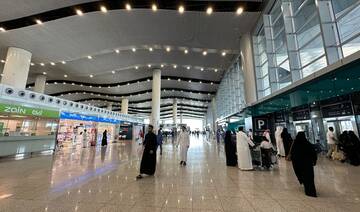
JEDDAH: King Abdulaziz International Airport started 2026 on a strong note, handling 5.45 million passengers in January, a 7.3 percent increase over the same month last year.
Flight movements reached 29,200, up 11 percent, while total baggage throughput rose 8 percent to 6.6 million items.
The airport recorded its busiest operational week from Jan. 11 to 17, serving 1.28 million travelers.
Passenger numbers peaked on Jan. 17, marking the airport’s busiest day ever with 195,300 travelers and 1,089 flights, underscoring the efficiency of its operations and the capacity of its infrastructure to accommodate growing travel demand.
These results reflect Jeddah Airports Co.’s ongoing efforts to enhance the passenger experience, expand travel options, and manage rising air traffic in line with the National Aviation Program and Saudi Vision 2030.
Since its establishment in 2022, the company, known as JEDCO, has overseen the management and operations of KAIA, driving the implementation of the Aviation Program under the National Transport and Logistics Strategy.
In 2025, the airport reached a historic milestone, welcoming 53.4 million passengers, the highest annual total ever recorded at a Saudi airport, placing it among the world’s mega airports in terms of traffic.
The airport handled a total of 310,000 flights and 60.4 million bags, representing a 12 percent increase compared to 2024. It also handled 9.57 million Zamzam water containers and 2,968 cargo flights.
This achievement reflects the airport’s qualitative transformation and its position as a regional hub and national gateway connecting the Kingdom to the world. It also highlights its role in facilitating the movement of visitors and pilgrims, promoting tourism in line with the goals of Vision 2030, diversifying the economy, and providing a distinguished travel experience.
The January milestone at KAIA is part of a broader success story for Saudi airports, with 2025 statistics showing unprecedented growth in the Kingdom’s air traffic, surpassing regional averages and cementing Saudi Arabia’s status as one of the world’s fastest-growing and most advanced aviation markets.
Passenger numbers rose 9.6 percent, fueled by tourism, international events, and expanding global connectivity.
This growth reflected both increased capacity and enhanced connectivity, with Saudi airports handling approximately 140.9 million passengers, 76 million international and 65 million domestic passengers. Flight movements rose 8.3 percent to around 980,400, highlighting the sector’s sustained recovery.
KAIA accounted for 38 percent of total passenger traffic, averaging 146,000 passengers daily and operating at 107 percent of capacity. King Khalid International Airport handled 29 percent of passengers, with a daily average of 112,000. Madinah and Dammam airports also recorded historic surges, operating at 137 percent and 112 percent of capacity, respectively.