DES MOINES, Iowa: In a presidential race seemingly frozen in place for months, the advantage has shifted toward President Barack Obama after a series of miscues by Mitt Romney, punctuated by the Republican challenger’s comments about people who pay no income tax.
Despite a continuing gray economic sky and unrest in the Mideast, the president has edged ahead of Romney in polls in some of the most competitive states, including Iowa and Virginia, and forced Romney to redouble efforts in Florida and Ohio, without which he has little chance of becoming president. The president is chosen not by popular vote but through state-by-state contests, making these battleground states especially important in a tight election such as this one.
With about six weeks left before Election Day and early voting under way in some states, Romney faces a problematic map, a ticking clock and a campaign demeanor that has failed to click with many voters.
Obama’s momentum did not come overnight. It built over several weeks in which Romney hit some potholes while the president made few errors and benefited from previously unseen advantages in advertising strategy and fundraising.
Weeks of campaigning remain, and the three debates, starting Oct. 3, are the kind of events that could change the momentum again. But the race has bent toward Obama at a pivotal moment, according to public and internal campaign polls as well as interviews with leading Democratic and Republican strategists in the most closely contested states.
“Months of paid media about Romney not caring about people, being out of touch ... it came into complete focus with Romney making the case against himself,” Democratic strategist Tad Devine, a top aide to past Democratic nominees Al Gore and John Kerry, said about a video that surfaced last week of Romney speaking at a private fundraiser in May.
The polls show trouble rising for Romney almost everywhere he looks. He has fallen dangerously behind in Virginia and Ohio, and his ability to close in on Obama in Iowa and Wisconsin is now in doubt.
The polls suggest that Romney must do more than inch his way up in a handful of states. He must win overwhelming shares of undecided voters, maximize the Republican Party’s turnout, and suppress Obama’s turnout where he can.
Republican officials say it’s too early to count Romney out.
“Maybe he can’t wait forever. But, today, a strong Romney effort offering good policy as opposed to the awful, failed policies of Obama ... will prevail,” said former Mississippi Gov. Haley Barbor, a past national Republican chairman. “It’s our election to win, and stakes are too high to let it get away.”
Most of the polls were conducted before there was widespread publicity of the video secretly recorded in May. In it, Romney tells donors that the roughly 47 percent of Americans who do not pay income tax will support Obama and “are dependent upon government” and “believe that they are victims.”
The revelation overshadowed Romney’s promise to sharpen his campaign approach and offer more specific proposals to improve the economy. Democrats said the video played into their portrait of Romney as a wealthy politician out of touch with ordinary people.
Romney may not have helped himself later in the week when he released his 2011 tax return. It showed that he and his wife paid $1.94 million in federal taxes on income of $13.7 million. Their effective tax rate was 14.1 percent, lower than many families pay, because most of the couple’s earnings come from investments.
Strategists in both parties have different explanations for Romney’s slippage in the polls.
Some say millions of Americans started paying serious attention to the race during the two parties’ conventions, when Democrats seemed to make a better impression. Former President Bill Clinton’s detailed defense of Obama was especially effective, it seems.
Other campaign veterans say Romney has failed to present a cogent vision for where he wants to take the country. His message sometimes seems vague or confusing, as when he pledges to slash federal spending and then criticizes Obama for promising to squeeze $716 billion from Medicare.
Obama has his presidential powers to appeal to voters. One example was his naming of a new national monument in sharply contested Colorado.
On the foreign front, he announced new actions against Chinese export subsidies while campaigning in Ohio. That move came shortly after Romney made what was widely seen as a premature criticism of the administration in the early hours of Muslim attacks on US officials and buildings in the Middle East.
Some strategists say Obama was wise to campaign aggressively during the Republican convention. He also kept his ads on the air in battleground states, while Romney went dark during the Democratic convention and stopping campaigning to prepare for the debates.
Whatever the reason for the shifts in polls, they have rocked the Romney campaign in states such as Virginia, which Romney badly needs to return to the Republican column. Until Obama’s win in 2008, Virginians had not rejected a Republican presidential nominee since 1964.
A Washington Post poll of likely Virginia voters showed Obama leading by 8 percentage points, while polls by Fox News and Quinnipiac/CBS/New York Times each showed Obama with a 7 percentage point lead.
Republican campaign strategist Chris LaCivita of Virginia said the polls seem to be projecting a larger Democratic turnout than will materialize. While early voting will have begun in 30 states by the end of this week, Republicans in Virginia and other states promote their turnout machines as the keys to close states.
“Everything I see continues to show an extremely competitive race ... won or lost in the last 72 hours,” LaCivita said.
But Steve Jarding, a veteran Democratic strategist in Virginia, says Romney hurt himself with talk of steep cuts in government programs, a threat to the many thousands of federal workers in the Washington suburbs. “They take pride in what they do,” Jarding said.
The Romney campaign still has time, through what it calls a sophisticated system of targeting, to identify swing voters, especially after the debates. His advisers hope the three debates will let them reset the campaign after what they acknowledge has been a difficult stretch.
“Forty-some days, that’s a lifetime,” said Rich Beeson, Romney’s political director.
Obama, Romney and groups that support them have poured millions more dollars into television advertising in Florida, Ohio and Virginia, doubling their total spending since early September to nearly $10 million last week in each of the three, according to reports of ad spending provided to The Associated Press.
Obama’s spending has flattened in North Carolina, where some Democrats agree that Romney has a slight edge. Romney and Republican groups were outspending Obama there last week by $2 million to about $680,000.
Both campaigns have poured advertising money into Wisconsin in the past two weeks. Obama made his first buys there last week and has spent more than $2 million since. Romney, who had hoped to put running mate Paul Ryan’s home state into play, has contributed heavily to almost $5 million in GOP spending there since early September.
An NBC poll showed Obama leading Romney by 5 percentage points in Wisconsin, and by 8 percentage points in Iowa.
“All has been slipping,” said Iowa Republican Doug Gross, Romney’s 2008 campaign Iowa co-chairman. “We are no exception.”
In the race for the 270 electoral votes need to win, Florida (29 votes) is always the biggest up-for-grabs state, and this year it seems to hold special promise for Romney.
Unemployment there still exceeds the national average, helping his indictment of Obama’s economic performance. The housing collapse has left vast numbers of homeowners in default.
Yet two polls of likely Florida voters, one by Fox News and one by NBC, showed Obama leading 49 percent to 44 percent.
The storm-delayed Republican Party convention in Tampa didn’t rally Florida Republicans as they hoped, said Florida Democratic Party Chairman Rod Smith. Also, voters are starting to see glimmers of economic hope, he added. “I’m not saying the sun is up, but people can see that it’s coming,” he said.
Smith noted that Florida’s new voter ID law, pushed by Republican lawmakers, may suppress the vote among some Democratic-leaning constituencies.
Palm Beach County Republican Chairman Sid Dinerstein expressed confidence. “We’re very happy, very optimistic,” he said.
But there is growing concern for Romney in Ohio, where no Republican has lost and been elected president, and where a Fox News poll showed Obama with a 7 percentage-point lead.
“I’d be worried if the election were held today,” said Ohio Republican Chairman Rob Bennett.


Tide shifts to Obama in most competitive states

Tide shifts to Obama in most competitive states
Old Delhi iftars revive Mughal heritage, one course at a time
- Dastarkhwan-e-Jahaanuma iftars have been held in Old Delhi since 2017
- Muslim and non-Muslim participants arrive from across India and abroad
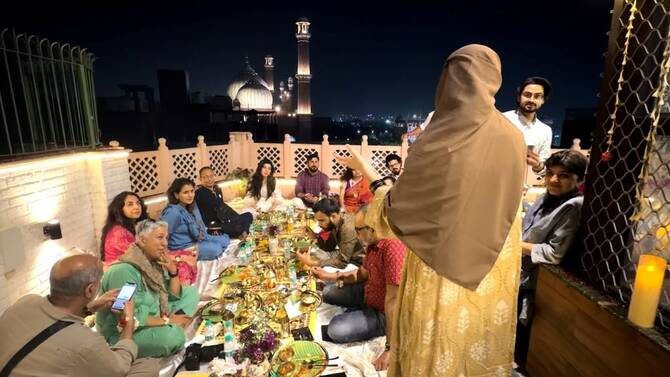
NEW DELHI: On a rooftop in Delhi’s historic walled city, guests from across India sit on cushions around a low table overlooking Jama Masjid, waiting for its sunset call to prayer — the signal to start a special iftar that will take them back four centuries, to the Mughal era, if only for a while.
Mughals ruled the Indian subcontinent between the 16th and 19th centuries. Originally from Central Asia, they carried traditions borrowed from Arabs, Persians and Ottomans, which they merged with the various local Indian styles — a fusion that marked the global revival of Islamic architecture and culture.
Jama Masjid is one of the most iconic examples of the Mughal style — a scenic background to the curated iftars that bring 40 to 50 people from across India to share a meal, knowledge and experience.
“People getting together from different walks of life, different parts of the country, different religions, different cultures coming together — it was absolutely and completely amazing,” said Arvind Sirohi, who took part in the event with his wife.
“Lovely storytelling, amazing food, and end of the day, right next to Jama Masjid in Old Delhi. The ambience, the environment, the atmosphere came together so beautifully.”
The community-led iftar experience is called Dastarkhwan-e-Jahaanuma — from Urdu words meaning a “spread of food” and “showing the world.”
For Veena Sirohi, it did exactly what the name promised by bringing together people from different communities, different parts of India, and abroad.
“I think that’s a great way of synthesizing different cultures, bringing people together, bringing the human aspect of what we all are ... we are actually all one,” she told Arab News.
“And we had some wonderful comperes who told us about … the history of Ramadan, what goes behind it, how the food is curated, and how each and every item has a specific place in the menu.”
Served in gilded bowls and plates from traditional Indian crockery, with rose petals dotting the dastarkhwan cloth, the dishes were some of the festive Ramadan delicacies, offering a taste of Mughal culinary heritage.
Among them was mutanjan, or fragrant rice cooked with ghee, sugar, saffron, cardamom, and studded with nuts, which for many Indian Muslims is traditionally the first dish to break the fast.
It was followed by shabde, a rich, slow-cooked aromatic meat stew or the Delhi biryani — a fragrant, mildly spiced saffron rice and meat dish, where marinated chicken or mutton is layered with basmati rice and cooked slowly.
The hearty feast closed with nihari, a hearty stew simmered overnight with spices and bone marrow, which emerged in the 18th century and was originally eaten by Mughal royals for breakfast.
“These are the traditional dishes which are not usually available in the market, but are specially prepared by the bawarchees (cooks) of Old Delhi. Some of the dishes are occasional dishes,” said Abu Sufiyan Khan, the founder of Tales of City, the cultural experience company that has been curating Dastarkhwan-e-Jahaanuma since 2017.
The special iftars are hosted once a week throughout the fasting month, usually on weekends. There are variations in dishes served as they come from different kitchens, as Tales of City collaborates with various local artisans and cooks.
“We are curating this with different experts and every time the menu changes,” Khan said.
“We bring all these dishes onto a single dastarkhwan, and we share this meal with the people coming from all over India to break bread together in the holy month of Ramadan, know each other, learn about each other’s culture, and create a dialogue space where we can have more meaningful conversations and an opportunity to get to know each other.”
Those who take part, like Ayandrali Dutta, a food critic, appreciate everything about the experience, especially as it takes place in Old Delhi, where the vibe is always “jovial, lively, in all positive ways” during Ramadan.
“You get to meet interesting people, you get to hear interesting stories ... It’s a great initiative to show what Ramadan is, what kind of food is eaten, talk about the cultures between Lucknow and Delhi and other parts of the country. And it just brings a lot of happiness,” she said.
“I loved it. My heart is happy, my belly is full. Nothing else I can ask for.”