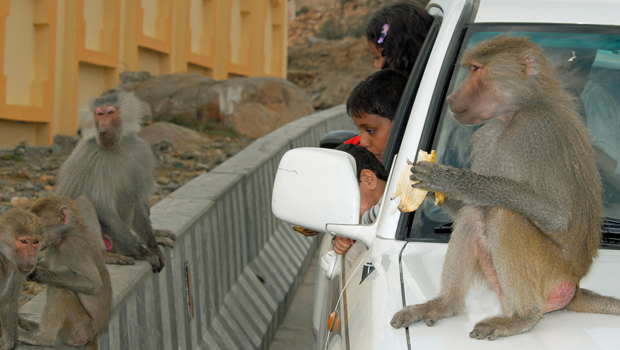
Cats, dogs and a band of Hamadryas baboons () are living in apparent social harmony as a group.
Traditionally they are enemies in other environments. Yet here they intermingle casually and over the 60 minute period of our observation seemed quite accustomed to each other with both cats and dogs even sleeping midst the baboon troop.
This bizarre social interaction raises a number of questions about the behavior of both the baboons and their territory-guests. The obvious question is:
”Why do the baboons tolerate the presence of animals that will compete for food?” A rather fanciful explanation is that the baboons, being highly social animals, are keeping them as pets.
With the Taif Hamadryas baboons there is a four-level social system at the center of which is the harem, a male with two to 10 females.
The harems live together as a clan and several clans make up a band. The fourth layer is the casual group that assembles for sleeping at night.
Describing the cats and dogs that mingle with the baboons as pets is likely to be a case of humanizing baboon behavior and attributing to baboons the ability or desire to love, play and care for a competitor species stretches credibility to breaking-point.
There have indeed been strange relationships between animals that from a human perspective look like evidence of human emotion; there was a case in Saudi Arabia where a goat “adopted” a chicken and defended it against all-comers — until both apparently ended up as dinner.
A simpler explanation might lie in the fact that the Taif baboons are a tremendous tourist attraction and that a fruit market lies a couple of hundred meters away. The baboons’ pulling power as an attraction is evidenced that a special pull-in area was built for tourists during the recent refurbishment of the escarpment road.
These are not hungry baboons; food aplenty in the form of fruit, cooked meats, rice, and bread are thrown to the perspicacious primates who have established their territory on that section of mountainside.
They simply cannot eat it all, so pariah and wandering domesticated dogs and ever-scavenging (some rather portly) feral cats have moved in to feed off the surplus. When a baboon is hungry, however, its view of the cats and even large dogs will change from guest to gustatory. A 30kg alpha-male omnivorous Hamadryas can tear a large dog to pieces an moments.
The cats and dogs are probably only there because, given the plentiful food supply, they are not competitors and therefore offer no threat. Once the baboons get used to them, as long as the copious food supply keeps coming, all will be well.
As a tourist attraction, the baboons form a useful attraction. However there are serious dangers in allowing them to get close to humans.
It is incredible to see tiny children leaning out of car windows offering the creatures a banana or some morsels of food and adults within snatching distance doing much the same.
There will come a time when a large male with fangs the length of your thumb will think: "Bananas again? No. Today I’ll have the steak. Rare!”