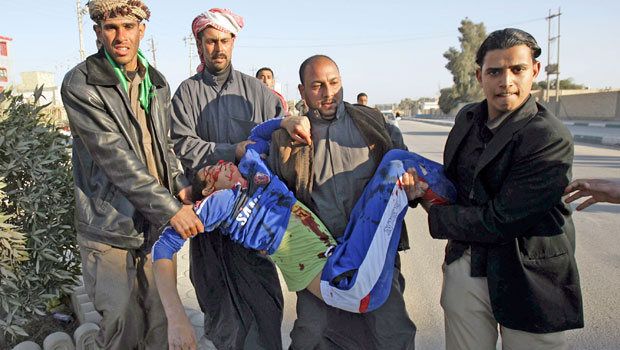
Most of the victims were Shiite pilgrims. They were headed to observe yearly religious rituals in the Iraqi holy city of Karbala when a pair of car bombs blasted through security checkpoints.
The attacks were launched by three suicide bombers who blew up their cars near security checkpoints on at least two roads to Karbala.
On Friday morning, troops lined main Baghdad roads as thousands of pilgrims headed to attend annual religious rituals in Karbala, 80 kilometers south of the capital.
There was no immediate claim of responsibility, but authorities said the methods and the targets were typical of Al-Qaeda and other Sunni-dominated extremist groups.
It was the latest in a wave of attacks in recent days, as insurgents test Iraqi security forces ahead of the planned US withdrawal at the end of the year.
Authorities estimated as many as 183 people were injured in the near-simultaneous blasts set off by suicide bombers driving cars packed with explosives.
Ali Khamas, a pilgrim from the Shiite neighborhood of Sadr City in Baghdad, said he saw a car speeding toward one of the checkpoints, its driver refusing to stop despite warnings screamed by Iraqi soldiers.
“He sped up and blew up his car near the checkpoint,” said Khamas, a 42-year-old truck driver. “After the explosion, people started to run in all directions, while wounded people on the ground were screaming for help. I saw several dead bodies on the ground.” Still, Khamas said, the pilgrims continued to head to Karbala: “It will not deter us from continuing our march to the holy shrine ... even if the explosions increase.” Crowds of pilgrims headed to a Karbala hospital to donate blood for the wounded. Authorities said 11 soldiers and policemen were among the dead, the rest were pilgrims.
Iraqi security officials and hospital staff who gave details on the attacks and casualty figures all spoke on condition of anonymity because they were not authorized to release information.
The series of attacks this week shattered a relative calm since the formation last month of a new government under Prime Minister Nouri Al-Maliki, a Shiite whose family comes from the Karbala area.
The attacks point to the resiliency of the Sunni insurgents and to the inability of the Shiite-dominated security forces to prevent major assaults, even though the level of violence is far lower than at the height of the war three years ago.
As long as Iraq’s security forces are unable to stop such attacks, there is a risk that extremists could re-ignite sectarian violence and destabilize the country as the American military presence fades.
Attacks against Shiite pilgrims have been a tactic of Sunni extremists since the early years of the Iraq conflict. Shiite politicians encouraged huge turnouts at religious celebrations to dramatize the power of the Shiite majority after the fall of the Sunni-dominated regime of Saddam Hussein.
“The enemies always develop their tactics and improvise new plans to make use of any security breach,” said Karbala provincial councilman Shadhan Al-Aboudi.
He blamed the blasts on Al-Qaeda and Saddam loyalists: “They have apparently found a gap today in the security measures and they carried out an evil act against innocent believers who were practicing religious rituals.” The bombings were the latest in a three-day barrage of attacks across Iraq that have killed more than 120 people since Tuesday.
Earlier Thursday, a suicide bomber rammed his explosives-packed car into the front gate of a police headquarters in the eastern Iraqi city of Baqouba, killing three. Another, earlier strike on Shiite pilgrims walking to Karbala from Baghdad killed one and wounded 10 of them.
A day earlier, on Wednesday, another suicide bomber killed seven people after he blew up the ambulance he waqouba.
And on Tuesday, 65 people died when a suicide bomber set off his explosives-packed vest in a crowd of police recruits in Saddam Hussein’s northern hometown of Tikrit.