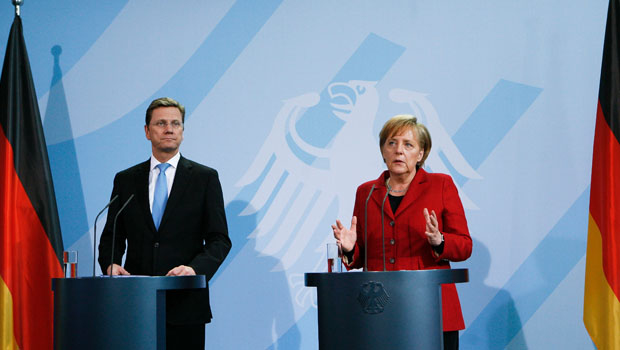
Merkel said the money would not only help Greece, which has been battered by the bond markets, but would help the ”stabilization of the euro as a whole and, therefore, help the people of Germany.” The remark was a nod to the popular discontent in Europe's biggest economy about having to pay so much to help a fellow European Union country that many Germans feel has been fast and loose with its finances for years.
The European Central Bank, meanwhile, suspended its rating limits on Greek debt.
Both moves were mandatory after European governments and the International Monetary Fund agreed Sunday to give 110 billion euros ($145 billion) in loans to Greece over three years.
The loans came after Athens adopted a new round of austerity measures that provoked fresh uproar among Greek workers.
IMF officials say Greece could start receiving money from the rescue package in about a week.
Germany will contribute 8.4 billion euros ($11.1 billion) for the first year of the bailout this year, followed by 14 billion euros ($18.5 billion) over 2011 and 2012. The money will come in the form of credit extended to Greece the KfW Development Bank, which is backed by the German government.
The draft law backed by the Cabinet now needs to pass both houses of parliament. Merkel has fast-tracked it, hoping to have it approved this week. The main opposition parties have already said they won't block the bill.
”This is the only way for us to return the euro to stability,” Merkel said of the Greek bailout. ”It is a sustainable program, spread out over many years.ª Merkel's government had insisted on the latest Greek austerity package before it would move to free up aid. Her party faces a crucial regional election Sunday in North Rhine-Westphalia, Germany's most populous state, and many German voters are angry that their taxes are being used to bail out Greece while Germany itself struggled through years of budget-tightening to stimulate its own economy.
”This is just the tip of the iceberg and I am afraid of it,” Werner Selmer told AP Television News at Berlin's main train station. ”Is this necessary? Should we do this? I think yes, my feeling is yes, but I have a bad feeling, a very bad feeling.” In Rome, Italian Foreign Minister Franco Frattini criticized Berlin for dragging its feet.
”The later you intervene, the worse it gets.” Frattini said Monday, noting that the initial figure mentioned was ”50 billion euros — 10 days later we decided on 110 billion euros.” Greece announced more austerity measures on Sunday worth 30 billion euros ($40 billion) through 2012 — including public service and pension pay cuts and higher taxes. In response, about 1,000 garbage collectors and other striking municipal workers marched to the Greek Parliament on Monday, chanting ”trash for Parliament, not the landfill!” But Prime Minister George Papandreou insisted the new measures are vital for Greece's financial survival.