“Make new friends but keep the old; One is silver, the other’s gold”— Proverb
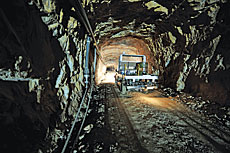
Until one has been three hundred and fifty meters under the earth with the lights switched off, there is no way to understand the meaning of ‘dark’. What started as a well-lit tunnel with walls of comfortably solid rock becomes an infinitely small (or big, you don’t know which) space heaving with the threat of collapsing on you. It is a primal fear that newcomers to mines usually experience and sometimes cannot tolerate.
Miners’ familiarity with it breeds a negotiated settlement but never contempt. They accept the presence of danger with an equanimity that stems from a combination of total faith in their abilities and almost paranoid attention to minimizing risk. “I suppose it is a bit like that, but you get used to it,” said Nathan Jones who runs a team of Australian contract drillers in Bariq Mining’s Jebel Sayid mining concession. Bariq Mining, a junior mining company not as heavily burdened with bureaucracy and overheads as the major companies, is 50 percent owned by the Australian Citadel Resource Group and 50 percent by CMCI of Alkhobar. The company is rapidly sampling and proving the quality and quantity of Saudi Arabia’s precious and base metal reserves in its concessions.
They work grueling hours seven days a week for a month at a time in temperatures often in the high 30s at depths of several hundred meters before breaking for a fortnight. “Yeah,” he mused, “it’s hard enough but the money’s not bad. No worries mate!” Their main concern during our visit was touchingly not for themselves, but for the hundreds of victims of the raging bush fires in southern Australia where some of the drillers were from.
Jebel Sayid is a copper mine, the first one to be developed by a private company since the new relaxed mining regulations came into force in Saudi Arabia in 2005. A mine abandoned 30 years ago already exists on the site, but since then new prospecting and mining techniques have developed and old workings are being revisited. And where there is copper, there is often gold.
The decline (a roadway that leads steeply downward to the workface) is dry and well maintained. Shiny new power distribution boards confirm that development is well under way. The attention to detail is punctilious; hoses coiled in figure-eight patterns (so they will not snag if run out quickly) and steel net secured to the ceiling to protect drillers from rock-falls. At about 350 meters, it all changes abruptly. Ahead is a flooded tunnel that carries on downwards for at least another 400 meters. It will be pumped dry and become workable — not a major task by modern mining standards.
Modern mining or not, it is when up to your waist in still black water in a dead black tunnel hundreds of meters below the surface of the ground in utter silence that you begin to understand the ever present threats of mining and the lurking horror of what could happen. Then of course there are the bats.
No worries, mate!
Some things have not changed very much in prospecting. Maps, historical documents and local knowledge constitute the basis of the mining company’s first researches. Ancient workings, mined for copper — a tracer element for gold — by early miners hundreds, or even thousands of years ago, are entry points for the modern geologist into the world beneath his feet. It is, however, feet on the ground, geologist’s hammers and powerful magnifying glasses in hand plus the experienced eye that are the first steps in the process to making that very expensive decision to “drill here.”
A good geologist “reads” the topography around him using accumulated knowledge and experience that combine to give him a feel for the terrain. Quite unprepossessing hills resembling dun-colored slag heaps send a frisson of joy down the spines of these otherwise serious-minded men who feel, as one long-term expat geologist muttered to me at a social gathering, “I really prefer rocks to people.” Without any warning they are much given to stopping in front of fractured walls of rock with a sigh and saying incomprehensible things such as: “Will ye just look at that gossan,” or spontaneously bark out “Chert” or “Goethite” surprising passers-by who get the impression that the odd looking guy in the floppy hat and big boots is afflicted with Tourette’s syndrome.
Even for the layman, a little etymological mining produces a different kind of gold from some of the strange terminology. ‘Gossan’ is a Cornish word used to describe iron-bearing outcrops of reddish soils and rocks. These colored soils, or ochres, were used by Aboriginal people as a ceremonial pigment.
After a couple of days with one of these specialists, it begins to make sense. The huge forces that laid down the geological structure of the planet underground that the field geologist needs to know about often leave traces on the surface.
There, the outcroppings of layers of rock and mineral are subject to weathering by wind and water, erosion and even chemical alteration. Occasionally strata are reshuffled in secondary and tertiary seismic activity, overlain by sediments and otherwise obscured and altered.
The skill is to be able to interpret this jumble of surface rock and, by a process of reverse mapping, come up with a three-dimensional plan of what might be underneath. Getting it right can make you rich; getting it wrong can completely ruin a venture capitalist’s lunch.
Good surface interpretation has to be backed up with hard evidence. Here the drillers, generally under 30, hard-looking characters who tend to move about the place with a relaxed sense of purpose, enter the picture. Seeing these hardy souls at work conjures up images of wild-catters of the early oil or gold rushes. Operating highly complex and extremely dangerous machinery in confined wet spaces underground or in incredibly isolated dusty places for long periods takes a special breed of person.
The canteen at Jebel Sayid was suffused with a sense of purpose, utter professionalism and rough — if inclining towards the taciturn — male humor, totally in character with the harsh environment the drillers operate in. All are masters of understatement. It is hard, unexciting and potentially dangerous work. As in most tough and highly specialist environments, a gallows humor has developed and it seems to place the drillers at the bottom of the social scale on the site. Believe none of it.
Under the casual banter, every individual respects and relies on his colleagues to provide backup if things go bad. Hundreds of meters underground, all that you can rely on to get you out is their total commitment and professionalism.
The drillers are responsible for getting samples of the underlying rocks to verify the field geologist’s first impressions. Core drills — think of them as high tensile steel drainpipes with the rim of the lowest one studded with diamonds — probe hundreds of meters into the ground providing a cross sectional sample of the strata. Logged and laid out for inspection, the precise location of each sample is the raw stuff, after assaying the material for content, of the back office whose dark arts produce three-dimensional maps of what lies underground. It is this solid data together with the mapping that, when interpreted, will attract or not the investor to finance the project. Hundreds of millions of dollars are at risk. Despite the macho verbal roughhousing, the field team relies on its ability to get hold of the data and a high quality lode in order to make a living. It is a very serious business. The western half of Saudi Arabia — the Arabian Shield — is extremely rich in a wide range of minerals. Gold and copper has been mined here for 3000 years but the ancient workings literally only scratched the surface. New technologies have developed, particularly satellite remote sensing, that have made revisiting old workings very worthwhile and revealed many new areas worthy of investigation.
The Kingdom has all the qualifications for becoming a new mining frontier because there really is “gold in them thar hills!”