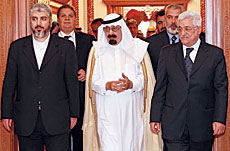
MAKKAH, 8 February 2007 — In a rare display of unity, Palestinian President Mahmoud Abbas, Hamas political strategist Khaled Meshaal and Prime Minister Ismail Haniyeh vowed not to leave the holy city of Makkah without reaching a comprehensive reconciliation agreement. Many in the Arab world see the Makkah Summit as the last chance to avoid civil war between the feuding Palestinian factions.
Soon after making these optimistic remarks at the Al-Safa Palace in Makkah, which overlooks the Holy Kaaba, the leaders of the two most important Palestinian factions went behind closed doors for meetings that officials say are expected to last three days.
“We want our sons and daughters to lead a dignified life,” said Abbas. “We want to form a national unity government. This will not be a wasted summit. We will not conclude our meetings until we reach an agreement. We will not leave this sacred place until we have given you the good news. And I tell our people to expect good news. I call upon our people to rejoice.”
Meshaal, who lives in exile in Syria and has survived several Israeli assassination attempts, echoed Abbas’ sentiments.
“We have no other option but to reach an agreement. Failure is not an option,” said Meshaal. “Yes, we will not leave this place without reaching an agreement. This is the intention we came with and this is the gift we will take with us from here. The international community will not be able, if it finds us unified, not to respect our wishes and it will lift the unjust blockade.”
Abbas said he hoped the talks would lay the ground for the formation of a unity government that would help put an end to crippling sanctions imposed by Western nations. He termed the factional violence a catastrophe.
“No doubt what happened was a huge catastrophe,” said Abbas. “We don’t want to see it repeated in any way and in any place. We don’t want to relive those black days. We want to put it all behind us.”
The meeting between Abbas and Meshaal was in itself excellent news. Both made good use of the opportunity of the televised opening address to cool frayed tempers in the streets of Gaza. Both sent positive messages to Hamas and Fatah members on the ground, especially in Gaza, asking them to exercise restraint and to maintain calm so that the talks can continue in a “peaceful, brotherly and positive atmosphere.”
During his speech, Meshaal turned to Abbas and said they both had to tell their supporters to respect the truce that took effect on Sunday.
“We want to give a message to the nation, and the world, to create a positive atmosphere for these talks,” he said.
Custodian of the Two Holy Mosques King Abdullah, at whose invitation the summit is taking place, came in for special praise from all three leaders.
“We appreciate King Abdullah’s efforts in bringing us to this holy land,” said Abbas. “He is the most sincere and the most straightforward Muslim leader. We trust him and respect him and that is why we responded honestly and with open hearts to his invitation. May Allah bless him and reward him for his efforts in uniting the Muslim world.”
Abbas blasted the Israeli government for undertaking excavation work near the Al-Aqsa Mosque in Jerusalem.
“The Holy Mosque is under threat,” said Abbas. “What is happening near the first qibla (direction of prayer) is highly condemnable. It is one of many efforts to ‘Judaize’ the city. The main aim is to change the city’s demographics.”
Abbas said they had agreed to focus on “the formation of a national unity government, the basis of partnership, the rebuilding of the PLO and the consolidation of national accord.” Working groups were named when the two delegations resumed talks yesterday evening.
Fatah official Azzam Al-Ahmed earlier said the working groups will discuss each of the four points on the agenda and make recommendations to the leaders.
Meshaal said: “We have come here for the cause of Al-Aqsa as our brother Abu Mazen (Abbas) has mentioned. There can be no better place than this holy city in the vicinity of the Holy Kaaba. And we are in a month in which wars are forbidden.” (During Muharram, the first month of the Islamic calendar, wars are forbidden.)
“It is time for the Palestinians to work together to get rid of the occupation,” said Meshaal. “We want to live in a sovereign nation where we can decide our future. This is the spirit we came with. We need to unite. I am confident Palestinian cooperation will solve all the internal problems. We are not asking for big favors (from the international community). We are asking for our rights. The international community should respect us. We should turn a new page. I call upon my brothers to stop fighting. Let bygones be bygones. Our enemy is one and we have one cause. And this is the only confrontation that we should have.”
In his address, Haniyeh quoted from the last sermon of Prophet Muhammad (peace be upon him): “Learn that every Muslim is a brother to every other Muslim and that Muslims constitute one brotherhood. Do not therefore do injustices to yourselves. Remember one day you will meet God and answer for your deeds. So beware: Do not stray from the path of righteousness after I am gone.”
Haniyeh added: “We come here understanding full well the meaning of being here. When we go back to our people there will be a unity government. We will go back to Palestine with glad tidings. With new hearts and new souls just as every pilgrim goes from here after performing the pilgrimage, we will unite our ranks.”
Previous efforts to stem bloodshed and find common political grounds between Hamas and Fatah have resulted in short-lived cease-fires and a threat by Abbas to call a new parliamentary election, a move Hamas has said would be tantamount to a coup.
On the so-called “Arab Street” in Jeddah, Palestinians in the Kingdom said they have great expectations of the Makkah meeting.
Ali Hadad, a Palestinian resident of the Kingdom for the past 25 years, said that the Makkah meeting was an ideal chance to re-establish the brotherhood of Muslims since Islam forbids fighting between Muslims.
He added that if prior meetings had not succeeded in stopping the violence and killing, the Kingdom’s support of this meeting and for the Palestinian people would have a positive influence on coming events.
Jamal Al-Shaweish, a Palestinian who has lived in the Kingdom for the past 30 years, blamed outsiders for creating the conflict between the two parties.
“Especially those countries that try hard to divide Palestine,” he said, “Israel’s plan to unleash a civil war by supporting one party against another has created divisions among Palestinians.”
Mohammed Saeed Al-Adloni, a Palestinian born in the Kingdom, said that Palestinians around the world do not wish the conflict to continue. “We are putting our hopes on the meeting in Makkah to reach an agreement by both parties and see the return of security and peace between Palestinians,” he said, adding that if there was more than one strategy, especially between the two main parties, it was natural in a democratic political setup “for in a democratic system, there are many points of view and visions.”
Fawaz Nakhal, a Palestinian working as an engineer in the Kingdom said, “Outside intervention that benefits one party at the expense of others in Palestine is the main cause of the problem.”
“One group is empowered over the other and the result is confrontation,” he said.
“The parties that do not want the Palestinian people to unite still exist, and they are very active on both the regional and international levels in serving their interests rather than those of the Palestinian people.”
Hassan Abu Jihad, a Palestinian working in sales at a major company in Jeddah, said he felt that the meeting would be a success because of the location and the brotherly care shown by the Kingdom in hosting the meeting and receiving both parties.
— With input from Galal Fakkar