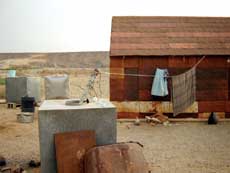
WADI STARA, 17 September 2006 — Away from the glamour of Jeddah and Riyadh and the spirituality of Makkah and Madinah, take yourself off the beaten track and over narrow mountain passes 180 km north of Jeddah to enter Wadi Stara (Stara Valley), a rural desolate and depressing world where poverty-stricken Saudis live in tin houses and primitive conditions.
Without any proper sanitation, education, water and electricity, the poverty and plight of simple Bedouin villagers in Wadi Stara comes as a huge shock. Is it even possible that this is Saudi Arabia? In spite of government offers to re-house the residents of this valley, villagers refuse to budge and continue living in poverty.
Poor villagers bear their hardships with patience and turn to God looking for solace. Traditionally, villagers have earned their living from the timber industry, but with rainwater scarce all are struggling to make ends meet.
“Cutting and selling wood isn’t a profitable business anymore. It’s a waste of time and I hardly earn SR500 a month,” said Abu Ghali, a Saudi father of seven living in a rusty tin hut.
Wadi Stara is home to 7,000 Bedouin families out of which, according to Saudi charities, 1,500 are extremely poor. With the aim of highlighting the plight of villagers, Arab News observed the work of “The Wadi Stara Charity Organization” (WSCO) to see firsthand the miserable condition of people living there.
Four-wheel drives are a must to reach the area and coming off the highway that connects Jeddah to Madinah, we descended an extremely steep ravine at the bottom of which was Wadi Stara — a floodplain 90 sq. km in size — dotted with 20 villages.
As we slowly drove down, we were shocked that there were no proper roads to the valley. Our experienced driver expertly zigzagged downward on a fenceless mud track avoiding boulders and ditches bringing our group safely below.
On reaching the bottom, I noticed how the valley was surrounded on all sides by treacherous steep mountains. It was early afternoon and we slowly drove across the rocky and sandy plain, the only sounds we could hear apart from our jeep was the distant barking of dogs. I was curious to meet people and asked the charity workers where the people were.
“Wait, you’ll meet them soon. People live far away from each other in the villages because they want privacy outside and inside their homes,” said the driver. I didn’t understand what he meant until we arrived at the first village in Wadi Stara.
The first house we came to was made from wood and tin. I looked around and noticed how everything was so primitive, even the roads were merely mud tracks worn away by the constant moving of pickups and jeeps.
A short while before reaching the house, my guide honked his horn sending a signal to the women that we were approaching. As we parked and disembarked the head of the family came and welcomed us inside.
As I entered the tin hut, I saw that a family of seven had a single living room, a kitchen and bedroom to live in. I tapped the thin walls and wondered what sort of protection they must give from wind and rain. According to the families living there, the temperature sometimes reaches 48 degrees in the afternoon heat.
The bedroom was five square meters and made from wood.
“When it rains, a lot of water comes in through the roof and gushes in from the sides as well,” said the 18-year-old son.
The house was poorly decorated and the floor was not level but rocky and sandy. Insects crawled everywhere and I wondered how people actually slept. On the walls hung clothes but what was even more shocking was the fact that there was no electricity and therefore no air-conditioning.
Attached to the room was a three-square meter kitchen with a small stove for cooking and hardly any appliances. It was extremely small and I wondered what the people must be cooking and eating. The way this family was living was shocking.
After sitting and speaking with the family, I requested a young boy to show me the way to the lavatory, he smiled. I thought perhaps I had said something wrong and asked him again. “Over there,” he said pointing outside. I then realized what he meant — there were no toilets. The young boy offered me a bottle of water and sent me on my way. Was I dreaming? Am I in Saudi Arabia?
On my return, we sat for a while and then got up to leave. I felt a little thirsty and asked for some water. The elder of the house went to a nearby water tank, opened the lid and filled a beaker using a bottle hanging from the side on a rope.
Thanking him, I looked inside and noticed how the water was unclear. Curious to know what was inside the tank, I took a peek and saw how dirty it was and that it contained insects. It was then that a dead lizard caught my eye. Feeling rather sick I did not drink the water and made back to our jeep.
On our trip we met lots of people. Sixty-year-old Abu Abdullah was a disabled person with a sad story to tell. He has three daughters and two sons. One of his feet had to be amputated three years ago because of gangrene. He is now wheelchair-bound.
“I thank God in whichever situation I am in. Life is tough and it is very difficult to feed our children. The crop harvest has been poor this year because of the lack of rain,” said Abu Abdullah. “The only steady source of income we have is SR2,000 a month that we get from the social welfare department. I have five goats and they are not enough to feed my family,” he said.
Abu Abdullah used to work as a woodcutter earning SR100 a week. “Because of my amputated foot, I’m unable to work and the doctors have told me to stay indoors as much as possible,” he said.
According to charity workers, there are 139 orphans and 120 widows who live in the area, not to mention the countless children. Due to extreme poverty many families struggling to pay electricity bills. Villagers say they have stopped sending their children to school because they just cannot afford the additional expenses.
Speaking about his children’s education, Abu Ghali said that having struggled to bring bread onto the table, he was forced to take his seven children out of school. “The help we are getting from the social welfare office is just not enough to fulfill our needs. Rain is scarce and the harvest poor,” he said.
Saudi welfare provides families of six children with SR2,000 a month — an amount which many villagers say is just not enough. “It’s no use educating the children because they’re not going to really get a job. They’ll just end up being unemployed and a burden,” said one father.
A study conducted by the Female Committee for Humanitarian Services — a Saudi charity run by Princess Sarah Al-Angari, wife of Makkah Governor Prince Abdul Majeed — revealed the urgent need for more than 15,000 housing units for people in the area. According to a spokesman, the committee is currently studying the areas that are most in need of help and will lay out an action plan in the near future.
Highlighting the help needed, the spokesman said: “The project will cost an estimated SR4 billion to build housing units equipped with basic amenities like water, electricity and furniture. The project needs the urgent support of businessmen and investors.”
Rajaulla Al-Sulami, deputy president of the WSCO, says that people have found bringing electricity to the region very expensive. “Many of the residents have had to borrow a lot of money and have paid huge amounts of money to bring electricity to their homes. Some have even had to sell their belongings as well.”
To make things even more difficult, Al-Sulami says the electricity company has a precondition that the buildings are made from concrete rather than wood.
“Many residents have been forced to borrow money to build two concrete rooms. I know so many people who have stopped sending their children to school because they cannot afford the additional expenses,” said Al-Sulami.
However, in spite of difficulties, some families continue sending their children to a school 25 km away.
“Children end up having to walk a long distance and make difficult treks climbing out of the valley to go to school. They walk through hot sands and volcanic rocks and are exposed to dangerous insects, snakes and wild dogs,” said a charity worker accompanying me on the trip.
Other slightly better-off families rally together and hire drivers to take their children to and from school.
One resident we met was Abu Nada who complains that the health insurance refuses to help him because he is less than 45 years of age. “I am jobless and cannot support my six kids. I don’t get enough milk from the ten goats that I have,” he said.
“I earn SR300 a month by selling wood. I am trying to find work but I do not have enough qualifications or the education necessary to secure a decent job,” he added.
The WSCO has been working hard to improve the situation in Wadi Stara. Al-Sulami said: “Our organization finds it difficult to work here. The main problem we have is with finances. We need a lot of donations to help people and the amount of support we get from the Social Affairs Ministry barely covers the costs of projects that we have planned.”
According to Al-Sulami, the charity recently developed an idea to build a large water tank to provide people in the area with drinking water.
“The main problem was finding a sponsor to build such a project that cost millions of riyals. A philanthropist gave SR300,000 to build water storages for the people in the valley after he took a tour of the area and saw the bad living conditions,” he said.
The WSCO recently built 17 two-bedroom houses for the poor at a cost of SR20,000 each. “We want people to settle at one plot of land and live close to each other. That will make it easier to provide basic infrastructure,” said a charity worker describing future plans.
With the aim of solving the problem of unemployment among people, the WSCO also signed a contract with a training institution to train for six months 30 men and women on how to use computers.
“Lately there have been some improvement in providing help to needy families. We want to help more people. Most are simple people who cut wood and have a few animals. A lot of the money they receive they spend on fodder for their animals,” said Al-Sulami.
As we left the area and headed back toward Jeddah, the sun was setting. I was pleased to leave the area but it was then that my guide asked me to meet a 70-year-old woman who lived by herself in a small wooden hut.
After a short drive, we came across a wooden hut and met the woman who had been abandoned by her children and was hardly able to speak. The charity workers accompanying me said the woman could not walk and crawls from one place to another.
It was a pitiful sight. I tried to talk to the wrinkled old woman but all that I got was a sad stare. It was as if she was blaming the world for her miserable state. I felt like crying and it was then that my guide explained that the charity looks after the woman by providing her with food and medicine and regular visits.
The residents of Wadi Stara are attached to the area that they have lived in for generations. How long they will continue to live here is a question only time will tell.